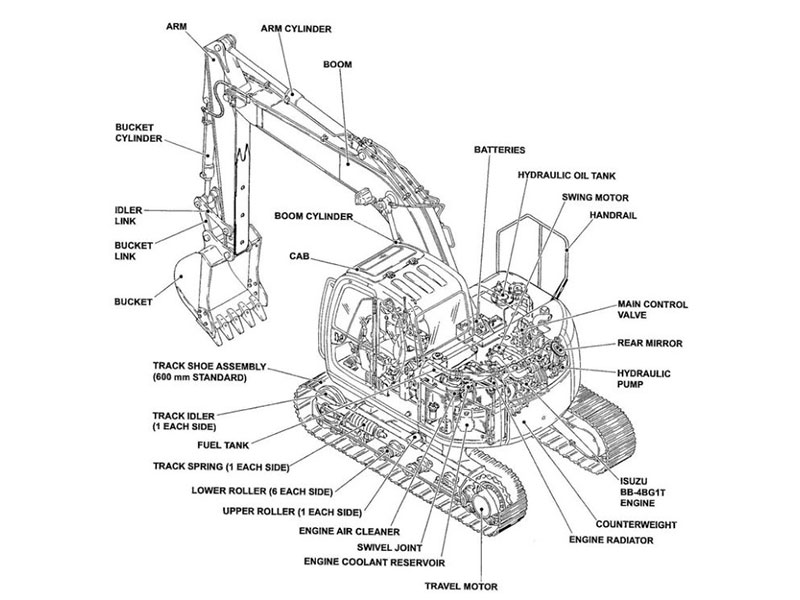
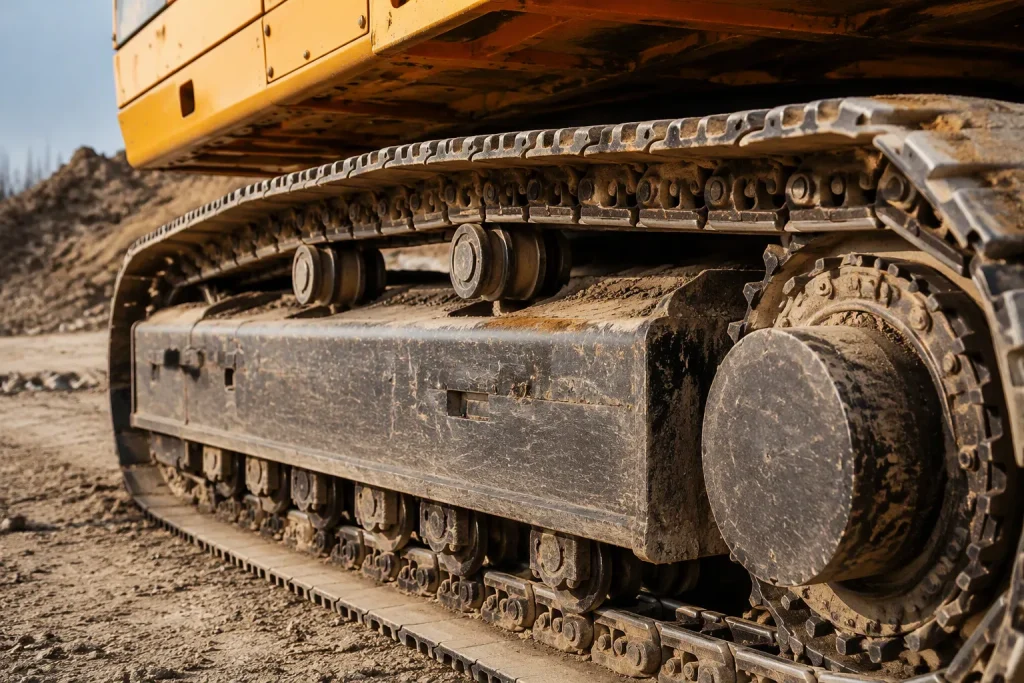
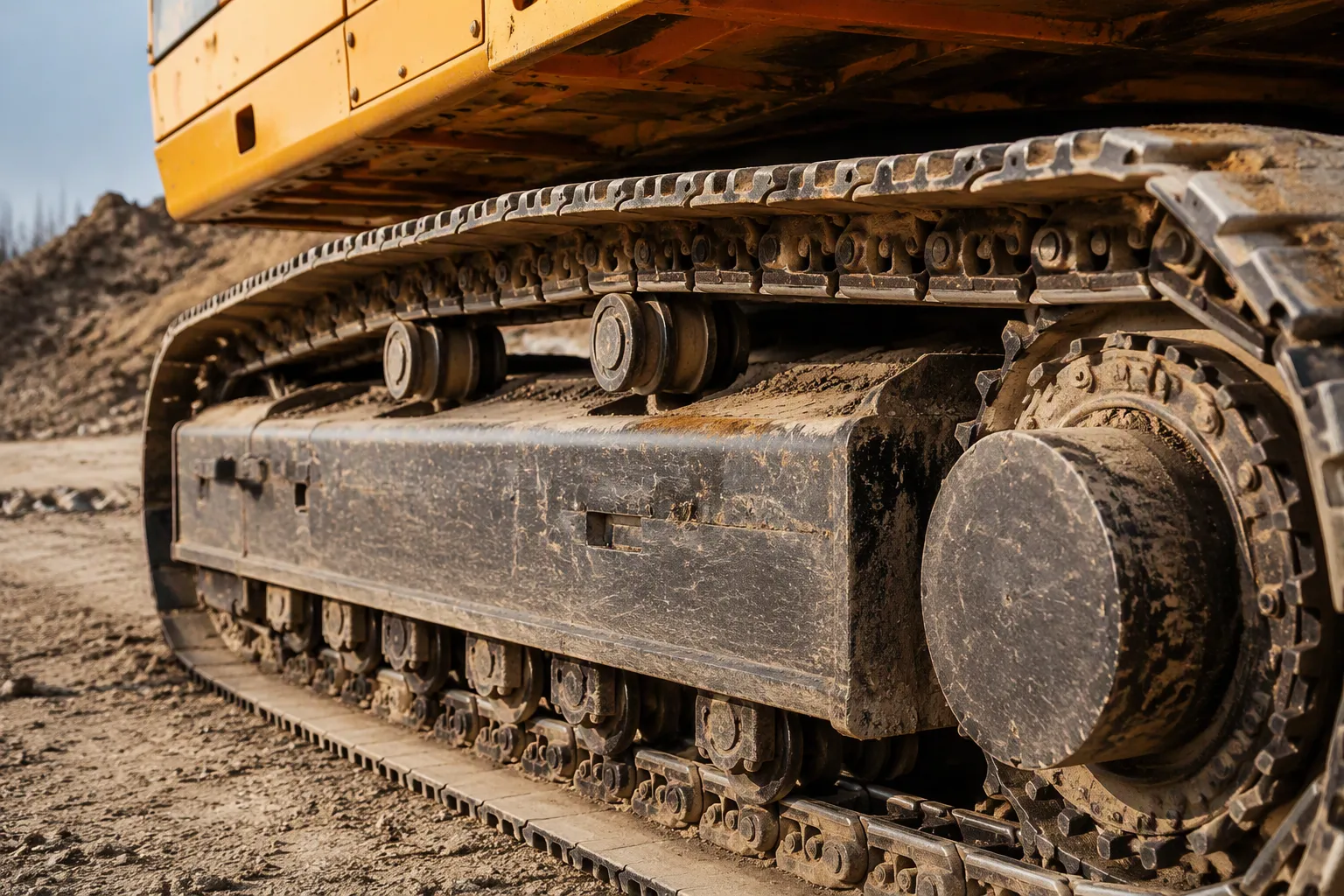
The undercarriage is the base of an excavator. It holds up the machine’s weight, grabs the ground, and moves the machine around the job site. The main excavator undercarriage parts are the track frame, the tracks (chains and shoes), the rollers, the idlers, the sprockets, and the final drives. Each part has a clear job in keeping the machine steady and able to move.
Some designs also use track adjusters, guides, guards, and rubber pads. The exact components depend on the machine configuration. Confirm these parts in the model-specific catalog and follow the service manual for inspection and adjustment.
Key Takeaways
The undercarriage includes tracks, rollers, idlers, sprockets, and final drives. Each part helps the excavator move and stay steady.
Follow the operator and service manuals for inspection frequency. Where a walkaround is prescribed, note loose bolts, leaks, or visible changes and record findings.
Check and adjust track tension using the machine-specific procedure and measurement points. Do not rely on appearance alone to decide whether tension is correct.
Inspect the chain and sprocket together, then follow the machine documentation to determine whether either or both need replacement. Replacement decisions depend on condition and service criteria.
Check the make, model, serial number, and part number before you order. Measure the key dimensions to make sure the part fits.
Track Frame and Track Chains in the Excavator Undercarriage
Track Frame Structure
The track frame is the main support of the excavator undercarriage. It links the lower assembly to the upper structure by way of the car body and swing circle. On many machines, the frame is a welded box section. It holds the rollers, the idler, and the final drive mounts. Some models use a fixed frame, and others use an extendable frame that widens the stance for stability.
The track frame supports the lower assembly during travel and work. Inspect it for visible cracks, deformation, damaged guards, and loose hardware. If a crack or structural damage is suspected, use the machine-specific service guidance to determine the proper assessment and repair.
Track Chains, Shoes, and Pads
Track chains form the moving loop of the undercarriage. Each track chain is built from links, pins and bushings, so the chain can flex around the idler and sprockets. The pins and bushings wear against each other, and that wear stretches the chain over time. A stretched track chain sits poorly on the sprocket and speeds up wear on every other part.
Track shoes and grousers bolt to the links and grip the ground. Track shoes for dirt work carry tall grousers, and track shoes for paved surfaces often use rubber pads. Loose or missing shoe bolts are a common finding, so check them during the walkaround. Watch the links, pins and bushings for shine, play, and seal damage. Compare measurements against the wear limits in the service manual before ordering excavator undercarriage parts.
Rollers, Idlers, and Other Excavator Undercarriage Parts
Bottom and Carrier Rollers
Bottom rollers carry the machine’s weight and roll along the inside of the track chain. Each bottom roller spins on shafts and sealed bearings, and the roller flange keeps the chain centered. These track rollers take constant load during digging and travel, so their seals and bearing surfaces wear steadily. A failed bottom roller can score the chain links and load the neighboring rollers.
Carrier rollers sit higher on the track frame. They hold the upper run of the track and control track sag. Carrier rollers see lighter load than bottom rollers, yet they still need the same seal care. Together, bottom rollers and carrier rollers keep the track loop running true.
Idlers, Track Adjusters, and Guides
The front idler sits at the front of the track frame and guides the chain into the ground contact zone. This idler wheel also holds track tension in partnership with the track adjuster. The track adjuster, usually a grease-filled cylinder, pushes the front idler forward to set tension. Guides then keep the chain aligned as it passes the idler and the track rollers.
A worn front idler shows up as wobble, noise, or a chain that climbs the flange. The front idler bearing and seal deserve a close look at every service interval. Track tension that runs too loose lets the chain slap and jump the sprockets. Tension that runs too tight strains the front idler and the track pins. Follow the manufacturer tension spec for the machine and configuration.
Maintenance checks for this group are simple. Look for oil weeping at roller seals, which signals a failing seal. Test each front idler for play by hand. Check track sag at the recommended point on the track. Replace worn track rollers before they damage the chain. These habits protect every excavator undercarriage part downstream.
Key Components of Excavator Undercarriage Parts: Sprockets and Final Drives
Sprocket and Chain Engagement
The drive sprocket is located at the rear of the track frame and engages the track chain. As it turns, it moves the chain around the undercarriage. Check the tooth profile and chain engagement against the parts documentation; the exact arrangement varies by machine.
A mismatch between chain and sprocket can accelerate wear. Inspect both components and follow the machine-specific service documentation for any replacement or pairing criteria. Some machines use bolt-on sprocket segments; confirm the part configuration in the parts catalog.
Final Drive Operation
Oil condition tells a story about final drive health. Check the oil level at the recommended interval, and watch for weeping seals or oil at the mounting face. Metal on the drain plug magnet points to internal wear. A noisy or hot final drive deserves attention before it fails on the job. These checks belong to the key components of excavator undercarriage parts that protect the whole undercarriage.
How the Main Components of an Excavator Undercarriage Work Together
Power Flow Through the Undercarriage
Power moves through the undercarriage in a clear order. The final drive takes hydraulic flow from the travel motor and multiplies torque. That torque turns the drive sprocket. The drive sprocket teeth pull the track chains around the loop. The chain rolls over the front idler at the front and over the bottom rollers beneath the frame. The track shoes then press against the ground and push the machine forward or back.
Each link in this chain of parts depends on the next. A weak final drive cannot turn a tight track. A worn drive sprocket chews the pins and bushings of a good chain. A loose front idler lets the track wander off line. Worn track rollers drop the frame and change the angle of the track. This is why the main components of an excavator undercarriage wear as a set, not as isolated pieces. A problem in one part shows up as extra load on its neighbors.
Because undercarriage components work together, wear or damage in one area can affect neighboring parts. Inspect the assembly as a system, while assessing each component against its own specifications and service criteria.
Confirming Part Fitment
Fitment errors waste time and money. Confirm four things before ordering any undercarriage parts of excavator assemblies: the machine make, the complete model, the serial number or PIN, and the exact part number from the parts catalog. The serial number matters most, because manufacturers change undercarriage parts of excavator models mid-production without changing the model name.
Dimensions close the loop. Measure the track pitch, the number of links, the shoe width, and the roller or idler mounting dimensions. Compare these figures with the catalog notes for the machine. A part that looks right on a photo can still sit wrong on the frame. When the catalog and the tape measure disagree, stop and confirm with the manufacturer service instructions. General guidance cannot replace the specs for a specific machine.
Keep the same discipline for every excavator undercarriage part, from track shoes to the final drive. Record the part numbers on the machine file. That record speeds up the next order and helps spot mismatched components. Neutral, careful fitment checks protect the key components of excavator undercarriage parts and keep the undercarriage excavator parts working as designed.
Undercarriage condition can influence machine movement, component wear, and maintenance planning. During inspection, document visible condition and measurements, then compare them with the service criteria for the machine.
Safe operation: damaged or loose components should be assessed promptly using the machine-specific service guidance.
Operation: the final drive, sprocket, chain, rollers, and idler must be compatible and in serviceable condition for the undercarriage to work as designed.
Maintenance planning: recording condition and checking related components can help identify which parts need further assessment.
Inspection frequency and maintenance steps depend on the machine, work conditions, and manufacturer guidance. Use the applicable service manual for intervals, adjustment procedures, and wear limits.
FAQ
How often should an operator inspect the undercarriage?
Follow the operator and service manuals for inspection frequency. Where a walkaround is specified, look for loose shoe bolts, leaks, visible damage, and changes in track condition. Use the service manual for more detailed checks and intervals.
What are the signs of worn track chains?
Possible signs of chain or sprocket wear include changes in pin and bushing condition, altered chain seating, unusual noise, or visible tooth-profile changes. These signs require measurement and comparison with the service manual limits; appearance alone does not establish the replacement decision.
Can a person replace only the sprockets and keep the old chain?
A mismatch between a chain and sprocket can contribute to accelerated wear. Inspect both and follow the machine-specific documentation to determine whether either or both components should be replaced.
How does track tension affect the undercarriage?
Track tension should be checked and adjusted using the procedure for the machine and its operating conditions. Do not estimate tension by appearance alone; the service manual defines the measurement points and limits.
What details confirm fitment before ordering?
Confirm the machine make, complete model, serial number or PIN, and exact part number from the catalog. Measure track pitch, link count, shoe width, and mounting dimensions. Compare them with the catalog notes. If the information conflicts, pause and confirm the application before ordering.
For excavator undercarriage parts support, consider YNF Machinery. Share the complete machine model, serial number or PIN, and part number so the application can be reviewed before ordering.