
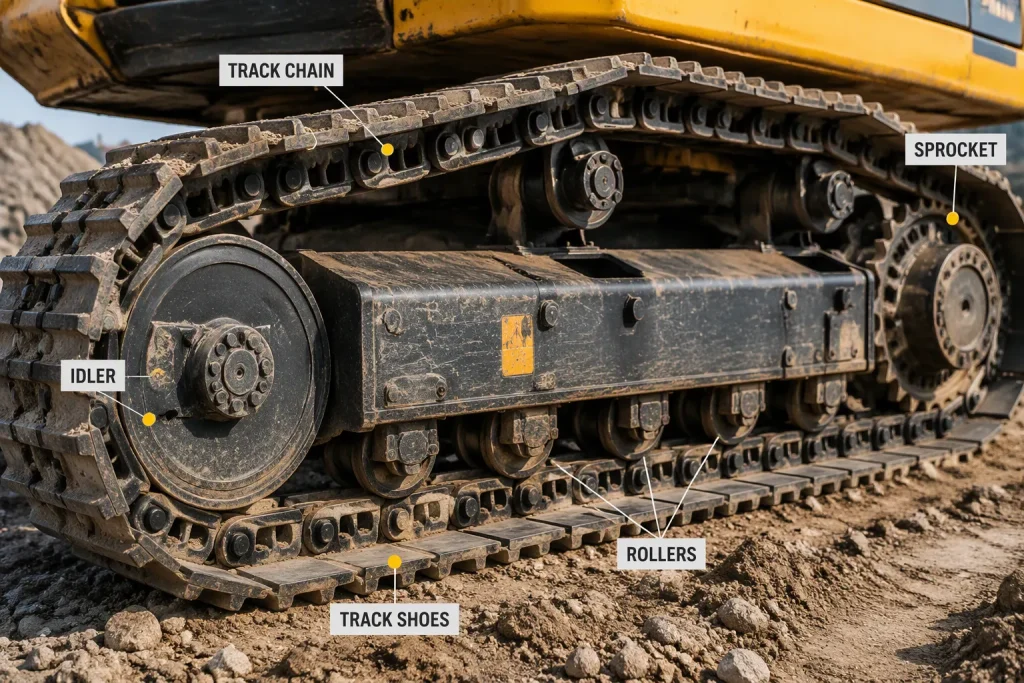
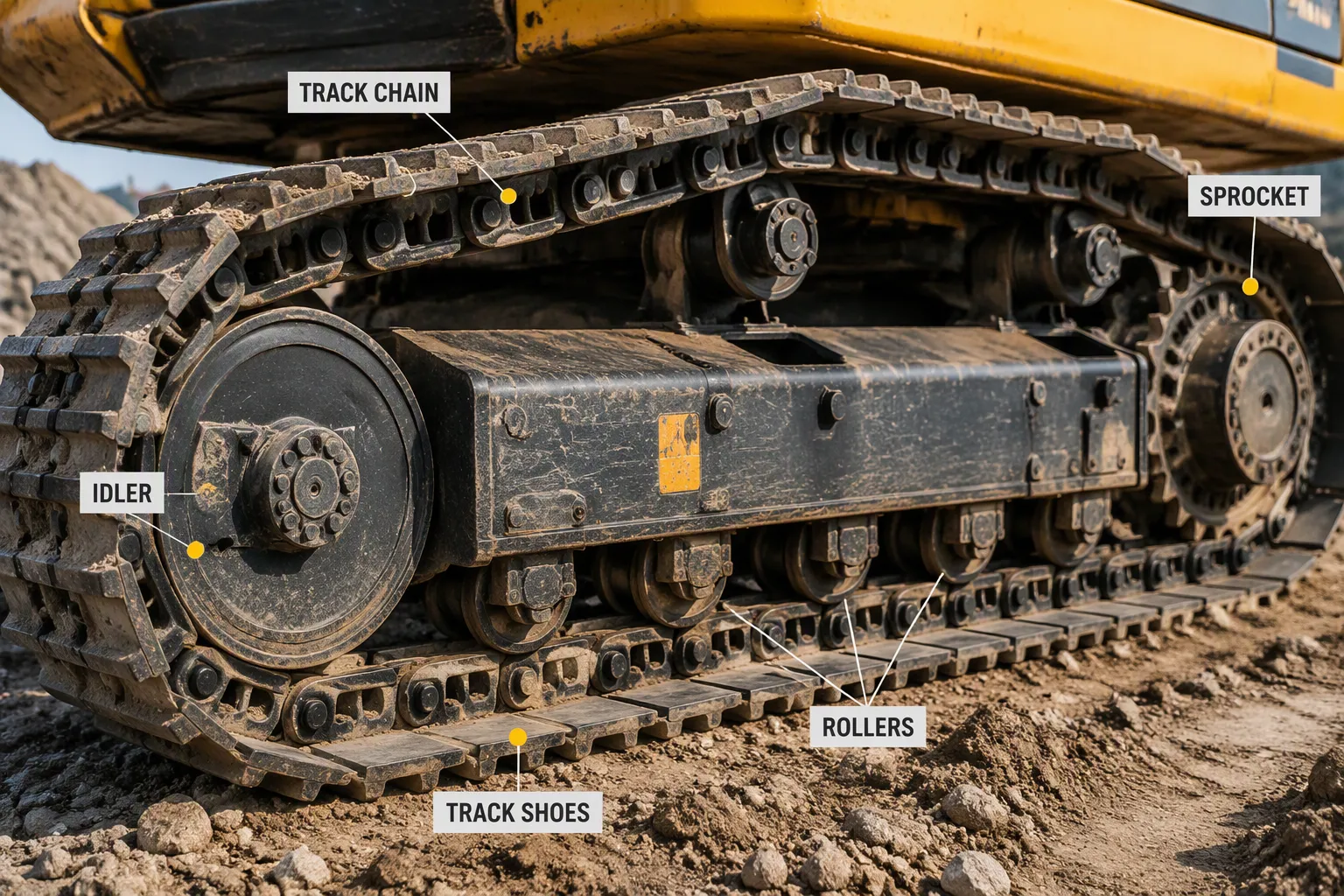
An excavator undercarriage is the lower assembly that supports the machine and carries it across the ground. Its parts must work together, but the exact layout and part references vary by machine model, size, track configuration, and production version. Understanding the main undercarriage spare parts for excavator helps with identification and inspection; it does not replace the machine’s parts documentation or fitment check.
Key Undercarriage Parts and Their Functions
Track chains form the continuous loops that run around the sprockets and idlers. Links connect through pins and bushings, allowing the chain to flex as the track moves. Some chain designs use sealed and lubricated joints, while other configurations differ. Check the machine documentation before deciding which chain type or part number applies.
Track shoes attach to the chain and contact the ground. Shoe width and grouser design affect how the track engages the working surface and how the machine behaves during travel. A shoe suited to one machine or work area may not be correct for another. Confirm the required shoe style, dimensions, bolt pattern, and chain compatibility before ordering.
Bottom rollers support the track along the lower frame. Carrier rollers guide the upper run of the track on designs that use them. Rollers can differ in diameter, width, mounting arrangement, seals, and part reference. Inspect for visible damage, leakage, uneven wear, looseness, or unusual movement, then compare findings with the machine’s service information.
The front idler guides the track and works with the track adjustment system to maintain the specified track tension. The idler and adjuster arrangement varies by model. A replacement must match the machine’s dimensions and mounting details; tension should be checked using the procedure in the service manual rather than judged from appearance alone.
The drive sprocket engages the chain and transfers motion from the final drive to the track. Its tooth profile must match the chain design. Sprockets may be one piece or use replaceable segments, depending on the machine. Check the part number and inspect the tooth profile for damage or uneven wear. A mismatched chain and sprocket can prevent correct engagement.
Some undercarriage systems also include guards, track adjuster components, recoil springs, seals, and related hardware. These are not interchangeable across all excavators. Identify each item by its parts diagram and reference number instead of assuming that a generic description covers the required configuration.
How the Components Work Together
The chain, shoes, rollers, idler, and sprocket form a moving system. The chain carries the shoes around the undercarriage; rollers support and guide it; the idler manages its path and tension; and the sprocket drives it. A problem in one area can affect the operation or wear pattern of neighboring components, so inspection should consider the assembly as a whole.
This does not mean that every worn part must be replaced as a set. The correct repair depends on the condition of each component, the machine’s specifications, and the inspection results. Review the service manual or parts documentation for the applicable replacement criteria and whether related parts should be checked together.
How to Identify the Correct Undercarriage Parts
Start with the machine make, full model designation, and complete serial number or product identification number (PIN). Read the identification plate directly and record the details carefully. A model name alone may not distinguish production changes, options, or serial ranges.
Next, locate the undercarriage assembly in the parts catalog or diagram. Record the exact part number, including suffixes and revision marks, and confirm the quantity and location shown. If a reference has been superseded, verify the replacement number and any associated notes for the machine’s serial range.
Use dimensions as a secondary cross-check when the documentation calls for them. Relevant details can include mounting-hole spacing, overall width, roller diameter, shoe width, bolt pattern, and orientation. Measure the same features and in the same units shown in the reference. A photograph can help explain a discrepancy, but it cannot establish hidden dimensions or material specifications.
Before ordering, confirm the item description, part number, machine application, condition if used or rebuilt, quantity, and included hardware in writing. Clarify whether bolts, seals, or other pieces are supplied separately. Resolve any mismatch between the machine records, catalog, and part description before installation.
Inspection and Maintenance Checks
During a visual inspection, look for cracks, deformation, missing or damaged fasteners, severe corrosion, damaged threads, leaking seals, and uneven contact or wear. Check that the track runs in its intended path and note unusual noise, vibration, or movement. These observations can help identify where a closer inspection is needed, but they do not establish a specific remaining service life.
Use the machine’s service manual for track tension and wear measurement procedures. Do not apply a universal tolerance or adjustment value to every excavator. Record measurements consistently and compare them with the limits for the exact model and configuration. If the result is unclear or a defect could affect safe operation, have the component assessed by a qualified technician.
Keep the inspection notes with the machine’s maintenance records. Include the date, machine identifiers, part numbers, observed condition, measurements, and any repair performed. These records help distinguish a change in operating conditions from a change in part fitment or condition.
Frequently Asked Questions
Which parts are commonly included in an excavator undercarriage?
Common components include track chains, track shoes, bottom rollers, carrier rollers where fitted, front idlers, sprockets, and track adjustment parts. The exact list depends on the machine design and the catalog for its model and serial range.
Can I choose undercarriage spare parts by machine model alone?
A model is a useful starting point, but it may not identify every production version. Confirm the complete serial number or PIN, exact part number, and any serial-range notes before ordering.
Should track rollers and sprockets always be replaced together?
No universal replacement rule applies to every machine. Inspect the related components and follow the applicable manufacturer documentation. Replace or service parts based on their condition and specified limits.
How can I check whether a replacement track shoe fits?
Compare the part number and catalog application, then verify the required dimensions and bolt pattern for the machine. Confirm compatibility with the installed chain design and resolve discrepancies before installation.
What should I do if the part number does not match?
Pause the order and compare the number with the machine’s parts diagram and serial range. Ask for clarification about any supersession or revision and verify dimensions and included items before proceeding.
For excavator undercarriage spare parts support, consider YNF Machinery. Share the machine model, serial number or PIN, and part number so the fitment details can be reviewed before ordering.



