A wrong used part costs you real money. Your machine sits idle, you pay return shipping, and you wait again for the right component. Most of these mistakes start with a guess.
The model and serial number together are the two checkpoints that prevent mismatches. The model identifies the machine family; the serial or product identification number helps distinguish its build. Use both before comparing a used component with parts information for your excavator.
Why Model and Serial Details Matter
A model name is a useful starting point, but machines in the same model family can have production or configuration differences. Those differences may affect a component, its connections, or how it mounts. Do not assume a part fits because the machine name or appearance seems close.
The machine identification plate and its documentation provide the details needed for a more specific lookup. Record the model and full serial or product identification number exactly as shown. If your machine has a separate engine or attachment identification plate relevant to the repair, record that information too.
Gather the Machine and Part Information
Locate the identification plate using the operator or parts documentation for your exact machine. Its position can vary by model and production configuration, so do not rely on a location described for another Bobcat excavator. Clean the area gently and photograph the plate in good light. Check each letter and digit before using the number in a catalog or fitment request.
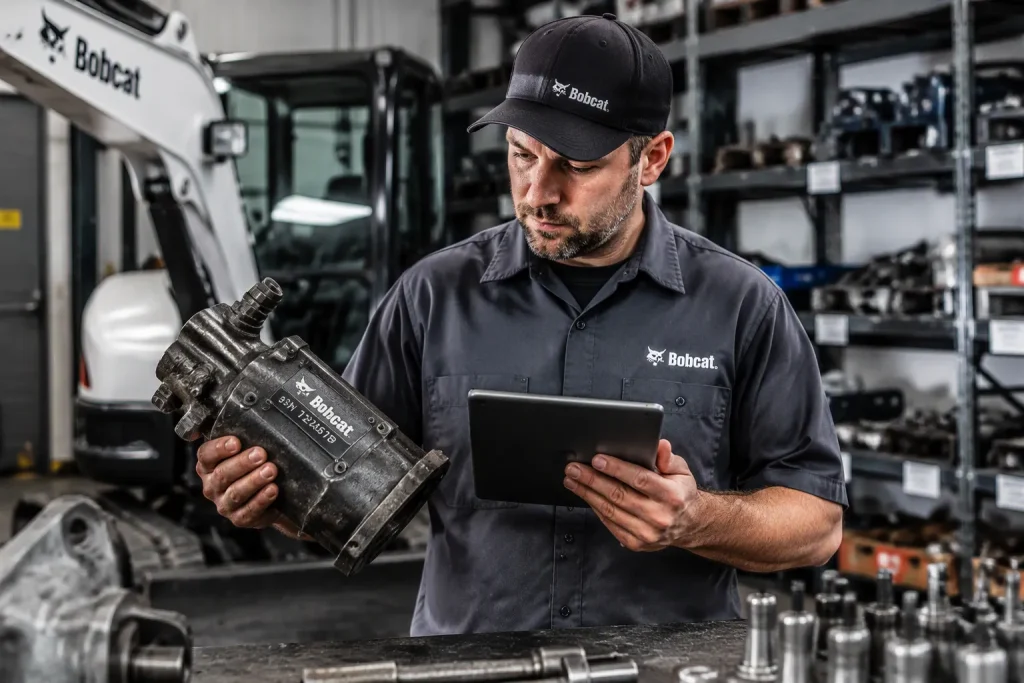
Identify the component you need and, when available, copy the part number from the removed item. Photograph the whole component and its label, mounting points, connectors, ports, and any visible damage. Note which system it belongs to and how it was installed. If the number is missing or unreadable, do not identify a replacement by appearance alone; provide the machine details, measurements, and clear photos for review.
Cross-Check the Part Number and Configuration
Use parts information that can be searched by the exact model and serial number. Compare the listing or item number with the parts diagram for the correct machine and system. If a catalog shows more than one possible number, check any serial range, configuration note, or replacement-number reference attached to the result. A superseded number should be treated as a possible match only after its application is confirmed for your machine.
Compare the physical details that matter for that component. Depending on the part, check mounting pattern, overall dimensions, orientation, connector shape, port position, spline or shaft details, and included fittings. Use the removed component or reliable machine documentation as the reference. Record measurement units and ask for measurements of the actual used item when the listing does not provide them.
Part numbers, diagrams, and photos should agree. If they conflict, stop and request clarification from a qualified parts professional or the parts supplier before paying or installing the item. Avoid modifying a component simply to make an uncertain fit work.
Inspect the Used Part and Its Records
Ask for current, well-lit photos of the actual component from several angles, including identification marks and areas that are normally hidden. Look for cracks, bends, corrosion, damaged threads, leaks, worn contact surfaces, missing hardware, and signs of repair. The relevant checks depend on the type of component; for example, inspect visible ports on a hydraulic part and the mounting surfaces on a structural part.
A photo can show visible condition, but it cannot establish internal condition or prove performance. Ask what inspection or testing was completed and whether records identify the same part. If the item is difficult to assess, safety-related, or important to a hydraulic or rotating system, arrange an appropriate inspection by a qualified technician before use.
Confirm What Is Included and the Purchase Terms
Ask for a written list of everything included. A pictured assembly may not include separate hoses, sensors, pins, brackets, seals, or installation hardware. Confirm whether the photos show the actual item and resolve any missing or unclear details before purchase.
Get the item condition, price, shipping terms, return period, and any warranty terms in writing. Clarify what happens if the part number or fitment differs from the information provided. Keep the listing, messages, invoice, and delivery photos with the machine’s maintenance records.
Pre-Purchase Checklist
Before ordering, record the exact machine model and full serial or product identification number; identify the component and its part number; compare the catalog reference and relevant physical details; review photos and available condition records; confirm included items and written terms. Resolve missing or conflicting information before installation.
Frequently Asked Questions
Can I confirm fitment with the model name alone?
Use the model and full serial or product identification number together. A model name alone may not distinguish a production or configuration change relevant to the component.
What if the identification plate is unreadable?
Check the machine documentation for identification guidance and photograph any readable characters. A qualified parts professional may be able to help verify the machine from its records, but do not guess at missing digits.
What should I compare besides the part number?
Compare the configuration and relevant physical details, such as dimensions, mounting points, connection type, orientation, and fittings. Which details matter depends on the component.
Can photos prove that a used component is in working condition?
No. Photos can help assess visible condition but cannot confirm internal wear or performance. Ask about inspection or test records and arrange a qualified inspection when the risk or uncertainty warrants it.
What should be written down before I buy?
Keep the exact machine identification, the part number and description, the condition and included items, the shipping and return terms, and any fitment confirmation. Written details make it easier to resolve a mismatch.
Conclusion
Cross-checking used Bobcat excavator parts starts with accurate machine identification and continues with part-number, configuration, condition, and purchase-term checks. If any detail remains uncertain, pause the order until it is clarified.
For excavator parts support, consider YNF Machinery. Share your machine model, serial number, and part details so the fitment can be reviewed before ordering.