
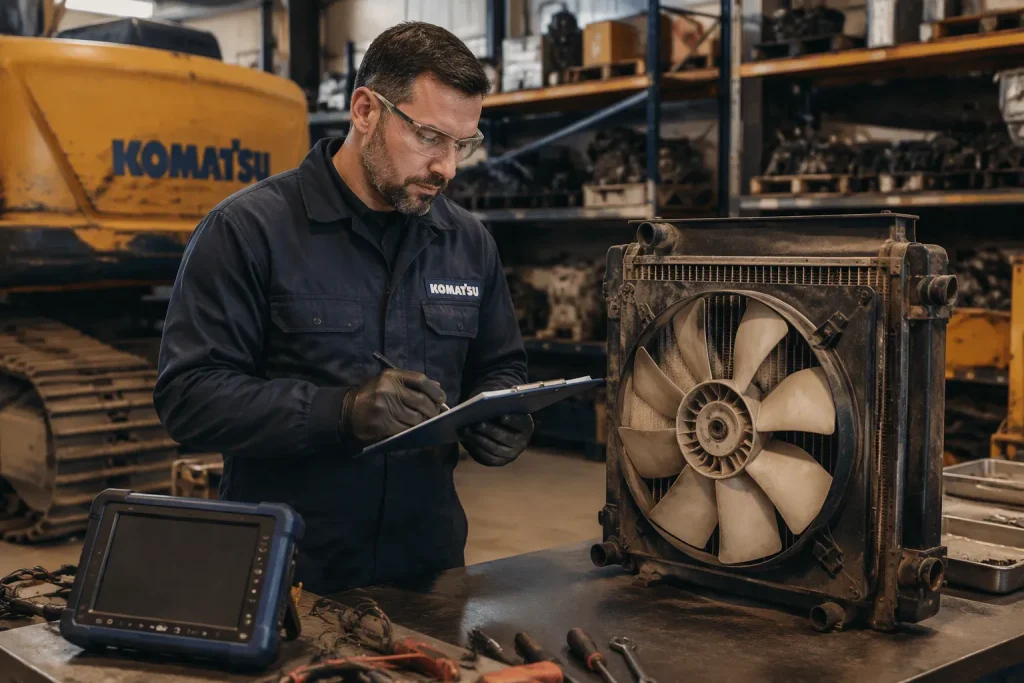
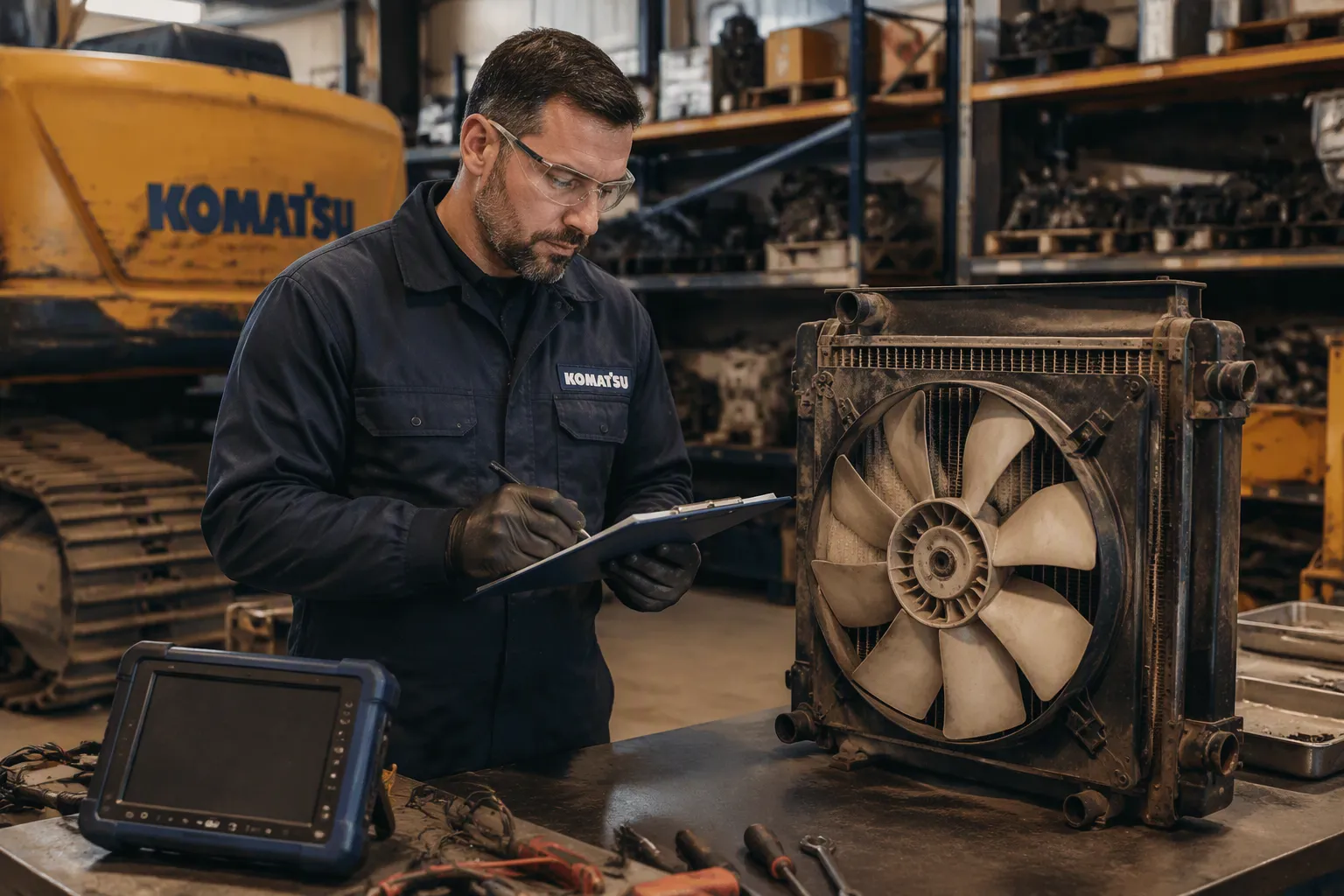
A used radiator, water pump, oil cooler, or thermostat can look perfect on the shelf and still fail you. It may not fit your machine. It may not work. It may not even be the part the seller claims. So how do you check used Komatsu excavator parts for the cooling system before you pay?
You follow a verification chain. First, qualify the donor machine. Next, identify the exact part. Then look at it closely, check its condition through qualified findings, confirm it is real, vet the seller, and compare your choices. Each step gives you evidence you can write down. None of it depends on guesswork or made-up testing.
Key Takeaways
Use available donor history as supporting context; it does not establish the condition or remaining life of the offered component.
Check the part number against your excavator’s model and serial number before you buy.
Check the cooling parts for harm, such as bent fins, leaks, or cracks.
Ask the seller for written condition reports and a clear list of what is included.
Compare the prices of used parts with new ones, based on what your machine needs.
Qualify The Donor Machine Before Buying Used Komatsu Excavator Parts
Ask for available donor history relevant to the offered cooling component, including recorded overheating, repair or removal information. A whole-machine inspection is not a substitute for assessment of the actual part.
Review Service History And Operating Hours
Compare recorded hours with dated maintenance records and note any gaps or replacements. Neither accurate hours nor a full history establishes the remaining life of a radiator, water pump or hose.
Request relevant cooling-system service and assessment records. Fluid appearance alone cannot establish past overheating or component condition. Leave fluid sampling, opening and interpretation to qualified personnel following the applicable procedure.
Use Third-Party Inspection To Reduce Risk
An appropriately qualified independent assessor can provide findings separate from seller claims. Confirm their scope and any relationship to the seller rather than assuming independence eliminates all uncertainty.
This step matters most when you buy used Komatsu excavator parts from sourced equipment you cannot see in person. Ask for the report in writing, review the findings, and keep a copy for your records. A documented inspection turns a verbal promise into evidence. That evidence protects your purchase decision.
Confirm The Excavator Model And Serial Number
Match The Part To The Correct Application
Model names can be the same across machine generations. Two excavators may share a badge and still use different radiators, water pumps, or fan assemblies. Confirm the exact Komatsu model and serial number before you evaluate any used komatsu excavator parts. The serial number narrows the machine down to a specific build range. That range decides which cooling components fit. Write both numbers down and compare them to the machine plate and the seller’s listing. A guide on model and serial number identification can help you read the plate correctly and record the details. Keep that record with your inspection notes.
Now match the candidate part to the confirmed application. Use supported documentation, not memory or guesswork. Ask the seller for the part number and the machine application tied to that number. Compare the number against a parts catalog or manufacturer documentation for your serial range. Check that the radiator core size, inlet and outlet positions, and mounting points suit your machine. Do the same for the water pump housing and the fan assembly bolt pattern. A part that fits a similar excavator may not fit yours. Similar excavators often differ in cooling layout across build ranges. When the documentation does not confirm the match, treat the part as unverified. Do not rely on a seller’s verbal assurance alone. A documented match protects your repair budget and your downtime.
Visual Inspection Criteria For Cooling Components
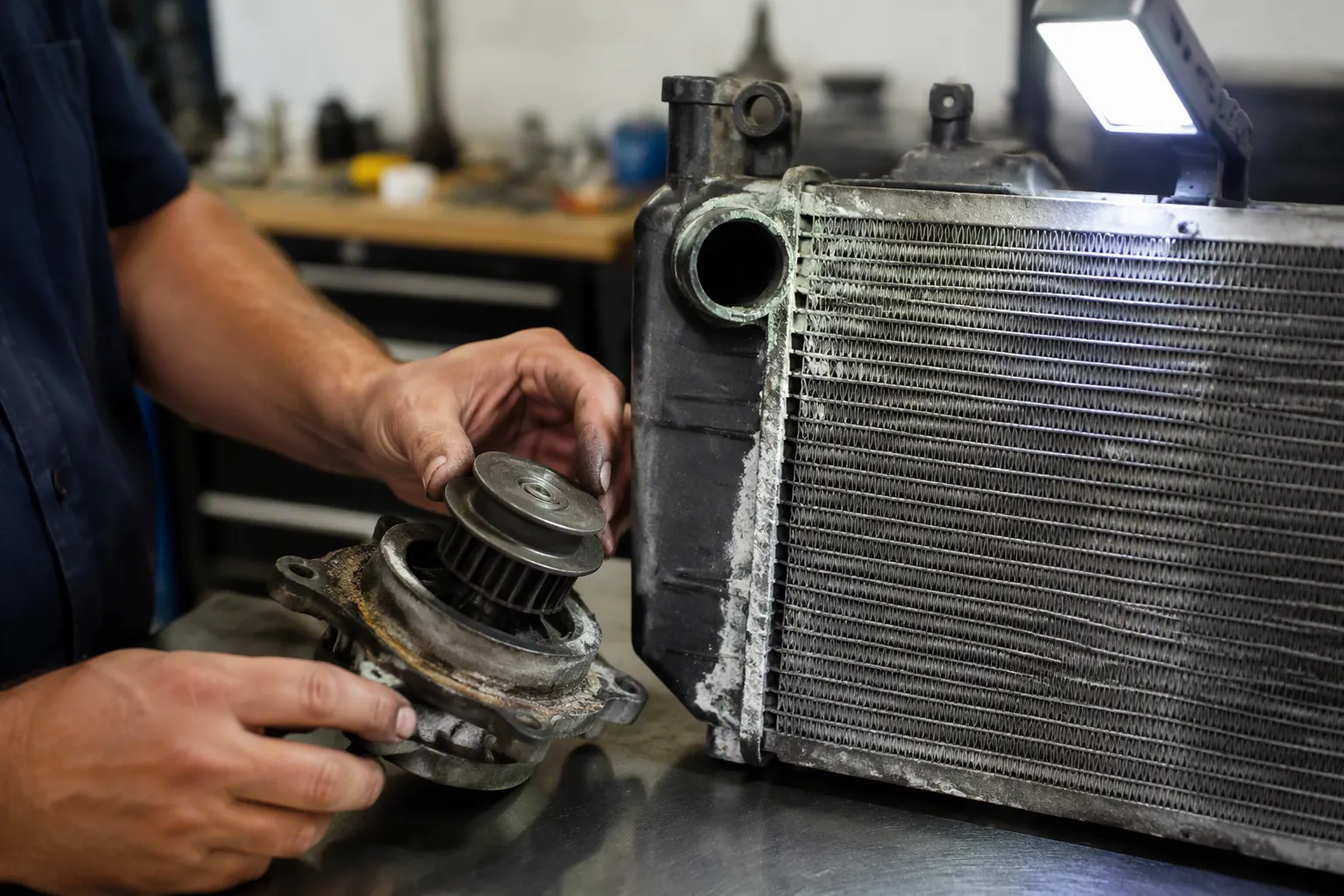
You can learn a lot from a careful look before you commit to a purchase. Thorough physical inspections of used cooling parts rely on your eyes and a good light, not on tools or tear-downs. Keep every check observational. Do not open the unit, measure internal clearances, or run your own operating tests. Those tasks belong to a qualified technician with the right equipment.
Radiators And Oil Coolers
Record visible fin damage, corrosion, residue and repair marks in actual-item photographs or qualified findings. Ask the assessor to interpret their significance; residue does not establish an active leak or prove how a repair became necessary.
Include accessible mounting areas, connections and visible tank condition in the review. Do not open a filler cap or cooling circuit yourself. Ask qualified personnel to explain any deformation, corrosion or repair and the applicable acceptance criteria.
Water Pumps And Thermostats
Request qualified findings on the pump housing, accessible shaft and bearing condition. Do not move the pulley or shaft yourself as a diagnostic test. Visible residue or damage needs interpretation rather than an assumed cause.
Thermostats deserve the same care. Inspect the housing for cracks and the flange for distortion. Look for corrosion around the seat and any residue that suggests coolant leaks. Read the housing markings and note them for the authenticity check later. Bent or broken mounting ears are clear component damage. These inspections catch obvious component wear and damage, yet they cannot prove function. Treat every finding as a question for the seller’s documentation, not as a verdict on its own.
Verify Condition Through Qualified Findings
A clean exterior does not establish pressure integrity, flow or thermostat function. Ask qualified personnel which assessment is appropriate for the actual component under the applicable procedure, and request the findings and limitations. Review any restrictions in the agreed return terms.
Request Supported Condition Documentation
Ask the seller for condition findings in writing before you talk price. The document should name the part, describe its tested state, and say who did the work. Look for a clear statement of what was checked and what was found. A report that says “tested good” tells you very little. A report that lists the checks done and the results gives you something to judge.
Compare visible observations with the report scope. Ask whether relevant leakage, bearing or functional questions were assessed and which remain unresolved. Do not assume the response speed of a seller establishes technical credibility.
Keep every document with your purchase records. These findings back up your decision if a dispute comes up later. They also help your service team plan the install.
Define The Written Supply Scope
The supply scope is the written statement of exactly what you get. It takes the guesswork out of the deal. A complete scope covers three things:
The exact component supplied, named by part number and application.
Its stated condition, tied to the condition findings.
Everything included in the price, like mounting hardware, fittings, pulleys, or sensors.
A useful scope names the actual component, proposed application, included items and exclusions. Confirm whether a fan shroud, cap, brackets or other pictured items are included rather than assuming the photograph defines the shipment.
Insist that the actual component matches its description in the paperwork. Compare the part number on the unit to the number on the paperwork. Check that the listed items are there. Photograph the part as received, before installation. This record protects you if the delivered item differs from the described item.
A donor machine may have undergone earlier repairs or modifications. Confirm the identity of the actual offered item and its proposed application rather than relying solely on the donor model.
Verify Authenticity And Part Numbers
Check Markings And Number Consistency
Record readable identification on the actual component and compare it with the seller records. Distinguish casting marks, assembly references and orderable service numbers before deciding whether a difference is meaningful.
Different components and packaging may legitimately carry different identifiers. Ask a qualified specialist to explain each relevant reference and resolve inconsistencies; matching labels alone do not establish authenticity or fitment.
Cross-Check Against Supported Documentation
Use applicable manufacturer parts documentation and qualified verification for the actual machine identification and configuration. Treat cross-reference information as a lead and confirm any relevant restrictions, replacement references and interfaces.
Never guess a part code or assume a number carries over between build ranges. Two excavators may look alike and still use different cooling parts. When the documentation does not confirm the number, treat the part as unverified. Ask the seller for written confirmation of the number and its application. Keep that confirmation with your records. A documented match is the only match you can defend.
Assess Seller Credibility And Documentation
What A Credible Seller Provides
A trustworthy seller backs up every claim with paperwork. Before you talk about price, ask for three kinds of documents. First, identification records: the machine model, serial number, and the part number for that application. Second, condition findings from a qualified technician, written down and signed. Third, the supply scope, which names the exact component and everything that comes with it.
Ask which records are available, what the actual item history is and how it has been stored. Missing or delayed documents leave questions to resolve; they are not by themselves proof of dishonesty.
Agree Written Terms Before Payment
Put the deal in writing before any money changes hands. The terms should repeat the condition findings, the supply scope, and what you expect for returns. Spell out what happens if the delivered part does not match the paperwork. Name the time window for raising a problem and the steps for a return. Keep the language plain and specific.
Do not accept a verbal promise about warranty coverage. If the seller offers a warranty, ask for its exact terms in writing. If there is no warranty, say so plainly in the agreement so both sides understand the deal. Compare the terms with your inspection notes and the condition report. Any mismatch deserves a question before you pay.
A written agreement protects both sides. It turns a conversation into a record. That record is what you count on if the excavator part arrives damaged or wrong. Treat missing terms as a reason to pause, not a reason to hope.
Compare Cost Against New And Aftermarket Options
Price alone does not decide this choice. You need to weigh the cost against downtime risk and how long you expect the machine to last. Each option works well in certain situations.
Where Used Parts Fit Best
A used component may be considered when its supported fitment, assessed condition, included items and actual quotation meet the repair requirements. Do not assume it is cheaper than a new part or that donor origin guarantees fit and function.
Compare availability, uncertainty and quoted total cost for the actual repair. A backup machine still needs appropriate condition and safety verification; flexible timing does not make an unverified part acceptable.
Where New Or Aftermarket Fits Best
A new component removes prior-use history from the comparison but still needs supported fitment, suitable quality evidence and written supply terms. Aftermarket coverage and availability must be checked for the actual application.
Compare actual quotations and supported findings against the service plan. New, used, repaired and rebuilt labels alone do not establish a longer life, lower cost or acceptable risk.
Final Checklist For The Purchase Decision
Go/No-Go Verification Points
You have collected evidence at every step. Now you need one clear point to decide. Go through these checks before you commit:
Available donor history and its limitations have been recorded.
The model and serial number match the part’s documented use.
Visible damage and any repairs have been reviewed by qualified personnel where relevant.
Qualified condition findings cover the checks you saw and the results.
The part number on the unit matches its paperwork and your catalog.
The seller gave identification records, findings, and a written scope.
The written terms cover condition, scope, and return expectations.
The cost comparison fits the machine’s role and your uptime needs.
One failed check means no-go until the seller fixes it. Do not let a low price override a missing document. Used komatsu excavator parts carry real value only when the evidence supports them.
Documenting The Decision
Record each verification result in one file. Note the date, the machine model and serial number, the part number, and the outcome of every check. Attach your photos, the condition report, and the written scope. This record makes your purchase defensible if a dispute arises later.
Strong equipment verification also protects your service team. They can plan the install with the documented condition in hand. Keep the file with your maintenance records for the excavator. When you buy used excavators or source parts again, the same file format speeds up your inspections. A written trail beats a memory every time.
You now have a complete verification chain. It begins with qualifying the donor machine and identifying the exact part. Next comes visual inspection, then qualified condition findings, authenticity and part number checks, seller documentation, and a cost comparison. Every step builds evidence you can record.
Keep the accepted supply scope, assessment findings and terms together. Pause when unresolved identification, condition or compatibility questions prevent a supported purchase decision.
The article photographs illustrate workshop context rather than the condition, test results or availability of a component offered for sale.
FAQ
How do I verify operating hours on a donor excavator?
Compare the meter information with available dated maintenance records and note gaps or replacements. Even consistent hours do not establish component condition or remaining life.
Can I test a used water pump or thermostat myself?
Ask qualified personnel to assess the component under the applicable service procedure. Obtain the actual method, results and limitations, and check any testing restrictions in the written return terms.
What should a written supply scope include?
It should name the exact component by part number and application, state its condition, and list everything included in the price, such as brackets, fittings, or sensors. Compare the delivered part against that scope before installation.
What if the part number on the unit does not match the paperwork?
Treat the part as unverified and ask the seller directly. Photograph every marking before you pay. Cross-check the number against a parts catalog for your confirmed model and serial range. A documented match is the only match you can defend.
When does a used cooling part make more sense than a new one?
Compare supported fitment, qualified condition evidence, actual supply scope, quotations and written terms for each option. Age, used status or a new label alone does not determine the right choice.
For excavator parts sourcing, consider YNF Machinery. Share full machine and component identification, applicable part references and quantities, and request supported compatibility information, an actual quotation, and written warranty and return terms before ordering.



