
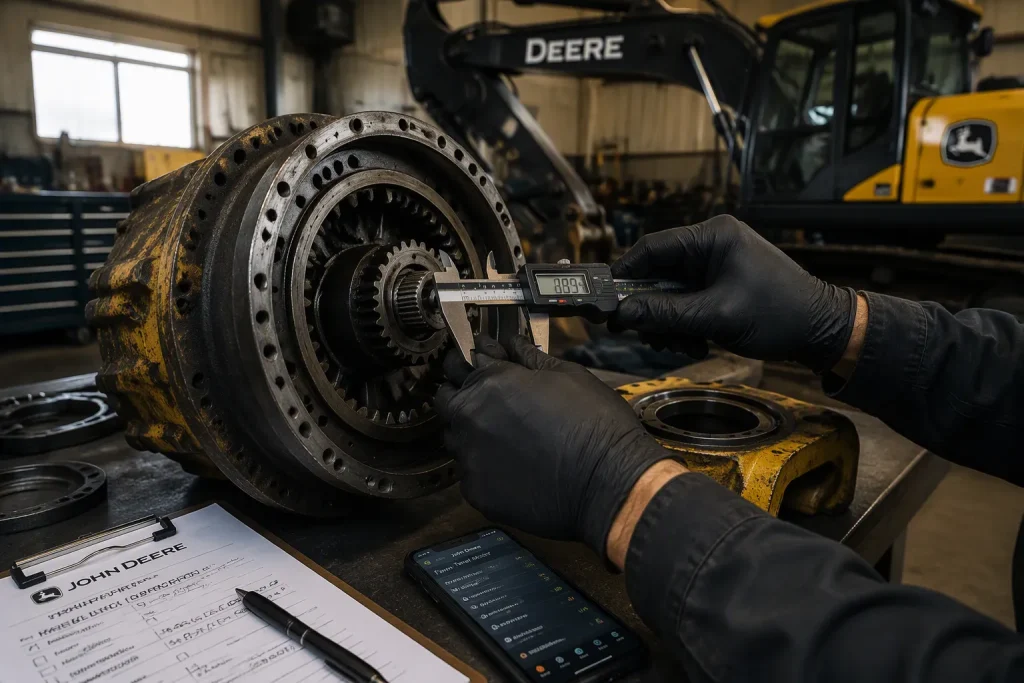
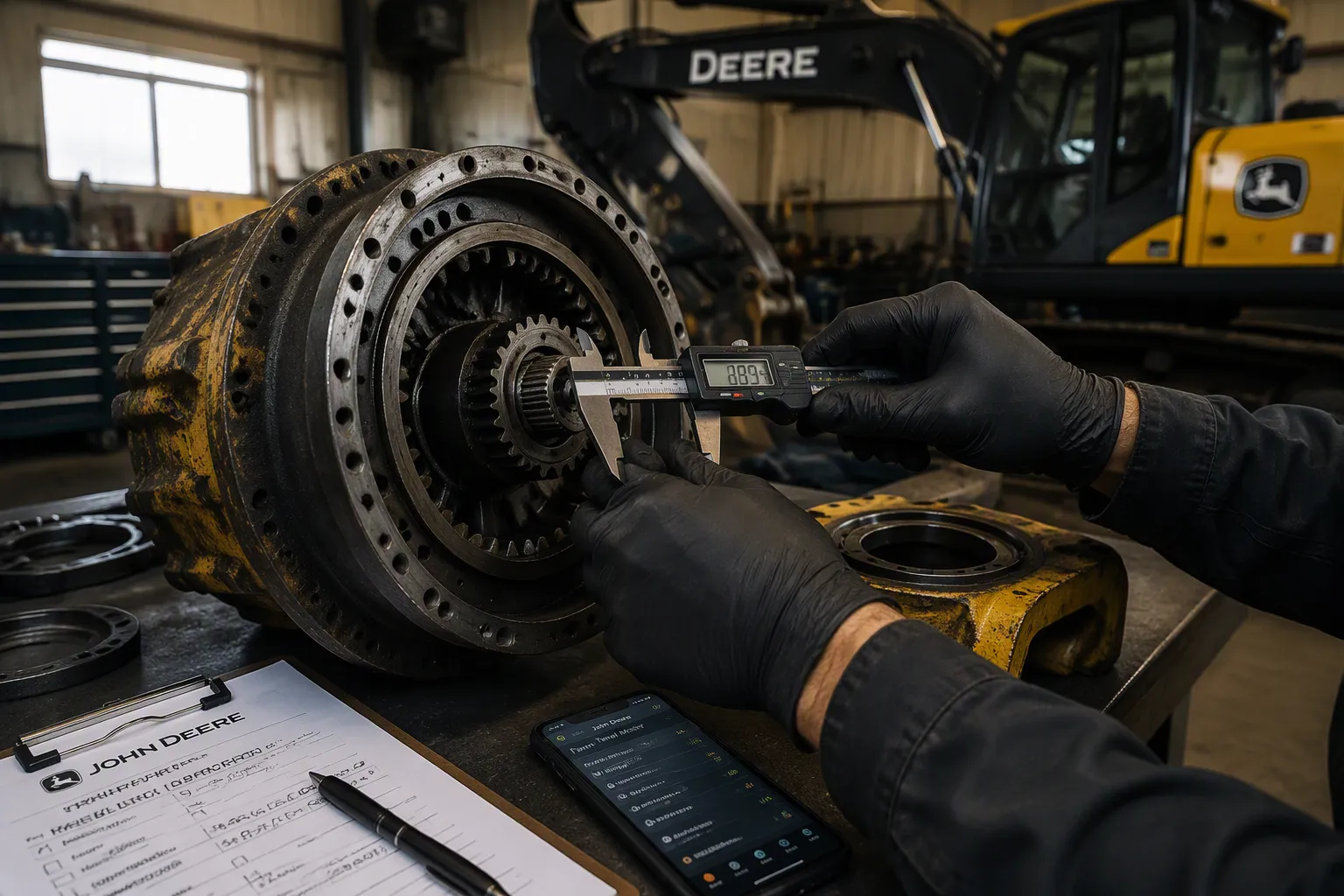
How do you check the condition of a used John Deere excavator travel motor before you buy it? This helpful guide for used-part buyers answers that question. It focuses on what you can see, write down, and confirm, not on what the seller promises. You will go through a clear order: understand the part, read the visual clues, interpret qualified test results, check the paperwork, and review the seller’s terms. Each step builds on the one before it. Decisions based on evidence protect you from costly mistakes in the used parts market. Use the same care when you look over used john deere excavator parts for sale. Strong proof beats a confident sales pitch every time.
Key Takeaways
Know the travel motor’s parts and common failure points before you check any used unit.
Take clear photos of leaks, cracks, and hose damage to build a visual evidence file.
Request appropriate assessment records from qualified personnel, including the method, item identity, applicable criteria, results and limitations.
Check the maintenance records, hour logs, and serial plate photos to confirm the machine’s history.
Do not buy from sellers who will not give written proof or clear return rules.
Know the Excavator Travel Motor
Core Components and Functions
A travel motor converts hydraulic energy into rotary motion within the travel drive. Confirm whether the offer is for the motor alone, a reduction assembly or a combined final drive. Internal design, brake and control arrangements depend on the actual unit; use applicable documentation rather than assuming one configuration.
Ask a qualified specialist to identify the actual assembly and relevant assessment points. A workshop illustration does not establish the internal design, service part reference or condition of an offered component.
Common Failure Points to Screen
Possible assessment questions include leakage, wear, contamination and control or brake function where applicable. Do not assume a universal failure sequence or diagnose an internal fault from one symptom.
Request relevant qualified findings for the actual motor and, where necessary, the circuit. Fluid appearance alone cannot identify a pump fault or establish internal motor condition. Do not open connections or sample fluid yourself for a purchasing check.
Read Visual Inspection Evidence
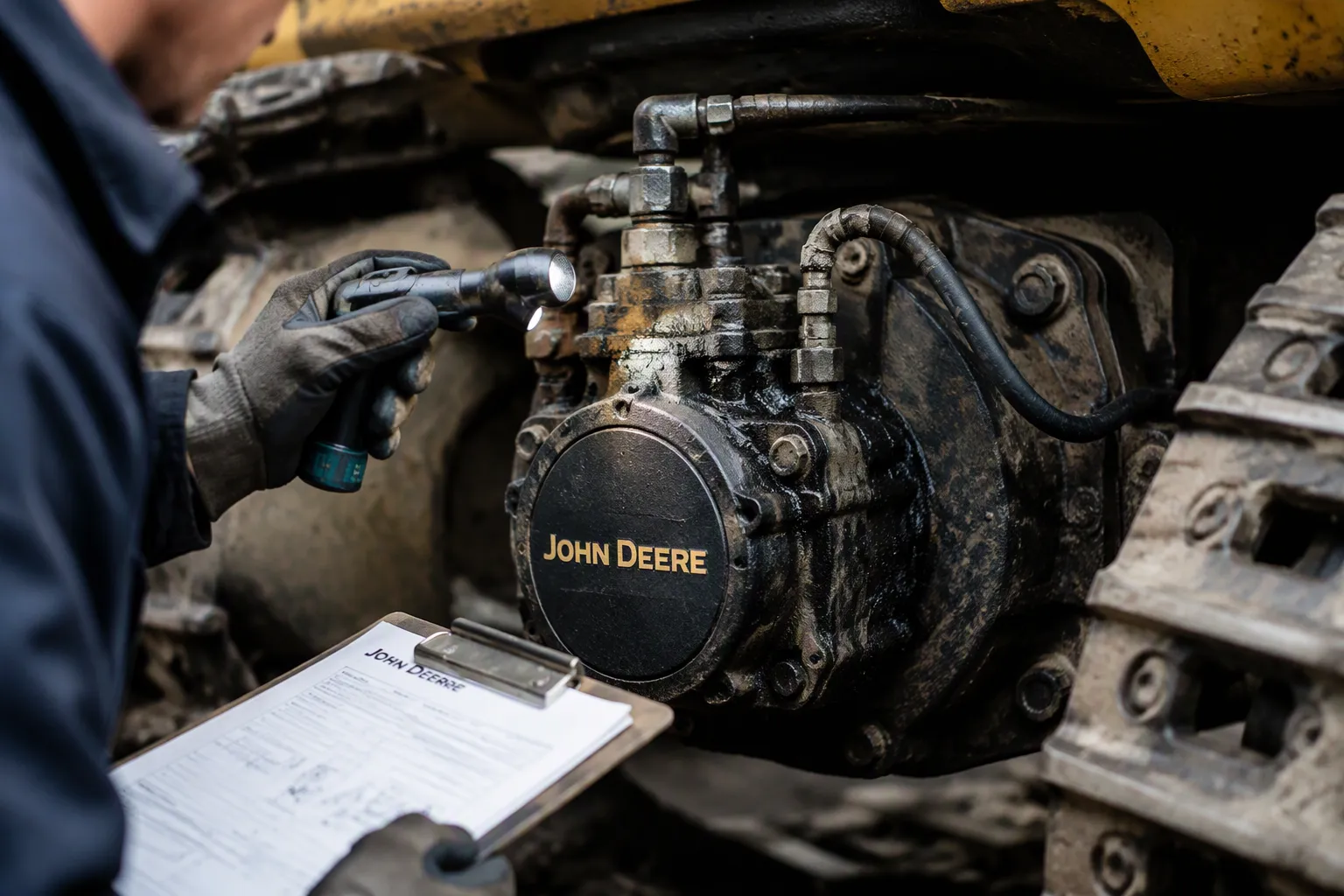
Review safely obtained actual-item photographs and qualified observations of accessible housing, mounting and connections. The motor condition cannot be inferred from unrelated pins or bushings elsewhere on the machine.
Leaks, Cracks, and Hose Condition
Record visible wet areas, residue, cracks and hose damage without assigning a cause. Ask qualified personnel to establish whether leakage is active and what assessment is needed. Do not approach a pressurized leak or handle hoses to investigate.
Where fluid condition matters, obtain applicable sampling or assessment records and qualified interpretation. Colour, texture or smell alone does not establish the cause or extent of a fault.
Housing, Mounting, and Shaft Condition
Have qualified personnel document accessible housing, mounting and shaft condition using applicable inspection procedures and criteria. Do not run a hand over damaged surfaces, move the shaft or manipulate unsupported components yourself.
Donor machine records may provide context, but an inspection of the engine or undercarriage does not establish the condition of the offered motor. Keep actual-item findings separate from whole-machine observations.
A clean or worn appearance alone does not establish service history, workload or internal condition. Use it to identify questions for qualified assessment rather than to infer honesty or remaining life.
Interpret Qualified Test Evidence
Visual clues only tell you part of the story. Ask the seller for test results from a hydraulic shop that is qualified. A written report turns an opinion into evidence you can check. The report should list the test method, the gauge readings, and the technician’s notes. Compare those findings against the machine’s documented condition. A report with no method and no readings tells you very little.
Pressure and Flow Findings
Ask qualified personnel which hydraulic or functional assessment is appropriate for the actual unit and applicable service reference. Request recorded conditions, results and limitations. Pressure or case-drain findings need context and cannot alone establish a specific failed component.
A safely recorded assessment video may support a written report when it identifies the unit, method and conditions. It does not replace qualified interpretation, and the required assessment scope depends on the actual motor design. Do not request improvised machine operation for a sales clip.
Noise, Vibration, and Operational Notes
Ask the qualified assessor to record any relevant noise, vibration or operational observations with the test conditions. These observations alone do not establish a specific internal fault or a universal normal sound.
A short operating clip does not establish durability or remaining life. Compare the report scope and limitations with the actual questions that need answering before purchase.
Verify Used Excavator Documentation
Paperwork turns a seller’s story into a record you can check. Ask for the full machine history before you talk about price. That history should include maintenance records, hour logs, and proof of past repairs. A complete file shows a seller who keeps track of the machine. A thin file tells you to slow down.
Maintenance Records and Hour Logs
Review available dated hydraulic maintenance and repair entries as historical context. Regular service does not prove present condition; missing records leave uncertainty rather than establishing a particular fault.
Machine hours alone do not establish component hours, duty or condition. Compare available records and ask a qualified assessor to resolve material inconsistencies without assuming the meter tells the whole history.
Keep donor machine identification separate from component identification and service part references. An identification plate does not establish operating hours or warranty coverage. If any warranty is offered, obtain its actual written terms.
Written Supply Scope and Repair History
Ask for a written supply scope. The document should name the exact parts included in the sale. It should also state whether the travel motor comes as a complete assembly or as separate components. List every item you expect to receive. Then compare that list with the seller’s written scope. Gaps here turn into disputes later.
Request the repair history in writing too. Ask which components a shop replaced, which ones it inspected, and which ones it left alone. A rebuilt unit should carry a record of the work performed. A unit with no repair record leaves you guessing about its internal state.
Connect each document to the relevant actual item, donor or intended machine. These are different identities and may use different numbers. Resolve meaningful inconsistencies in writing and retain the original records.
Build a Used-Buyer Guide Checklist
Seller Responsiveness and Evidence Consistency
Have a qualified specialist establish the required service part reference for the actual machine and configuration before comparing offers. A machine class or an undercarriage description alone does not determine the correct motor.
Request actual-item photographs and readable identification where available, with relevant assessment records. Record inaccessible areas and the limits of remote review; agreement between documents is useful but not conclusive proof.
Return Policy and Written Terms
Confirm actual-item identity, supported application, available condition evidence and clear supply scope. Ask qualified personnel what assessment is appropriate rather than requiring the same full-function test from every unit. Record what remains unknown and obtain written terms.
Read any offered warranty, return window, core arrangement, exclusions and freight responsibilities before committing. Written terms define the agreed process; they do not automatically guarantee a remedy for every hydraulic fault.
Screen Used John Deere Excavator Parts for Sale
Match Evidence to the Machine
Distinguish machine identification, component identification and service part references. Match each record to the relevant actual item and machine, and ask a qualified specialist to resolve unclear or conflicting references.
Use component-specific findings to assess the actual offered motor. Undercarriage wear may raise questions about donor history but does not establish internal motor condition or drive loads. Keep the evidence scope and limits clear.
Walk-Away Red Flags
Pause when identity, application, supplied scope or condition cannot be supported sufficiently for the purchase decision. A missing report may require further qualified assessment; it is not by itself proof of failure or dishonesty.
Record meaningful inconsistencies and ask for an explanation and supporting evidence. Fresh paint, incomplete records or a short video do not by themselves establish a fault. Do not let price substitute for unresolved verification.
You now have a method you can use again and again. Learn the part, read the visual clues, weigh qualified test findings, check the paperwork, and review the seller’s terms. Each finding needs support and a written record before you pay. Hour readings alone never prove the condition of used parts.
Walk away when evidence is missing, inconsistent, or not written down. Weak files on used parts rarely get better after the sale.
The article photographs illustrate workshop context and may show a combined drive assembly. They are not evidence of a service part reference, dimensions, test results or condition for an offered motor.
FAQ
What proof should I request before buying a used travel motor?
Request actual-item identification, supported application information, available history, appropriate qualified findings and written supply terms. The report should state what was assessed, the method, relevant criteria and limitations.
Can I judge a travel motor from a short running video alone?
No. A short clip does not establish internal condition, durability or suitability for the intended application. Ask qualified personnel which assessment is appropriate for the actual unit and interpret supporting video within that scope.
Do low hours guarantee a healthy used travel motor?
No. Recorded machine hours alone do not establish motor condition or component service history. Review the available records with qualified findings and resolve material inconsistencies.
What belongs in a written supply scope?
The scope should name every part included in the sale. It should state whether the motor arrives as a complete assembly or as separate components. Ask for the repair history in writing too. Gaps in the scope turn into disputes after the sale.
When should I walk away from a used parts listing?
Pause or decline when important identification, fitment, condition or supply questions remain unresolved after reasonable verification. Record the limits of the evidence and do not fill gaps with guesses or sales assurances.
For excavator parts sourcing, consider YNF Machinery. Share full machine and component identification, applicable part references and quantities, and request supported compatibility information, an actual quotation, and written warranty and return terms before ordering.



