


You ask five wholesale excavator parts factories for the same quote. The prices and MOQs you get back are all different. The lowest price seems like a good deal. Then you see its MOQ is twice as high as the others, and the shipping terms are not clear.
Comparing quotes is not easy. You need to know what sets the price, what the MOQ means for your stock, and what the total delivered cost will be. This article gives you a step-by-step method. You will learn to normalize quotes, figure out the true cost per part, judge supplier reliability, and negotiate better terms with wholesale excavator undercarriage parts manufacturers.
Key Takeaways
Use the same format for quotes so you can compare factories fairly.
Learn about MOQ rules: per-SKU versus mixed orders change your inventory costs.
Find the real landed cost per part, including freight, duties, and carrying costs.
Check how reliable a supplier is by looking at their paperwork, how they communicate, and their references.
Negotiate order quantities, delivery and payment terms together, while protecting your cash flow and confirming the written agreement.
Why Pricing and MOQs Vary Across Wholesale Excavator Parts Factories
Each factory starts its quote from a different cost base. You notice this when you compare wholesale excavator parts factories next to each other. One plant runs big batches on automated lines. Another runs smaller, more flexible batches. Their pricing and MOQs will never be the same, and that is normal.
Pricing Factors for Undercarriage Parts
Materials, machining, heat treatment, inspection and packaging can affect a quotation. Ask each factory to identify the specifications and processes included in its price. A price difference alone does not prove that one part uses better materials or has a longer service life.
Demand, stock availability, production schedules and order size can affect pricing. Request the price for your actual quantities and required delivery date. Do not assume that a container order, trial order or particular market condition always receives the same pricing treatment.
How MOQs Reflect Production and Inventory Costs
A minimum order quantity is not a random number. It shows the batch size a factory needs to run a profitable production cycle. Setup, tooling changes, and material handling all cost money. A short run spreads those costs over few units. That is why a low MOQ often comes with a higher unit price.
Factories also set MOQs to control inventory turnover. They do not want to hold slow-moving stock for months. Some quote MOQs per SKU. Others allow mixed orders across a product family. You must ask which model applies. A mixed-order MOQ of 50 units across ten part numbers is very different from 50 units per part number.
Stocked and made-to-order parts can have different minimums and lead times. Ask about each product family and proposed part number. A broad catalog does not guarantee mixed-order flexibility, and a made-to-order factory may still offer a suitable trial quantity under agreed terms.
Comparing Quotes for Wholesale Excavator Undercarriage Parts
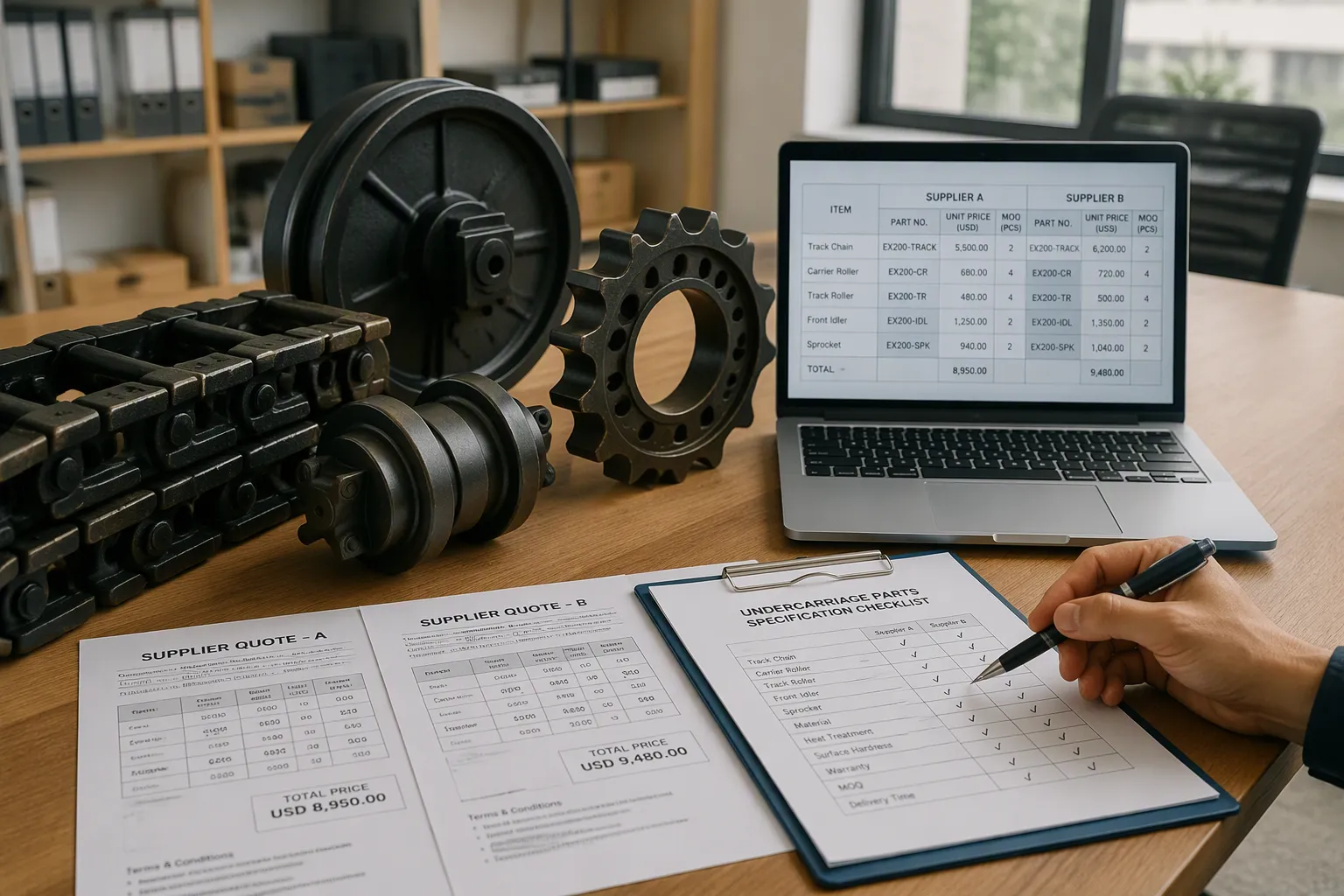
Build the Same Quote Request for Every Factory
Use one specification request for every candidate. Include the exact machine model and serial range, OEM reference, proposed replacement number, condition and critical drawing requirements. Request the relevant material and inspection documentation. Ask the factory to identify any departures from your request rather than assuming every quotation covers the same part.
Keep the specification as a checklist and compare each written response with it. Ask for the drawings or dimensions needed to verify the component and record the agreed inspection criteria. Documentation should match the actual order; a look-alike part or a higher price is not proof of conformity.
Clarify MOQ Policies and Landed Costs
Confirm whether the minimum applies per part number, per product family, per order value or across a mixed order. Ask whether trial quantities are available and whether they change unit pricing or lead time. Record the agreed quantity for every line before planning inventory.
Ask for itemized pricing as well. List the unit price separately for each part number. Add tooling charges, packaging, and documentation fees. Some factories fold these costs into the unit price. Others list them as line items. You cannot see the difference until you ask. Request a breakdown of what the unit price includes. Does it cover the box, the pallet, and customs paperwork?
Separate delivered purchase cost from inventory holding cost. Delivered cost includes the parts price and the freight, insurance, applicable import charges and delivery expenses not already included in the quotation. Holding cost may include storage, financing and obsolescence risk. Compare the same shipping terms and destination for each quote, and confirm responsibility for charges and risk transfer.
Build a consistent comparison worksheet using the complete delivered cost of each order. Allocate shared charges using a documented method, then estimate inventory holding cost separately. Compare the resulting quantities with realistic demand so a low unit price does not lead to unnecessary stock.
Factories set minimum order quantities to protect their production schedule. They offer low MOQs when you reduce their risk. In return, you can negotiate lower MOQs by committing to a larger mixed order. Start with samples and a trial order. A trial order records the factory’s performance. Then negotiate pricing against the normalized quotes you have built.
Supplier Evaluation for Excavator Undercarriage Parts
OEM vs Aftermarket Tradeoffs
OEM, aftermarket, rebuilt and used parts can differ in sourcing, condition, price and documentation. Verify the actual configuration and quality evidence for every option. Do not assume OEM status guarantees fitment or that a used or rebuilt unit always costs less. Compare the written quotation and warranty for the exact part.
The cheapest quote is not always the best value. High-quality aftermarket undercarriage parts can give strong performance at a lower price. Low-grade parts may fail early and damage other components. That risk raises your total cost. Compare oem and aftermarket undercarriage parts by total cost per operating hour, not just purchase price. This approach works for oem and odm of excavator parts too.
Vetting Factory Reliability and Delivery
Check each factory’s catalog coverage before you commit. A supplier with broad coverage of excavator undercarriage parts can fill mixed orders and lower your moq burden. Ask about component quality. Request material certificates and inspection reports. Confirm stock levels and delivery schedules. A low quote means nothing if the factory cannot ship on time.
Documentation and communication show a factory’s true reliability. Wholesale excavator undercarriage parts manufacturers should give drawings, test data, and clear order confirmations. Slow or vague replies signal future problems. Ask for references from other buyers. Compare moqs across factories and check whether they apply per SKU or per mixed order. Wholesale excavator parts factories that communicate clearly and document their work are more likely to deliver as promised. Strong communication also helps you negotiate better pricing on future orders.
Negotiating Better Prices and MOQs with Wholesale Excavator Undercarriage Parts Manufacturers
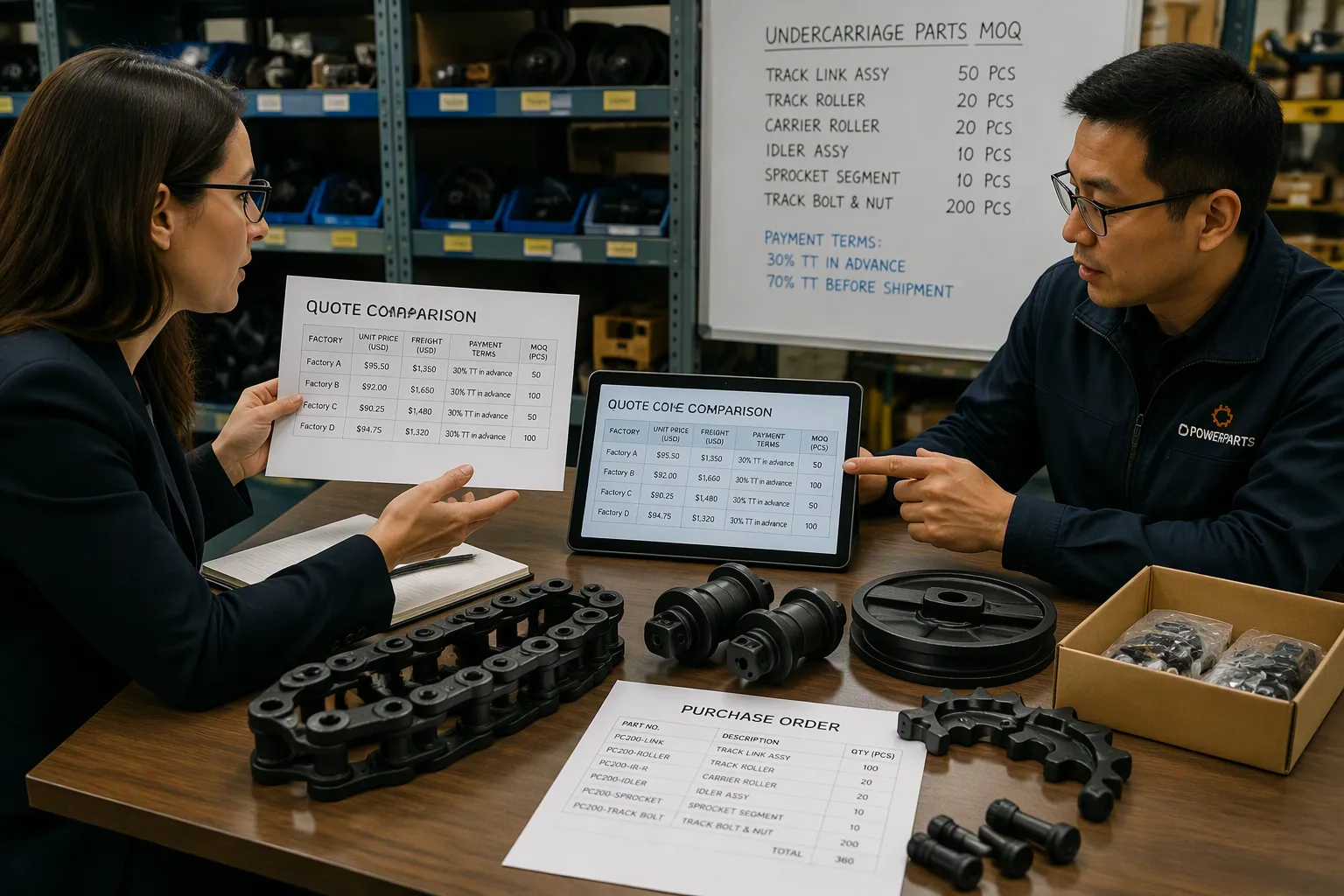
You now have quotes ready for fair comparison. Use them as bargaining power. Be practical and professional. Do not demand one factory match the lowest price. Instead, show you have other good options and want a long-term relationship. This approach can open the door to better terms and lower MOQs.
Use Quote Comparisons and Mixed Orders
Use the normalized quote comparison to ask about a mixed-order option. Confirm whether different part numbers may be combined and whether this changes production, packing or delivery costs. Mixing products may improve purchasing flexibility, but it does not automatically reduce manufacturing setup costs for every component.
Discuss the quantity you realistically expect to use, rather than increasing the order solely to meet a price target. A larger mixed order may support a negotiation, but its effect on price and minimums depends on the factory and product lines. Request the revised terms in writing.
MOQ flexibility is a commercial agreement, not a guarantee.
Clear specifications, predictable order planning and reliable communication may help negotiations. Ask about repeat-order terms and phased deliveries where useful. The factory may still retain its minimums, so assess the actual proposal rather than assuming lower risk always results in a lower price or MOQ.
Samples, Trial Orders, and Payment Terms
Start with samples or a trial order sized to verify the required parts and the order process. Agree on price, inspection criteria, delivery and return terms before payment. Inspect the delivery against the approved requirements and keep photos and records for future comparisons.
Negotiate payment terms alongside inspection, delivery and dispute procedures. Consider the buyer exposure created by advance payments, as well as the supplier requirements. Do not offer a larger deposit solely on an assumed promise of lower MOQs; obtain the complete written agreement and use appropriate professional advice for unfamiliar payment arrangements.
Track quality, delivery performance and stock usage across order cycles. Use that evidence when discussing repeat-order pricing or product-family minimums. OEM, ODM and private-label arrangements may have different specifications, tooling and approval requirements, which should be confirmed separately.
Begin by giving every factory the same part details. Next, compare moq rules, then work out the full delivered cost for each part. Check how reliable each supplier is before you start negotiating. The best deal balances unit price, moq flexibility, part quality, lead time, and order risk. The lowest quote seldom wins by itself.
Ask each factory to confirm per-SKU and mixed-order moqs in writing. Request itemized costs, payment terms, and delivery terms. This step guards your pricing and your stock. Buyers who compare wholesale excavator undercarriage parts this way avoid surprises. The same method works for any excavator undercarriage parts order. Treat every quote as one input, not the final answer. Careful comparison of undercarriage parts and other excavator parts keeps your operation running.
FAQ
How do I know if two quotes cover the same part?
Give every factory the same specification sheet. Include the OEM part number, dimensions, material grade, heat treatment, and hardness requirements. Ask for a drawing and a material certificate. A quote only compares fairly when both factories build to the same drawing and the same quality standard.
What does a per-SKU MOQ mean for my inventory?
A per-SKU moq makes you buy the full minimum for each part number. A mixed-order minimum lets you spread that total across several part numbers. Ask which model applies before you plan stock. Mixed-order terms usually lower your inventory risk and your carrying cost.
Why is the lowest quote often not the best deal?
A low unit price can hide a strict minimum, unclear freight terms, or weak documentation. Add freight, duties, and carrying cost to each quote. Then compare the true cost per part. Quality, lead time, and delivery risk also shape the real value of any excavator parts order.
How do I compare landed cost across factories?
Compare itemized parts prices and all delivery-related charges not already included under the agreed shipping terms. Allocate shared freight and import charges consistently across the order. Estimate storage and other inventory holding costs separately when deciding how much stock to buy.
Can I negotiate a lower MOQ without losing pricing?
You can ask for a mixed-order minimum, trial quantity, phased delivery or repeat-order arrangement. A supplier may accept or decline depending on the parts and production requirements. Compare the complete revised quotation and your inventory needs before committing.
For wholesale excavator parts, consider YNF Machinery. Share your part-number list, machine identification and planned quantities, and request an itemized quotation, applicable minimum order quantities and written delivery and return terms. Confirm any mixed-order arrangement before purchasing.



