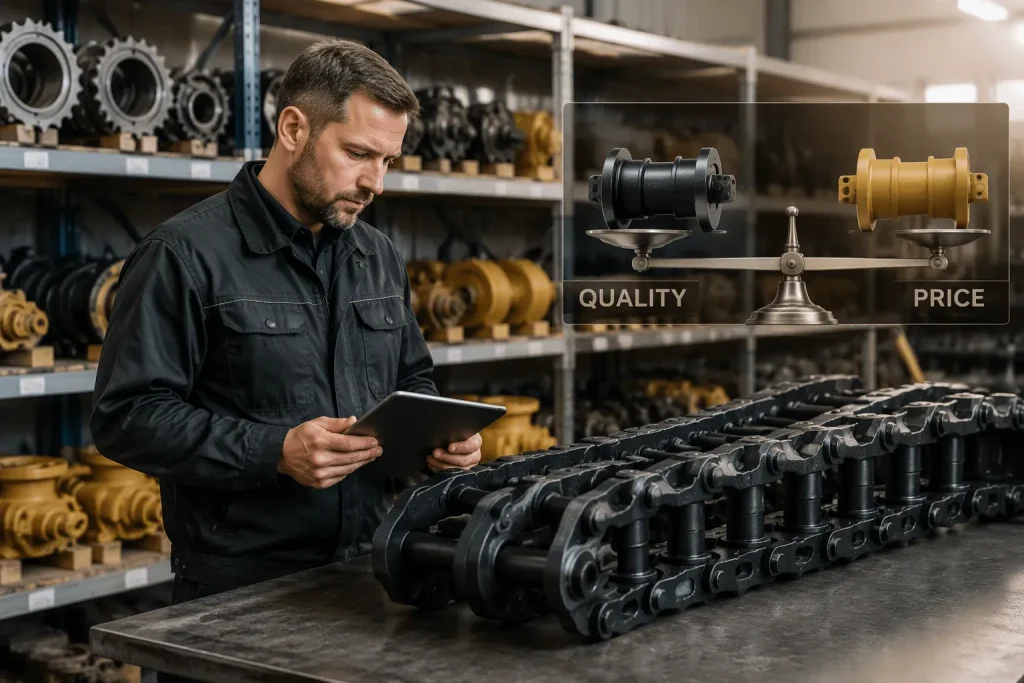
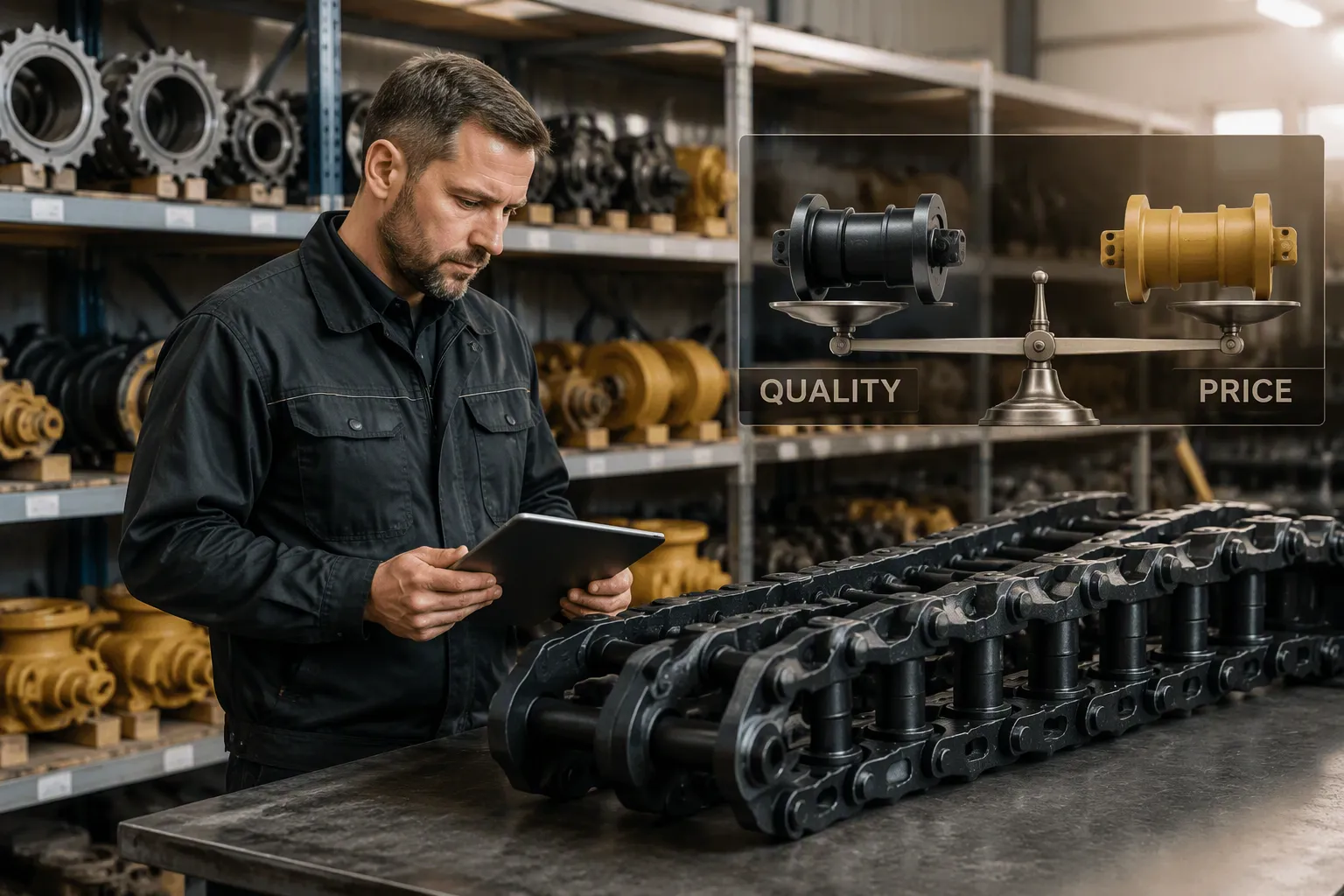
People who buy wholesale excavator undercarriage parts face a common trade-off. They want strong parts at low prices. But a low price often means lower quality. The right choice depends on how often the machine runs, your budget, and how much downtime you can accept. An excavator that runs every day needs different parts than one used once in a while. This article gives a simple way to compare options. It does not give a single best answer for everyone. The worldwide market for undercarriage parts was worth about $7.05 billion in 2025. That number shows how many people face the same choice. Smart buyers think about cost and value, not just price. The goal is to choose parts that are right for the job.
Key Takeaways
Pick parts that match how many hours your excavator runs each year to get the best value.
Compare the full cost, including downtime and repairs, not just the price of the part.
Look at the warranty terms for how long it lasts and what it covers before you pick a supplier.
High-quality replacement parts often equal OEM quality but cost less.
Use cost-per-hour math to find out which parts save money over time.
Quality Factors in Undercarriage Parts
Material and Heat Treatment
High-quality undercarriage parts start with strong steel mixes. These materials can handle tough conditions, heavy loads, and ongoing wear. Makers choose mixes like 42CrMo and 50Mn because they keep their shape under stress. Then the heat treatment decides how well the final part works.
Quenching and tempering is the most common way to treat track rollers. First, the roller is heated to 850–900°C, then quickly cooled in water or oil. This changes the surface into a hard material called martensite and increases hardness. Next, a tempering step at 180–250°C removes internal stress and balances hardness with toughness. With careful heat treatment, surface hardness can reach HRC50 or higher, while the core stays tough to avoid breaking.
Induction hardening is another option for wear-heavy jobs. This method creates a hard outer layer of 58–62 HRC that goes 6–8 mm deep. The inside stays at 30–35 HRC. This two-level hardness resists surface cutting and soaks up impact shocks at the core. Hardening all the way through can make the whole part brittle, so induction hardening usually works better and lasts longer in tough uses.
Poor quality undercarriage parts are a problem for all brands. Low-cost materials and outside suppliers often lead to early breakdowns. YNF Machinery‘s parts go through strict quality checks to meet high standards.
Wear Resistance and Structural Integrity
Wear resistance is what makes premium parts better than budget ones. Several key signs show material quality. A higher durometer rating means the part resists changing shape under weight. Stronger tensile strength means the material bends less and bounces back better. Wear rate, measured in millimeters lost per thousand hours of use, tells how long a part will last. How well the rubber pad sticks to the steel base also matters, tested by shear and peel tests.
Lab tests check these properties. Metallographic analysis confirms the material’s structure. Tensile testing checks its strength. Fatigue testing sees how it holds up under repeated stress. Full dimensional inspection makes sure parts meet the needed specs. The dry sand rubber wheel test (ASTM G65) checks wear resistance of track shoes. Chemical analysis (ASTM E415) finds the material’s makeup. Brinell hardness test (ASTM E10) measures hardness, and Charpy V-notch test (ASTM E23) checks impact toughness.
Comparing materials for performance and reliability shows clear give-and-take. Boron alloy steel with deep induction hardening handles abrasive wear well. Through-hardened or dual-hardness steel with reinforced roller flanges works better for impact wear. Buyers who know these differences can pick quality parts that fit their specific needs.
Sourcing Wholesale Excavator Undercarriage Parts
Supplier Type and Brand Tier
Wholesale vendors let buyers compare prices side by side. They also give expert advice. A good vendor helps a buyer pick the right parts for a certain machine and job. This support matters because the wrong part can fail early. Buyers should ask where the supplier’s factories are and how they check quality. A supplier who answers these questions clearly often sells better quality.
Brand tier affects price and performance. Authorized dealers sell oem excavator parts at a higher price. These parts match the original specs exactly. Aftermarket suppliers sell aftermarket excavator parts for less. Some aftermarket parts meet or beat OEM standards. Others do not. For example, Caterpillar track rollers cost $75–80 per unit from a dealer. A full aftermarket undercarriage set runs around $834.99, and some sellers offer it as low as $799.99. These numbers show the gap between tiers. Buyers who need high quality for daily use may pay more upfront. Buyers with light use can save with a trusted aftermarket source.
Order Volume and Logistics Costs
Order volume changes the total excavator parts cost. Large orders lower the unit price. But they also raise storage and shipping costs. A buyer who orders a full container of undercarriage parts may get a better rate per piece. That same buyer must pay for freight, customs, and warehouse space. Small orders cost more per unit but reduce storage risk. Buyers should figure out the total landed cost, not just the part price.
Logistics adds another layer. Heavy parts like track chains and rollers cost more to ship. Air freight is fast but expensive. Sea freight is slow but cheap for bulk orders. A buyer on a tight schedule may accept higher shipping fees. A buyer with a stocked warehouse can wait for a slower shipment. YNF Machinery offers competitive pricing without compromising quality. The company also keeps low minimum order quantities. This policy helps small buyers stock essential parts without a huge upfront cost.
Aftermarket vs OEM Excavator Parts
OEM vs Aftermarket Analysis
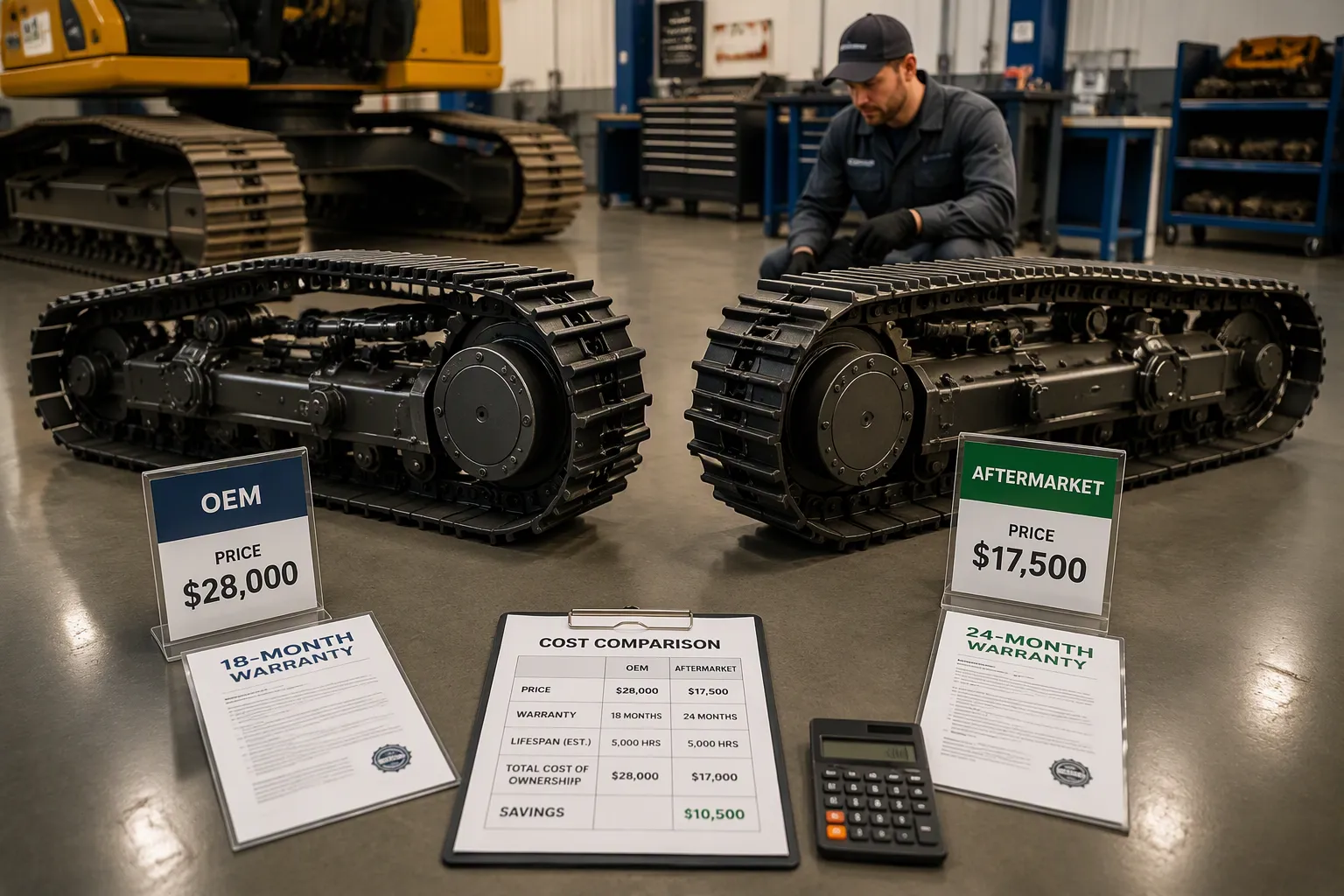
The aftermarket vs oem excavator parts debate comes down to four things. Buyers compare cost, quality, warranty, and return on investment. An oem vs aftermarket analysis helps a buyer see the whole picture. Original equipment manufacturer parts come from the same factory that made the machine. They match the original design exactly. Aftermarket excavator parts come from independent makers. Some follow the same specs. Others do not.
Quality is not the same across the aftermarket. Premium aftermarket excavator parts often use the same steel grades and heat treatment as OEM undercarriage parts. These parts can match OEM performance and reliability. Budget aftermarket excavator parts may use softer steel or skip key hardening steps. A performance and reliability comparison shows this gap clearly. A buyer who picks quality aftermarket parts from a trusted maker gets strong results at a lower price.
A performance comparison also looks at fit and finish. OEM parts always fit the machine they were made for. Aftermarket excavator parts may need small adjustments. A good supplier checks compatibility before shipping. YNF Machinery provides parts for over 26 excavator brands. This range covers most major models on the market. Buyers get compatibility and quality from one source.
Cost and Warranty Differences
Cost is the first thing buyers notice. Non-OEM parts are usually priced 10–20% below CAT values. That gap adds up fast on a full undercarriage rebuild. A 40-ton excavator undercarriage set from OEM costs $28,000 with an 18-month pro-rata warranty. The aftermarket option costs $17,500 with a 24-month straight-line warranty. Over a 5-year lifecycle at 6,000 operating hours, the aftermarket set saves $10,500 upfront and adds 6 months of full coverage. If a track chain fails at 20 months, the OEM pro-rata credit may be only $2,800. The aftermarket warranty replaces the chain at zero cost. That is a big ROI difference for fleets with more than 5 machines.
Warranty coverage tells a buyer a lot about part quality. The table below shows key differences.
Warranty Feature | Typical OEM | Premium Aftermarket |
|---|---|---|
Duration | 12–18 months / 2,000 hours | 24 months / 3,000 hours |
Pro-Rata Start | After 6 months | After 12 months |
Transfer Fee | $150–$300 | $0 (fully transferable) |
Labor Coverage | Sometimes at authorized dealers | Not included, but discounted rates via partner network |
Freight on Approved Claims | Covered | Covered up to $500 sea freight |
Batch Failure Clause | Rare | Included if metallurgical deviation exceeds 8% |
The total excavator parts cost includes more than the sticker price. Downtime, labor, and repeat replacement all add up. A cheap part that fails early costs more than a quality part that lasts. Buyers should compare the full cost over the part’s life. Aftermarket sprockets from a reliable maker often deliver the same service life as OEM at a lower price. The key differences in cost, performance, warranty, and roi favor the aftermarket when quality is equal. Buyers who check warranty terms and supplier reputation make better choices.
ROI for Excavator Undercarriage Replacements
Cost-Per-Hour Analysis
A smart roi calculation begins with cost per hour. This number shows the true value of a part over its life. Fleet managers use a simple formula to find it.
Cost per Hour = (Total Ownership Costs + Total Operating Costs) / Equipment Usage Hours
This cost analysis turns a big purchase into a clear hourly rate. A 13–20 tonne excavator with a purchase price of $150K–$300K often runs at $120–$175 per hour. Fuel and the operator drive most of that cost. The table below shows a full total cost of ownership example for a $300,000 machine over 5,000 hours.
Cost Category | Amount (CAD) |
|---|---|
Purchase price | $300,000 |
Operating costs (fuel, fluids, etc.) | $180,000 |
Maintenance | $75,000 |
Downtime (200 hrs @ $200/hr) | $40,000 |
Depreciation | $100,000 |
Subtotal | $695,000 |
Resale value (after 5 years) | –$120,000 |
Total Cost of Ownership (TCO) | $575,000 |
Cost per hour (5,000 hours) | $115/hr |
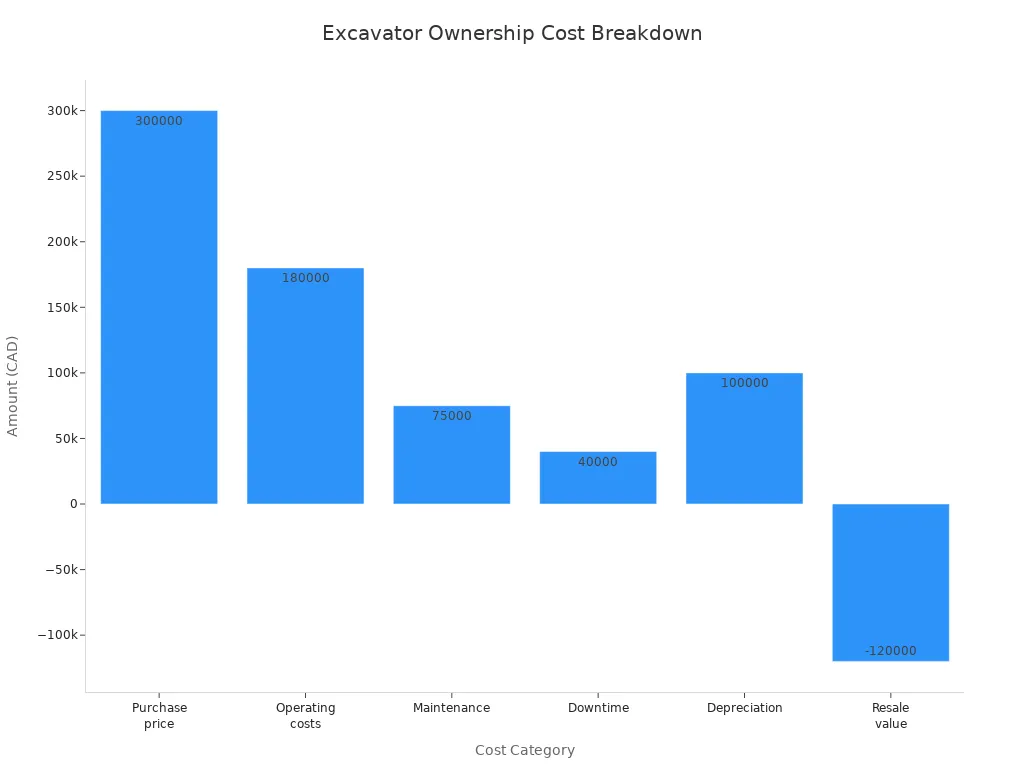
A buyer who compares short-term savings against long-term value sees the full picture. The roi for excavator undercarriage replacements depends on this hourly figure. A cheap part lowers the upfront price. It may raise the hourly cost through early failure.
Hidden Costs of Cheap Parts
Cheap undercarriage parts carry hidden costs. Downtime, premature failure, and repeat labor all add up. A case study from BaodingCM shows a contractor who ignored early wear signs. The result was a $15,000 full undercarriage replacement instead of a $2,500 early-stage fix. That gap shows how small savings create large losses.
Chain lifespan in sandy soil proves the same point. The table below compares grades.
Chain Grade | Lifespan in Sandy Soil (hours) |
|---|---|
OEM / Premium | 2,500 – 3,500 |
Premium Aftermarket | 1,800 – 2,800 (quality dependent) |
Economy / Low-cost Aftermarket | ~1,200 (failure point) |
An economy chain may fail at 1,200 hours. A premium chain lasts more than twice as long. The total lifetime cost of the cheap part is higher once labor and downtime enter the math. The global excavator undercarriage parts market was estimated at USD 7.05 billion in 2025. It should reach USD 7.54 billion in 2026. This growth shows that buyers value quality and machine uptime. A strong return on investment comes from matching part quality to real working conditions. Good undercarriage maintenance protects both the budget and the schedule.
Warranty and Supplier Reputation
Reading Warranty Terms
How long a warranty lasts and what it covers can tell you a lot about part quality. Suppliers who believe in their products offer longer terms with clear rules. A strong warranty connects coverage to real numbers. A track chain has to reach 3,000 hours with 75% pin and bushing wear. A roller has to keep its oil seal working for 2,500 hours under a 20-tonne load. If a part does not meet these standards, the warranty kicks in on its own.
Covered parts deal with specific hidden defects. Track chains cover unusual link cracking and pin failure caused by bad heat treatment. Rollers and idlers cover early flange wear from casting holes and bearing collapse. Sprocket segments cover tooth root fractures that are not caused by impact damage.
Every warranty has things it does not cover. Normal wear is the one exception everywhere. External pin wear, roller tread abrasion, and sprocket tooth polishing are just regular wear and tear. No supplier promises a part will never wear out. They promise it will not fail early because of a manufacturing mistake.
Buyers have to follow the rules for reporting problems. Most warranties require you to contact the supplier within 48 hours of a failure. You also need to send clear photos and keep the broken part for inspection. If you miss these deadlines, a valid claim can be denied.
OEM warranties cover 12 months or 2,000 hours. Premium lines go up to 24 months for large excavators. Aftermarket suppliers offer 6 to 18 months with hour limits from 1,500 to 3,000.
Vetting Suppliers Beyond Price
Price by itself should not decide where you buy. Buyers need to check quality, compatibility, brand reputation, and long-term value. Certifications give you real proof of manufacturing standards.
Certification | Requirement |
|---|---|
ISO 9001 | Documented processes, defect tracking, annual audits |
CE Marking | Safety directive and environmental compliance |
ASTM F3122 | Impact resistance and abrasion testing standards |
ISO 9001 is the starting point. Suppliers who do not meet it have 37% more warranty claims.
Legal problems from unclear contract wording also cause trouble. Most warranty rejections come from fights over “premature failure” versus “normal wear.” Without clear numbers, the buyer has to prove their case. Vague force majeure clauses add more risk. When damage comes from bad sealing rather than a real event, that difference decides if a claim is valid. A buyer in Riyadh lost a container of undercarriage parts when a heatwave cracked rubber seals. The supplier’s contract did not have clear definitions.
Buyers should see total excavator parts cost as more than just the purchase price. Good warranty coverage stops hidden costs from denied claims and early failure. YNF Machinery has served the global market for over 35 years. The company offers full support, including documentation and logistics help.
A Decision Framework for Buyers
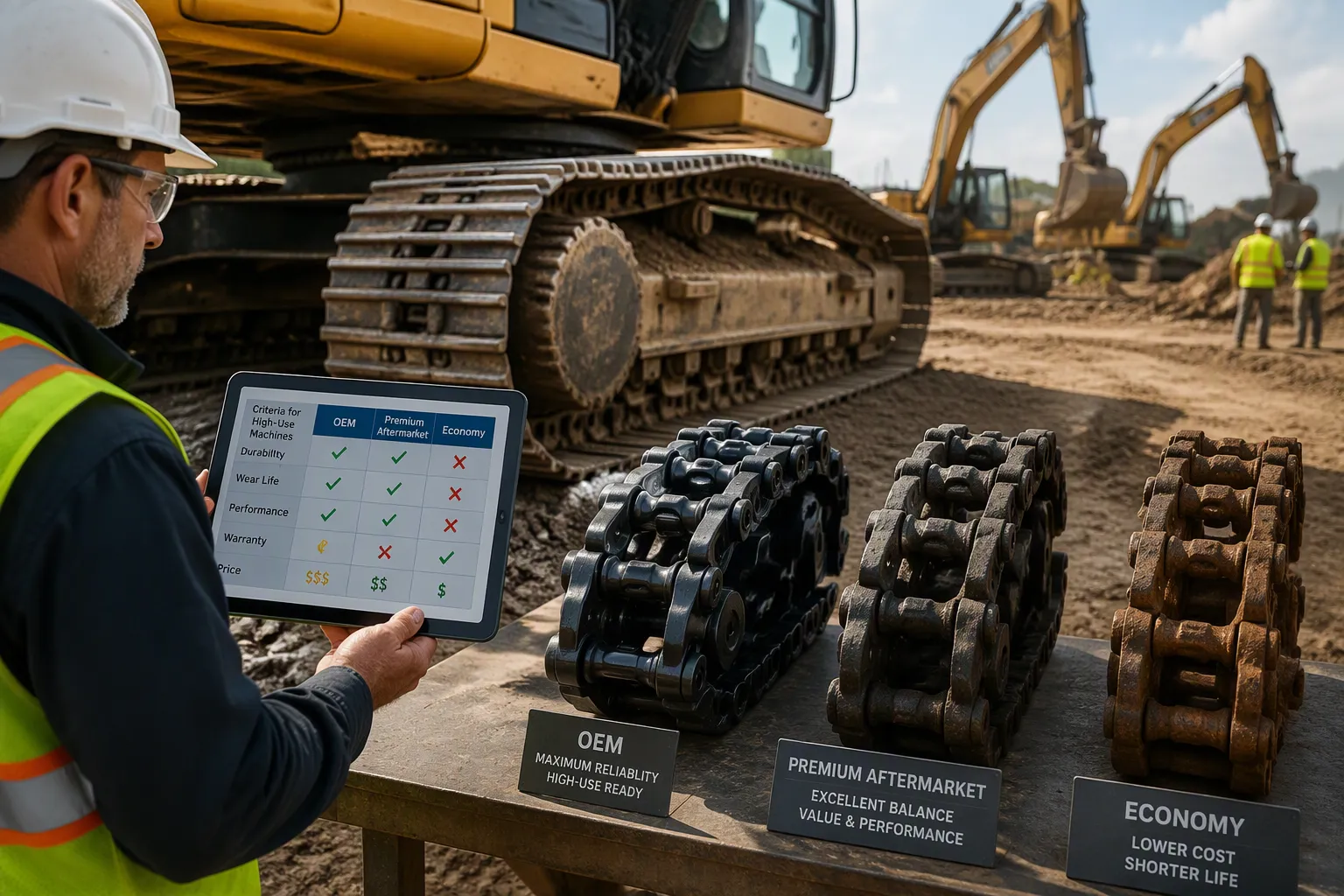
The choice between part tiers comes down to one question: how many hours does the machine work each year? A simple framework helps buyers match undercarriage part quality to real usage. High-use machines that run daily need OEM or premium aftermarket parts. Low-use machines on intermittent projects can accept economy parts with caution. Two real-world examples show how this framework works in practice.
High-Use Machines: OEM or Premium Aftermarket
A production excavator that runs 2,000 hours per year needs reliable parts. Every hour of downtime costs money through lost production and idle labor. Track chains on this machine face constant stress from digging, traveling, and turning. A failure in the middle of a project forces the operator to stop work or rent a replacement machine. Both options raise costs quickly.
For these conditions, buyers should choose high-quality oem excavator parts or premium aftermarket parts. The service lifespan of premium aftermarket parts is nearly identical to genuine parts. The table below shows how the three tiers compare across key metrics.
Attribute | Premium Aftermarket Parts | OEM / Genuine Parts | Low-Quality Aftermarket Parts |
|---|---|---|---|
Service Lifespan | Nearly identical to genuine parts | Longest, fully matches equipment design life | Shorter, prone to rapid wear and precision loss |
Unplanned Downtime Risk | Minimal, consistent performance and high stability | Minimal, ultra-stable with low failure rate | High, frequent sudden failures cause production halts |
Maintenance and Replacement Cost | Low, durable quality reduces maintenance frequency | Low, long replacement cycle and less labor cost | High, frequent replacements increase labor and accessory costs |
Warranty and After-sales Support | Standard formal warranty and mature technical support | Complete official warranty and full after-sales coverage | Limited short-term warranty, no reliable after-sales service |
Overall TCO Level | Best value, lowest comprehensive TCO | Excellent, controllable long-term operating cost | Poor, hidden costs keep rising continuously |
Recommended Use Case | Bulk long-term procurement for construction machinery, fleet maintenance, and routine equipment servicing | Core precision components and safety-critical load-bearing parts | General low-risk wear parts only |
Premium replacement parts offer the best balance for high-use machines. They deliver the same lifespan as OEM parts at a lower upfront cost. The risk of unplanned downtime stays low. Maintenance costs stay predictable. Some fleets standardize on oem excavator parts for consistency across multiple machines. Buyers who order aftermarket excavator parts in bulk get the best value per hour of service. Aftermarket sprockets from a trusted manufacturer match OEM wear rates while costing less. The total cost of ownership stays low because replacement intervals match OEM schedules.
Low-Use Machines: Economy Parts With Caution
An excavator that runs 500 hours per year on intermittent projects faces different demands. The machine may sit idle for weeks between jobs. Idlers on this type of machine experience less wear per year than a production unit sees in a single month. A mid-range idler that lasts 1,500 hours still covers three years of use.
Economy parts can work in these conditions. The buyer must check compatibility and inspect parts on arrival. But economy parts carry real risks. A cheap roller that loses its seal after 500 hours still leaves the machine down for repairs. The cost of that repair can wipe out the savings from the low purchase price. A field replacement adds labor costs and delays the next job.
Buyers who use quality aftermarket parts for low-use machines get better results than those who pick the cheapest option. Oem excavator parts cost more upfront but may last longer than the machine’s remaining service life. The smart approach matches part tier to expected usage. A buyer should ask: will this part outlast the machine’s time in service? If yes, an economy option may work. If the machine might be sold or reassigned to heavier work, premium parts make more sense.
Buyers who rely on aftermarket excavator parts for intermittent use should still verify specifications. Quality aftermarket excavator parts serve both high-use and low-use machines well. The best aftermarket excavator parts come from suppliers who offer clear specifications and reliable support. A final check: does the part type match the machine’s primary job? Track chains on a production site need premium grade. Idlers on an intermittent project can use mid-range parts. The framework helps buyers spend money where it counts and save where it is safe. Quality matters most in high-use environments where every hour counts.
The main choice when buying wholesale excavator undercarriage parts is to match part grade with machine use. Machines that run a lot need top quality to prevent downtime. Machines that run less can sometimes use cheaper parts, but be careful.
Buyers should do three things. Figure out the cost per hour for each option. Check the warranty terms. Pick the part tier that fits the expected yearly hours.
Check these items before ordering:
Part tier matches how much the machine is used
Warranty covers at least 24 months
Total cost (including shipping and fees) fits your budget
Supplier gives clear documents and support
Smart buying looks at value, not just price. YNF Machinery sells wholesale excavator undercarriage parts that balance quality and cost well.
FAQ
How can a buyer tell if wholesale excavator undercarriage parts are high quality?
A buyer should look at the material grade and heat treatment. Surface hardness over HRC50 is a sign of good hardening. A supplier who shares test results and factory details often sells better parts. Quality shows up in clear specs and steady performance.
Are aftermarket undercarriage parts as good as OEM parts?
Premium aftermarket parts often match OEM performance. They use the same steel grades and heat treatment. Budget aftermarket parts may use softer steel. Buyers should compare warranty terms and supplier reputation before they choose.
How many hours should a track chain last?
Lifespan depends on the soil and the part grade. In sandy soil, an OEM or premium chain lasts 2,500 to 3,500 hours. A premium aftermarket chain lasts 1,800 to 2,800 hours. An economy chain may fail near 1,200 hours.
What warranty should a buyer expect on undercarriage parts?
OEM warranties cover 12 to 18 months or 2,000 hours. Premium aftermarket lines offer up to 24 months or 3,000 hours. Buyers should read pro-rata start dates and labor coverage rules. Clear terms show a reliable supplier.
How does a buyer calculate cost per hour for undercarriage parts?
Add total ownership and operating costs, then divide by usage hours. A $300,000 machine over 5,000 hours runs near $115 per hour. This figure shows whether cheap parts save money or raise long-term costs.