
Picking the wrong wholesale excavator parts factory causes downtime, return shipping, repeat labor, and project delays. You need two must-haves: verified part quality and confirmed compatibility with your excavator’s exact model and serial number. This guide gives procurement managers a practical evaluation framework, not a supplier list.
Vet wholesale excavator parts suppliers by reviewing quality documents, checking samples before you buy, checking part numbers, figuring out total landed cost, and negotiating bulk order terms.
Buy wholesale excavator parts only with traceable test results. Pick a bulk excavator parts supplier that confirms fitment by serial number. A dependable excavator parts supplier writes down every claim.
Key Takeaways
Check quality management records, part-specific test reports, and inspected samples.
Check compatibility with your excavator’s model and serial number.
Figure out the full cost to your door, not just the wholesale price.
Check samples and agree on bulk order terms before buying.
Pick suppliers who give written paperwork and help.
Why a Reliable Excavator Parts Supplier Matters
A reliable excavator parts supplier keeps your project on schedule and your budget safe. When you buy wholesale excavator parts from a factory you have not checked, you take on risks that grow with every machine hour. Those risks come in two groups: part quality and part fitment.
Cost of Low-Quality Parts
A low-priced component may become expensive if it wears prematurely or introduces debris into the hydraulic system. The repair can then require flushing, filter changes, and inspection of other components. Compare specifications and test records alongside the price.
OEM, aftermarket, and rebuilt parts can differ in price, materials, manufacturing tolerances, testing, and warranty terms. Price alone does not establish quality. Ask for written specifications and test records so you can compare each option against the same requirements.
Incompatibility and Downtime
An incompatible part stops your machine. A bucket tooth that does not match the adapter, or a seal kit with the wrong dimensions, makes you stop work. Your crew waits. Your project schedule slips. You then pay for rework and rush shipping.
Compatibility depends on more than the machine model. Serial number breaks matter. A part that fits an early production unit may not fit a later one from the same model line. A careful bulk excavator parts supplier checks the oem part number against your exact machine. That step stops costly guesswork.
Downtime can cost more than the replacement part itself. Lost production, idle labor, equipment rental, and project overhead can continue while a machine is unavailable. Include these costs when comparing a repair plan and the delivery time for replacement parts.
How to Check a Wholesale Excavator Parts Factory
Checking a supplier starts with proof, not promises. You need to see how a wholesale excavator parts factory controls quality at every step. Ask clear questions and make them give you written answers.
Certifications and Testing
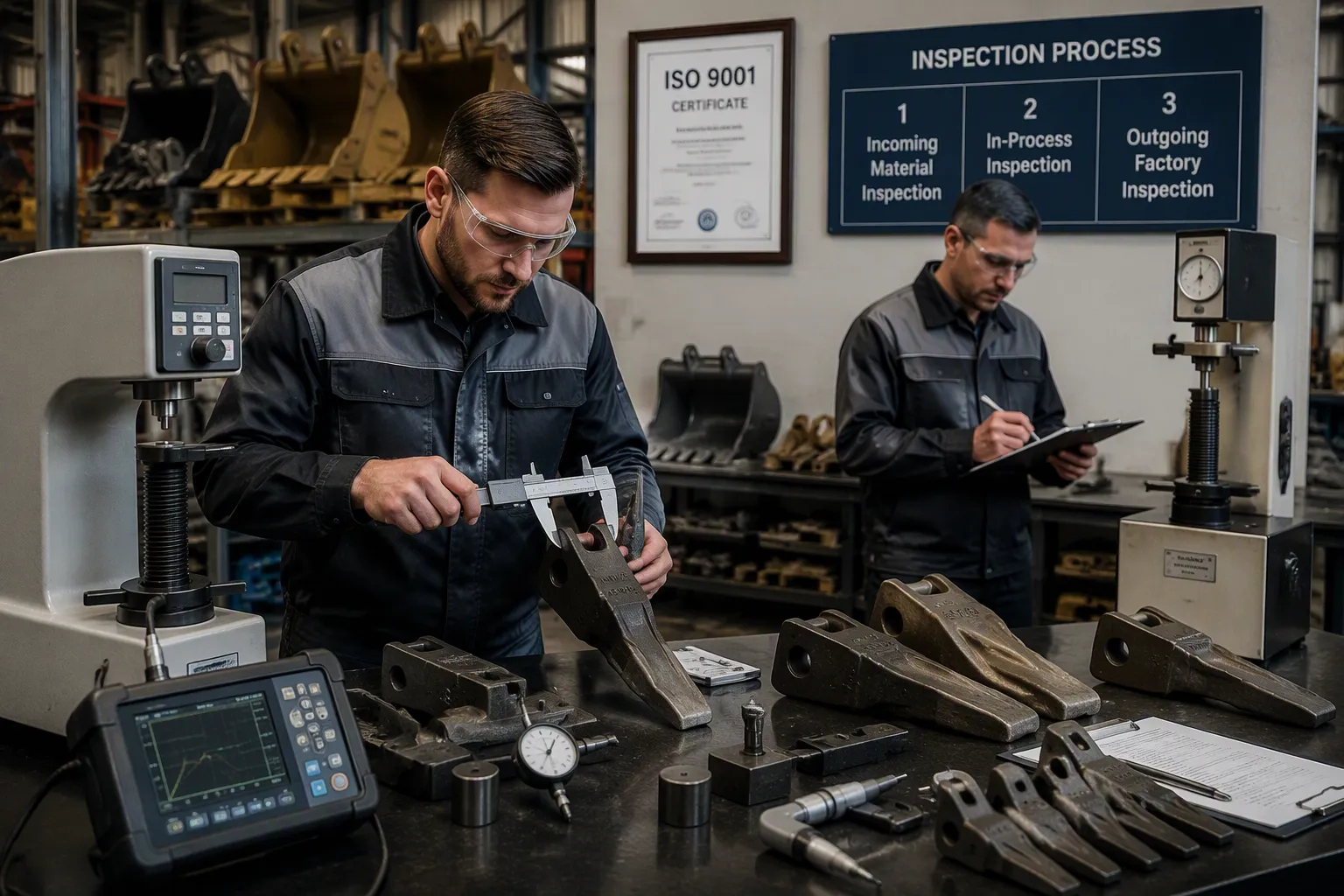
ISO 9001 concerns a quality management system; it does not certify an individual replacement part or prove that it fits your machine. If a factory claims certification, verify the certificate, its validity, the covered facility, and its scope. Evaluate the actual parts separately through specifications, test reports, and sample inspection.
A strong quality control system checks at three points. Incoming material inspection (IQC) makes sure raw materials meet standards before production starts. In-process inspection (IPQC) watches dimensional accuracy, surface quality, and mechanical properties while parts are being made. Outgoing factory inspection (OQC) confirms finished parts meet dimensional, surface, and mechanical standards. Ask for records from all three points.
For wear parts, request material and heat-treatment records, hardness test results, and dimensional inspection reports appropriate to the component. Hardness alone does not establish service life: toughness, geometry, material quality, and operating conditions also matter. Agree on the required specifications and test method before ordering. Measure critical dimensions such as pin diameter, bore size, and mounting interfaces against the approved drawing or OEM requirements.
Documentation and Sample Inspection
Before agreeing to a large order, request a document package matched to the components being purchased. This may include material traceability, dimensional inspection records, and relevant test reports. For pumps, request applicable pressure and flow test results; for wear components, request the specified material and hardness records. If independent inspection is needed, agree on the inspection scope and acceptance criteria. Do not treat a general certificate as a substitute for part-specific evidence.
Write down specifications before you order. Record grade, hardness with measurement position, case depth with core hardness, and seal type. Note dimensions and tolerances against nominal values so parts stay interchangeable. Agree on marking and packaging for batch identification. Make clear who inspects, against what standard, and whether a sample is measured before shipment.
Sample inspection catches problems early. For hydraulic seals, confirm the material, dimensions, fluid compatibility, temperature range, and pressure requirements against the machine service information. Check for damage, incorrect profiles, and poor storage. For cylinders, verify mounting dimensions, bore, rod, stroke, ports, and operating specifications. Use the exact component drawing and service manual rather than assuming a general dimensional standard proves interchangeability.
A dependable wholesale excavator parts factory also keeps a large, varied on-hand inventory across many brands and machine sizes. That stock depth supports faster fulfillment and shows the factory serves more than one model line. Use a supplier evaluation checklist to score each candidate on certifications, test reports, sample results, and inventory breadth. This way of sourcing quality excavator parts protects your schedule and your budget.
Finding a Trusted Bulk Excavator Parts Supplier
Finding a trusted bulk excavator parts supplier begins with two checking habits: looking at the machine model and serial number, and matching part numbers. These steps keep you from ordering wholesale excavator parts that seem right but fail when installed.
Model and Serial Number Checks
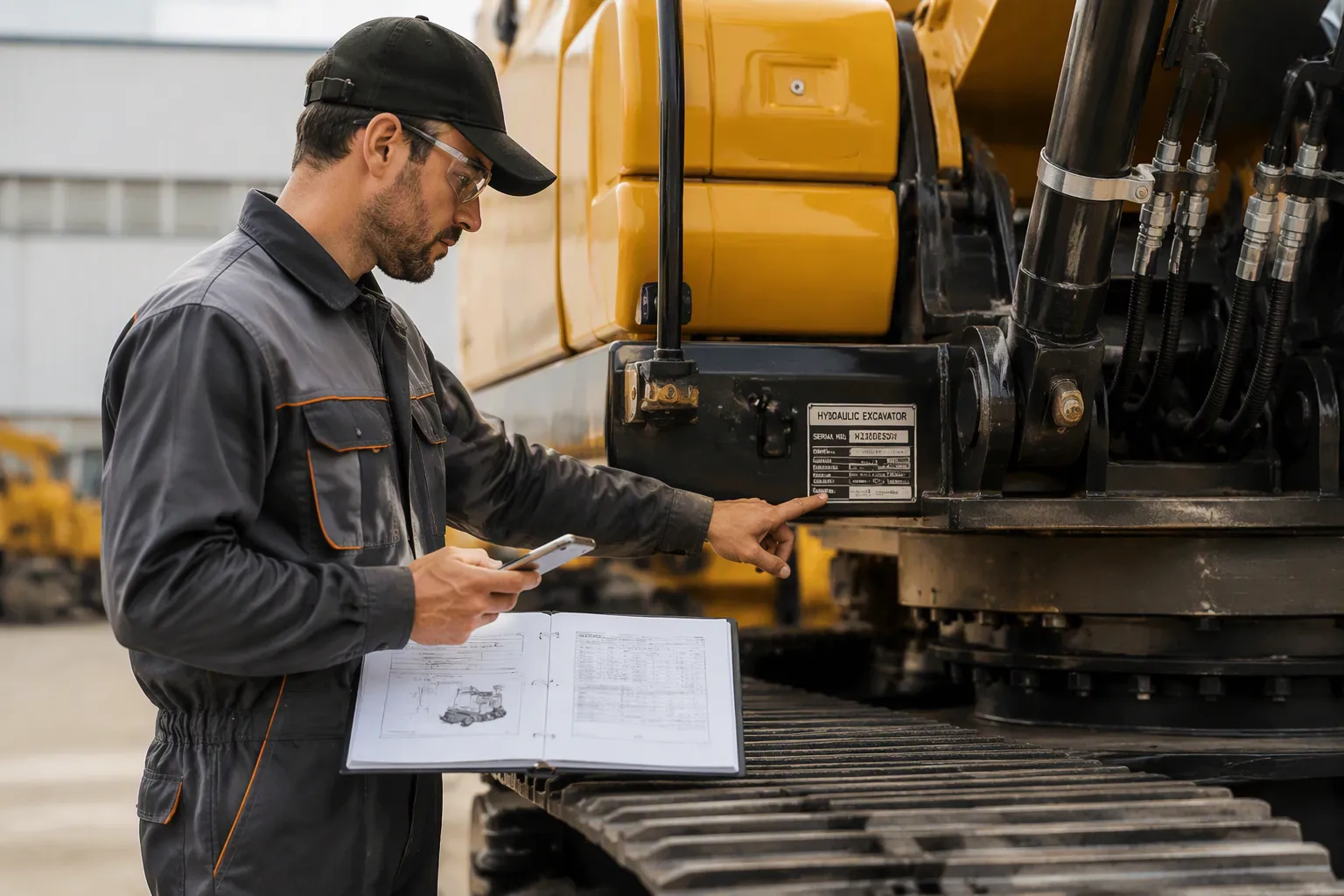
Check the machine model and serial number before each order. Consult the operator or service manual to locate the identification plate; its position varies by manufacturer and model. Record every letter, number, and suffix, and take a clear photo. Where relevant, also record the engine or component identification number. Similar model names can have different hydraulic systems or regional configurations.
A serial-number break is a point in a model’s production timeline where a part’s design, supplier, or setup changed. You cannot depend only on the general production range. Match the machine’s exact serial number to the breakpoints in the parts catalog or technical bulletin. For example, a model prefix can split parts coverage at a defined serial breakpoint. Missing a break can lead to parts that do not fit right, more wear, and downtime. For hydraulic parts like control valves, pumps, and cylinders, the wrong side of a break can affect seals, fittings, mounting, pressure ratings, flow features, and safety factors.
Match the serial number first when picking compact excavator parts. Without checking the exact serial range, an aftermarket part for a Caterpillar or Komatsu excavator may fall outside the right compatibility window.
Part Number Cross-Referencing
Cross-reference the OEM part number against the exact machine model, serial range, and component revision. Equipment brands such as Caterpillar, Komatsu, Hitachi, Volvo, Kobelco, Doosan, Hyundai, and Kubota identify the machine application; they do not establish compatibility by themselves. Ask the parts supplier to document the part-number match before you order.
Manufacturing quality and compatibility are separate checks. Appropriate materials, machining, and heat treatment help a component meet its specification, but they do not make it fit every excavator. Confirm the mounting interfaces, dimensions, ports, electrical connections, and operating requirements that apply to the specific part.
For older or used equipment, confirm parts availability and the identity of any previously replaced components before ordering. Compare the installed part with the service information and approved replacement number. Record any modifications, damage, or uncertain identification, and ask the supplier to resolve discrepancies in writing. Check the supplied part again before installation.
Request a written compatibility confirmation that connects your model and serial number with the proposed replacement part number. Keep the supporting drawing, dimensions, and any supersession information with the purchase record. A manufacturer, distributor, or local supplier should be evaluated using the same documented requirements.
How to Find Reliable Bulk Excavator Parts Suppliers
Finding good wholesale excavator parts suppliers needs a clear plan. You need a compatibility checklist and a clear view of total landed cost before you commit to any bulk order.
Checklists and Landed Cost
Build a pre-purchase checklist for each order. Confirm the machine identification, OEM part number, component revision, and critical dimensions. Review the condition, return terms, warranty coverage, and relevant inspection records. Evaluate customer references and delivery history. Use parts diagrams to resolve differences within a model series, and inspect the systems directly affected by the replacement part.
Checklist Area | What to Check |
|---|---|
Part number | Match with the machine manual and existing part |
Machine identification | Confirm make, model, and serial number |
Supplier policies | Review return rules, warranty, certificates, photos |
Reputation | Evaluate customer references and documented delivery history |
Diagrams and manuals | Check size, shape, fit, and part changes |
Condition and safety | Inspect the replacement part and the affected machine systems |
For a U.S. buyer, compare the complete delivered cost: the quoted parts price, packaging or origin charges not included in the quote, freight, insurance, applicable import duties and fees, customs brokerage, and domestic delivery. Add inspection and potential return costs where relevant. Confirm the agreed shipping terms and avoid counting charges twice. Ask a customs broker to confirm the classification, origin, customs value, and applicable charges for the actual shipment; total delivered cost is not the same as customs value
Bulk Order Terms and Delivery
Negotiate payment terms carefully. Move from full advance payment to payment terms that let you check goods before payment once you build a track record. Require pre-production samples with defined OEM requirements like marking, packaging, and part numbers. Approve a sample before mass production. Require third-party inspection before shipment using statistically significant sampling. Check dimensions, hardness, and surface finish. Define defects clearly and agree how to replace them. Require batch-specific certification for traceability.
Follow delivery check steps when your shipment arrives. Note the cargo number, arrival date, part specs, quantity, and outer packaging status. Check the anti-rust coating, packaging integrity, and any shipping damage. Put received parts into your ERP or WMS system with barcode or RFID scanning. Take photos of bad or doubtful parts. Do a final appearance check before outbound dispatch.
Compare candidates using written evidence of compatibility, quality control, delivery capability, and after-sales procedures. A clear quotation and a responsive contact are useful, but neither replaces sample inspection or documented acceptance criteria. Apply the same checklist to every candidate.
Check every wholesale excavator parts factory for documented quality, verified compatibility, and total landed cost. A reliable excavator parts supplier gives traceable documents. Sample checks catch defects. Serial number checks make part number matching accurate. Delivery checks confirm your order.
Compare candidates on documented quality, confirmed fitment, complete quotations, and agreed delivery terms. Keep the evidence with the order so receiving staff and technicians can verify the supplied parts.
Resolve unclear specifications before placing the order.
Use these checks to make a documented purchasing decision before committing to a bulk order.
FAQ
How do I confirm a part will fit my excavator before ordering?
Consult the machine manual to locate the identification plate, then confirm that the proposed part number matches your exact model and serial range. Review parts diagrams, dimensions, and the installed component. Keep the written compatibility confirmation with the purchase record.
Why does total landed cost matter more than wholesale price?
The delivered cost includes the parts price and the shipping, insurance, import charges, brokerage, and domestic delivery costs that apply to the actual order. A low unit price can be offset by other charges or costly returns. Confirm the shipping terms and compare complete quotations.
What quality documents should a wholesale excavator parts factory provide?
Request documents relevant to the part, such as material traceability, dimensional inspection records, and applicable test results. If the factory claims ISO 9001 certification, verify its scope and validity. Certification of a quality management system does not replace inspection of the actual parts.
What should I inspect when a bulk parts order arrives?
Check cargo number, arrival date, part specs, quantity, and packaging. Look for anti-rust coating and shipping damage. Take photos of any unclear parts. Log the goods in your ERP or WMS before dispatch. Run compatibility checks again at arrival.
How do serial number breaks change compatibility?
A serial number break shows a design change during production. Parts for an early unit may not fit a later one. Match your exact serial number to the breakpoints in the parts catalog before ordering.
For your next excavator parts order, consider YNF Machinery. Share your machine model, serial number, and part numbers, and request compatibility confirmation and relevant quality documents. Start with a sample order before committing to a larger purchase.



