
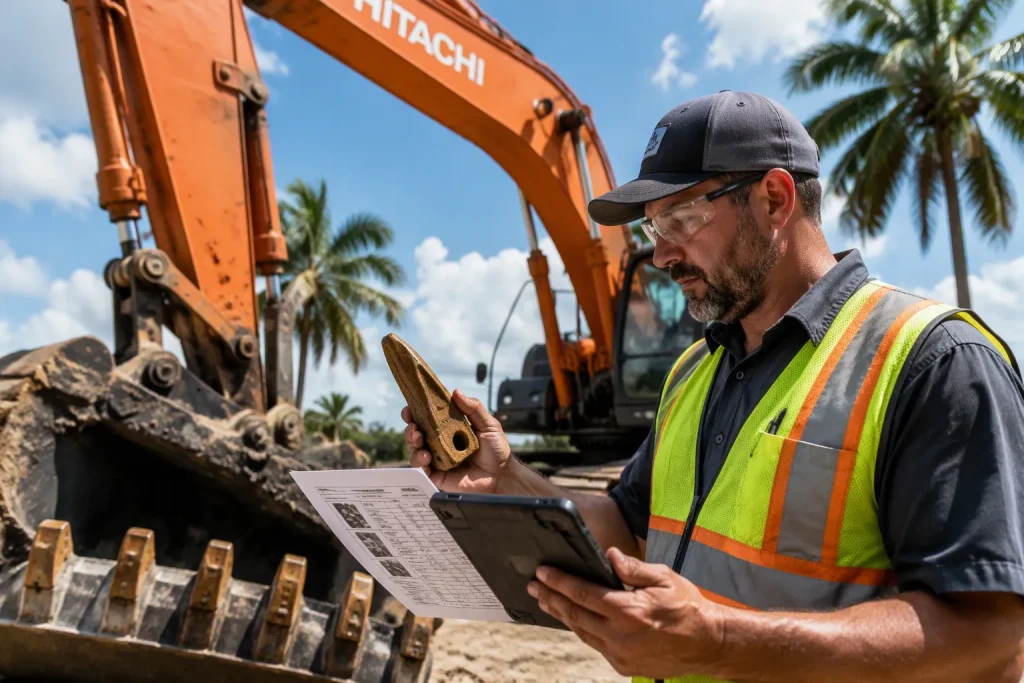
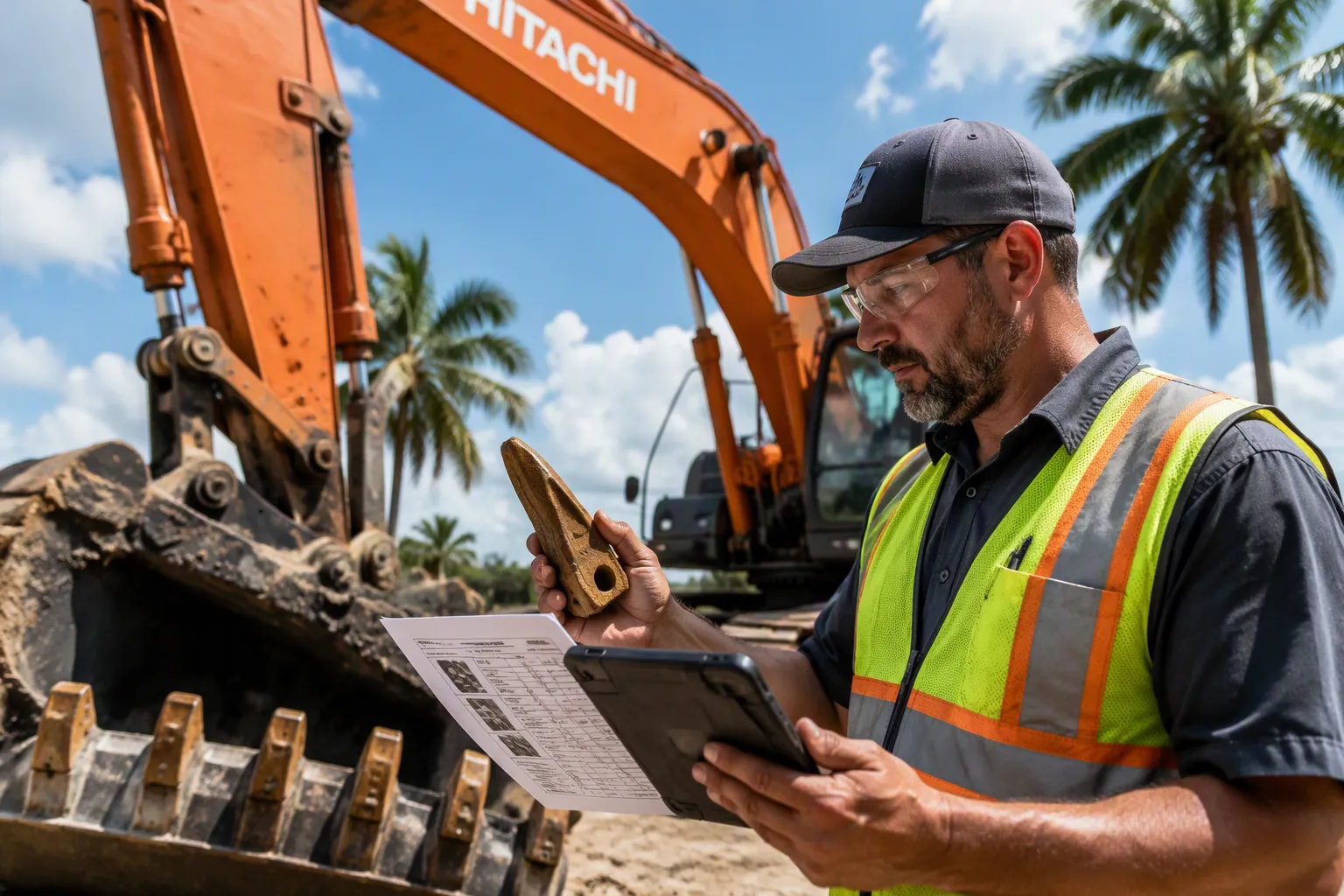
Before buying Hitachi excavator parts for delivery to Florida, confirm machine identification, the applicable part number, dimensional and functional specifications, and the seller’s written order terms. This guide provides a checklist for evaluating compatibility and purchasing arrangements without assuming that a model listing or supplier guarantee resolves every fitment question.
Key Takeaways
Know your machine’s exact model, serial number, and PIN to get the correct part.
Use official Hitachi diagrams to find the right OEM part numbers.
Compare relevant dimensions with the applicable specification, accounting for wear and approved replacement changes.
Ask the seller for written proof that the part fits your machine.
Evaluate corrosion protection and connector sealing against the machine specification and actual operating environment.
Know Your Exact Hitachi Excavator
Fitment starts with knowing your machine. You cannot match excavator parts using just a model name. Hitachi makes many setups under the same series. You need the exact machine details before you order anything.
Locate Model, Serial, and PIN
Use the model’s operator or service documentation to locate the identification plate. Record the full model, serial number and product identification number where applicable. Photograph the plate and resolve unclear characters before ordering.
The PIN tells a parts supplier more than the model name does. Two Hitachi excavators with the same model number can leave the factory with different parts. Production year changes often bring updated pumps, valves, and electronics. A part that fits a machine from one year may not fit the same model from another year. Always give the full PIN when you ask for a quote.
Note Hydraulic System and Attachment Configuration
Record relevant boom, stick, cab and hydraulic configuration details. For pumps, valves or other assemblies, include their own identification and specifications. Verify these details against the applicable documentation rather than inferring the hydraulic design from the model name.
Attachments add another layer. A breaker, thumb, or quick coupler changes the replacement parts you need. Heavy machinery dealers and aftermarket suppliers both depend on this data. Check your machine’s build sheet or call a dealer with your PIN. Confirm the hydraulic system type and every attachment before you buy. This step keeps you from ordering a part that looks right but will not work on your excavator.
Use Official Hitachi Parts Diagrams
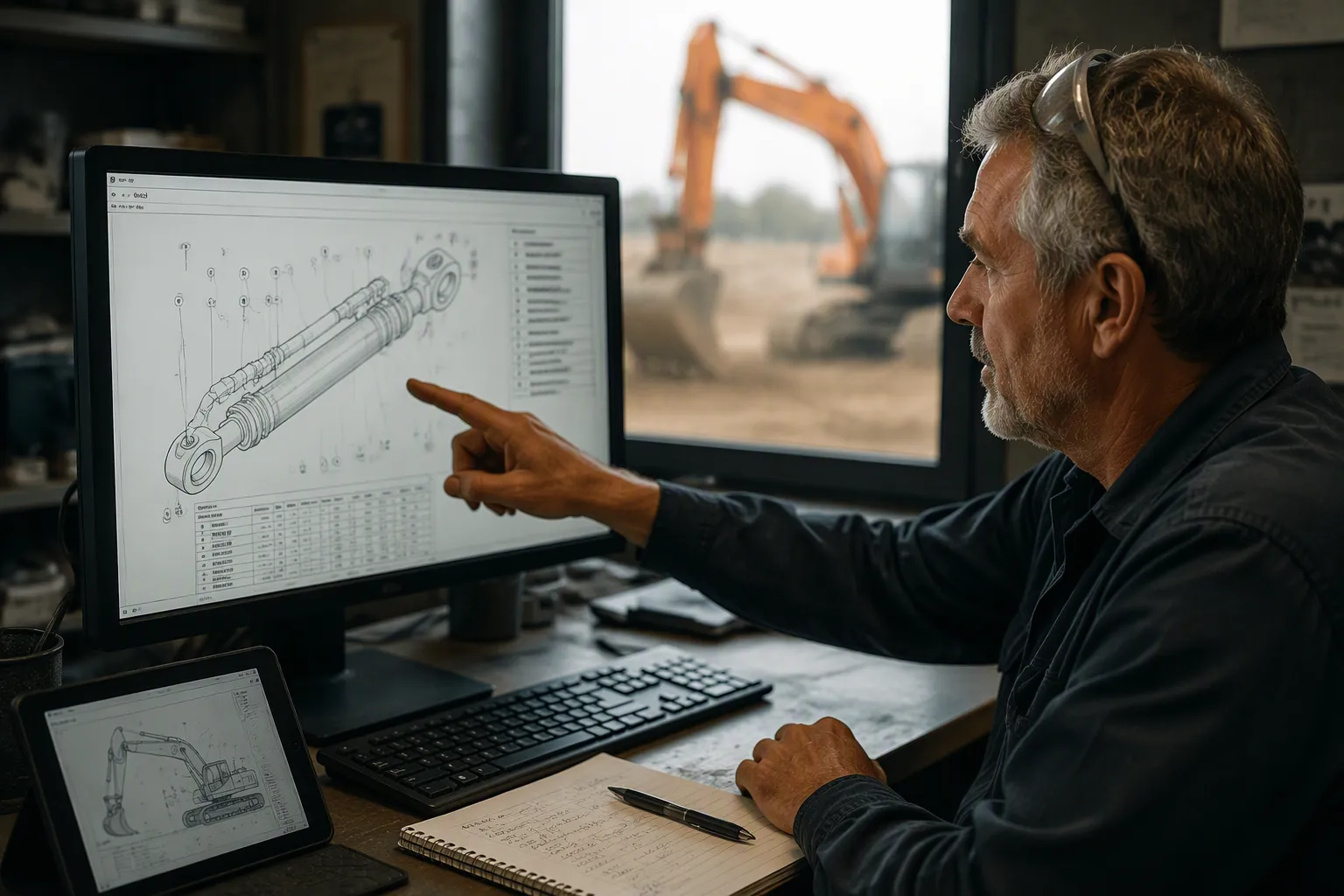
After you write down your machine’s PIN, look at the official Hitachi catalog. This catalog shows every part for each excavator model. It gives you the exact numbers you need. Check the catalog before you look at aftermarket choices. The official diagram stops guessing and shows which excavator parts match your serial number.
Find Diagrams With Your Serial Number
Use the catalog or identification service that supports the exact machine and serial range. Access and lookup functions vary; if the correct diagram is unavailable, seek qualified identification help.
Distinguish diagram reference positions from actual part numbers. Confirm the applicable catalog page and serial range. Support and digital coverage for older models vary, so check what is available for the particular machine.
Copy OEM Part Numbers and Superseded Numbers
Write down the OEM part number exactly as it looks. Include every suffix letter and digit. A missing suffix can point to the wrong part. For example, a hose assembly with a different suffix may have another fitting angle. Copy the number twice and take a photo of the screen. You will compare this number with aftermarket listings later. Each excavator uses its own set of numbers.
Check current supersession information and any substitution instructions. A replacement number may require related components or installation changes. Confirm the approved application before accepting a substituted part.
Record alternative numbers only when their relationship and applicability are verified. Multiple numbers on a catalog page are not automatically interchangeable.
Check Part Numbers Against the Old Part
The old part on your excavator is your best guide. Check it before you buy. Grease may hide stamped numbers. Clean it. Look for marks on the housing or tag. Take photos of the mounting face, connectors, and label.
Check the Old Part Before Ordering
Compare relevant mounting and interface dimensions with the applicable specification. Account for wear on the old part and any approved design changes. Dimensional similarity alone does not establish material or functional suitability.
A casting mark may identify a housing or unfinished casting rather than the complete assembly. Use component tags, applicable part records and the catalog together. Investigate discrepancies and preserve the old unit until identification and any core-return requirements are resolved.
Compare Aftermarket Numbers with OEM Equivalents
Match the aftermarket listing with your OEM number. Sellers add cross-reference numbers for a reason. A cross-reference number is useful only when it matches your OEM equivalent or the superseded number. Check each number against your list. Ignore any listing that claims fit without a specific number. Vague fit claims cause most ordering mistakes with heavy machinery and excavators.
Request a supported cross-reference to the applicable original or approved replacement number. Matching a listing number is one check, not proof of complete compatibility. Confirm configuration, dimensions and functional specifications where needed.
If multiple reference numbers are listed, ask the seller to explain each one’s applicability and any supersession conditions. Keep that explanation with the order record.
Confirm Excavator Parts Fitment by Measurement
Check Bolt Patterns, Pin Diameters, and Shaft Lengths
Numbers on a screen only help so much. Use a tape measure or caliper to check the real size yourself. Measure the mounting holes, bore sizes, pin diameters, and shaft lengths on the old part and the new one. Write down each measurement. Put the numbers side by side and compare them. A mounting flange with the wrong bolt spacing will not bolt up, even if the listing says it will.
Just looking at a part can fool you. Two pins may seem the same until you measure them. A shaft can look the right length until you place it next to the original. Measuring is the last check before you pay. This step matters most for undercarriage parts, where track links, rollers, and idlers must match your excavator’s exact size. A caliper gives you a trustworthy reading on pin diameter and bore size. Use one whenever you can.
Verify Hydraulic Ports, Threads, and Fitting Angles
Identify hydraulic connections using the specified thread standard, diameter, pitch, sealing geometry and fitting orientation. Threads may use metric pitch or threads per inch. Similar-looking connections can have different seals. Have qualified personnel verify uncertain interfaces and follow the service procedure before disconnecting any hydraulic line.
For electrical parts, verify the exact connector, keying, pin assignment, voltage and functional specification as applicable. Shape and pin count alone do not establish compatibility. Confirm the relevant sealing requirements.
Plan for Florida Heat, Humidity and Coastal Exposure
Check Corrosion Coatings and Seals for Florida Conditions
Consider the actual site’s humidity, dust and coastal exposure while retaining the machine’s specified materials, sealing and corrosion protection. Do not substitute a different seal or sealed-bearing arrangement simply because it appears more protective.
Coastal salt exposure can increase corrosion risk. Request applicable coating information and follow the machine’s cleaning and maintenance procedures. A stronger steel grade or extra coating is not automatically an approved substitute.
Follow the machine’s specified operating-temperature limits, fluid requirements and cooling-system maintenance. Confirm the replacement meets the required specification rather than assuming a separate Florida-only part is necessary.
Confirm Electrical Sealing and Environmental Ratings
Verify connector sealing and any applicable environmental rating against the original specification. Protect connections during handling and installation. A similar connector shape does not prove correct electrical function or water resistance.
Assess the actual exposure to rain, washdown and wet ground, and follow the equipment’s operating and maintenance limits. Ask for relevant component specifications instead of assuming water resistance.
A sealed component does not authorize machine immersion or saltwater operation. Follow the exact machine’s permitted working conditions and protect electrical and mechanical systems from exposure beyond their ratings.
Ask for Fitment Proof Before You Buy
You have the numbers and measurements. Now you need proof from the seller. A listing can look correct and still send the wrong part. Ask for evidence before you send payment. This step protects your money and your excavator.
Request Photos, Written Confirmation, and Quote Details
Ask the seller for clear photos of the actual part. The photos must show the label and the part number. A stock photo does not prove anything. You need to see the real item that will ship to you. Ask for shots of every angle, including the mounting surface and any connectors. Look for the OEM number in the photo. Compare it with the number you wrote down from the official diagram. If the seller cannot provide photos, treat that as a warning sign.
Request written compatibility confirmation identifying the machine and offered part. Keep it with the quotation and agreed return terms. A written record helps document the agreement but does not replace technical verification or guarantee a particular remedy.
Review the quote details with care. The quote should list the part number, quantity, and total price. Check that the number on the quote matches the number on the part. Ask about core charges if you buy a remanufactured part. Confirm what is included in the price. Some quotes leave out freight or handling fees. You want the full cost before you commit. A clear quote stops surprise charges later.
Confirm Guarantees, Exchange Policies, and Return Windows
Ask about the fitment guarantee before you pay. A fitment guarantee means the seller stands behind the claim that the part fits your machine. Get the terms in writing. Find out what happens if the part does not fit. Does the seller offer a refund or an exchange? Who pays for return freight? These details matter when you buy excavator parts for heavy machinery.
Confirm the return window. Ask how many days you have to return the part. Check whether the window starts from the ship date or the delivery date. A short window may not give you enough time to install and test the part. Ask if the part must be unused and in original packaging. Some sellers charge a restocking fee. Find out the fee before you buy. A clear return policy protects you from a non-returnable mistake.
Get the exchange policy in writing too. If the part does not fit, you may need a different size or a superseded number. Ask how the seller handles exchanges. Find out if they cover shipping for the replacement. Confirm the lead time for the new part. You do not want to wait weeks for a replacement while your excavator sits idle. A good exchange policy keeps your machine running.
Do not send payment until you have these answers. A seller who avoids these questions may not support you after the sale. A seller who answers clearly earns your business. This step applies to every excavator part you buy, from a small seal to a final drive. Protect your investment with written proof. Your excavator depends on the right part, and you deserve a supplier who stands behind the fit.
Where to Buy Hitachi Excavator Parts in Florida
You have three main ways to buy Hitachi excavator parts in Florida. Each one balances cost against certainty. Compare them before you spend your money.
Compare Authorized Dealers, Aftermarket, and Remanufactured Parts
An authorized dealer can help identify and source genuine parts for supported applications. Confirm the applicable part number, provenance, actual price, availability and written coverage. Genuine-part status does not eliminate fitment checks.
Compare aftermarket and remanufactured options using actual quotations, condition, rebuild scope, test evidence and coverage. No universal percentage saving applies. Confirm the supported cross-reference and functional requirements.
Online retailers and auction listings vary in price, information and inspection opportunities. Verify the actual seller and offered component using the same checklist. A low price is useful only when compatibility and purchasing terms are acceptable.
Ask About Delivery, Return Terms, and Technical Support
Shipping changes your real cost. Ask each seller for a shipping quote to your Florida address. Confirm the delivery time before you pay. A part that takes three weeks may cost more in downtime than the money you saved. Compare total delivered cost, not just the sticker price.
Get the return window and exchange policy in writing. Ask who pays return shipping if the item is wrong or damaged. Ask if the seller charges a restocking fee. Get fitment guarantee terms before you pay.
Ask what technical support is available for identification, specifications and installation questions. Evaluate the substance of the answers and the agreed support process rather than treating one response as proof of future service.
Inspect Used Excavator Parts With Extra Care
A used excavator part can save you money. But a used excavator can hide serious problems. Treat every used heavy machinery component as unproven until you check its history. Use the same fitment standards as new equipment. Ask for the original machine’s data when you buy a used excavator part. A used excavator failure costs you more than the savings. Verify every number before payment.
Ask for Wear History and Pressure Test Records
Request available operating and maintenance history, noting that machine hours may not equal component hours. For hydraulic components, ask for relevant inspection and performance-test records, including the test conditions. Missing records increase uncertainty, and neither history nor one test guarantees remaining service life.
Look for Cracks, Rewelds, and Sanded Part Numbers
Fitment comes down to a simple checklist. Know your exact machine, use official part numbers, compare measurements, check Florida conditions, get written proof, choose a reliable supplier, and inspect used excavator parts with care. A part you cannot return is costly no matter how low the price looks. That cost hits twice: you pay for the wrong item and lose working hours. A low price means nothing when the part sits on a shelf. You cannot install a part that does not match your machine. In Florida, the cheapest part is still expensive if it does not fit. Check fitment first, buy with confidence, and keep your Hitachi excavator working.
FAQ
Here are common fitment questions with clear answers to protect your purchase.
What Happens If I Order With Only the Model Name?
The model name alone can’t tell you your exact machine. Two excavators with the same model may use different parts. Give the seller your full PIN and serial number. This prevents ordering the wrong part.
Can I Trust Aftermarket Cross-Reference Numbers?
Cross-reference numbers work only if they match your OEM or superseded number. Check each listing number with the official diagram. If a seller can’t give the matching OEM number, that is a warning. Vague fit claims mean keep looking.
How Do I Measure Hydraulic Ports and Fittings?
Identify the specified thread standard, diameter, pitch and sealing geometry, then verify fitting orientation and hose-routing requirements. Metric pitch and threads per inch are different measurements. Have qualified personnel resolve uncertain connections and follow the service procedure.
Does a Verbal Fitment Promise Protect Me?
Ask for written compatibility confirmation with machine identification, part details and the agreed remedy for a mismatch. Keep the record with the order terms. It supports clear documentation but does not replace verification or guarantee a refund.
What Extra Checks Matter for Used Parts?
Request available component history and relevant inspection or test reports. Evaluate damage, repairs, identification, compatibility and actual condition. Matching part numbers alone does not establish the remaining life of a used component.
For Hitachi excavator parts sourcing, consider YNF Machinery. Provide full machine identification, component details and applicable part numbers, and request compatibility confirmation, specifications, a delivered quotation to your Florida address and written return and warranty terms before purchasing.



