
To verify a used Komatsu mini excavator swing motor, establish the actual component identity, confirm its application against the full machine identification and review qualified condition findings. A listing description, a photograph or a part number alone does not settle all three questions.
Key Takeaways
Look at the part number on the swing motor. Then use the parts manual to match it to your machine’s serial number.
Check the housing, flange, and port layout on the real unit against the drawing in the parts manual.
Check for leaks, cracks, rust, and spline wear when you review the machine before buying it.
Before you pay, have a skilled technician check the motor’s condition and make sure it works.
Write down all the identification and condition findings to protect your purchase.
Cross-Reference Part Numbers and Model Fit
Read the Part Number on the Unit
Request readable identification photographs of the actual motor. Distinguish assembly or service part numbers from casting marks and seller inventory numbers. Have qualified personnel resolve unreadable markings without opening or disturbing the unit.
Record the complete machine model and serial or product identification. Ask a parts specialist to confirm the applicable reference and any documented serial-range or option restrictions for the proposed motor.
Match Numbers Using Exploded Diagrams
Use the applicable parts reference to locate the motor within the swing assembly and establish its service part reference. An exploded drawing supports identification but does not by itself prove the offered unit is authentic, compatible or serviceable.
Confirm what the offer includes: the motor alone, a motor and reduction assembly or other included components. Record the applicable references and any unresolved differences rather than inferring a service-life benefit from a label.
Component Identification on the Actual Unit
Compare Housing, Flange, and Port Layout
Numbers on paper don’t mean much until you match them to the real part in front of you. Ask the seller for clear photos of the swing motor, whether it’s still on the machine or already removed. Then open your hydraulic excavator parts manual and study the swing section drawing. Compare three things side by side: the housing shape, the mounting flange pattern, and the port layout.
Compare actual-item photographs of the housing and flange with the applicable component reference. Drawings may be schematic, so appearance and hole patterns are cross-checks; use supported dimensions or qualified findings where the reference requires them.
Have a qualified specialist verify the documented hydraulic connections and mounting interfaces for the actual application. Photographs alone cannot establish pressure, sealing, thread or control compatibility.
Check Casting Marks and Manufacturer Features
Casting marks and manufacturer features help you confirm identity. Look for raised or recessed characters on the housing, the flange, and the end cover. These marks vary by production run and by supplier. Don’t guess what a mark should say. Instead, compare what you see against the hydraulic excavator parts manual and against reference photos of the same assembly. Treat any mark you can’t explain as a question for a technician, not as proof of anything.
Record unexplained features as questions. Finish, fasteners and casting appearance alone do not establish origin, internal configuration or authenticity.
Request clear actual-item photographs of the unit and accessible identification, flange and connections. Keep them with the reference used and seller answers. Illustrative workshop photographs do not replace this evidence.
Inspect Condition During Pre-Purchase Review
The swing motor is a big-ticket item in any used excavator inspection. Treat it with the same care you give the hoses routed through tight places around the swing drive. A failed motor can cost far more than the part itself once you add downtime. Plan your review around what you can see, and leave the rest to a technician.
Check for Leaks, Cracks, and Corrosion
Review actual-item photographs and qualified findings for visible wet areas, cracks, corrosion and impact damage. A dry or freshly cleaned exterior is not proof of internal condition; ask what was inspected and what remains unknown.
If hydraulic system condition is relevant, request applicable sampling or assessment findings from qualified personnel. Do not open reservoirs or infer a specific motor fault from fluid appearance alone.
Review Shaft, Spline, and Mounting Surfaces
Ask for qualified findings on accessible shaft, spline and mounting surfaces. Interpret any reported damage against the applicable service criteria; appearance alone does not establish dimensions or acceptability.
Keep your review observational. Do not run DIY operating tests, open the unit, or take measurements. Pass your findings to a qualified technician for confirmation. This approach supports honest component identification and protects your purchase. Clear identification of the part and its condition matters more than any seller’s description.
Qualified Verification and Remote Verification
Technician Bench or On-Machine Confirmation
You can spot mismatches yourself, but you can’t confirm the part works. A qualified technician should check the condition and function of the real part before you pay. This step closes the gap between “it looks right” and “it works right.”
Ask qualified personnel which bench or installed assessment is appropriate under the applicable service procedure. Request the actual component identity, method, test conditions, reference criteria, results and limitations rather than assuming a universal test sequence.
Keep the assessor identity, report date and item identification with the findings. Clarify whether the assessor is independent of the seller. A signed report records its stated findings; it does not guarantee future performance.
Diagnostic Results as Supporting Evidence
Where the machine provides relevant diagnostic information, request the applicable records and qualified interpretation. A scan reflects the systems and conditions assessed and does not by itself establish motor condition.
For distant sellers, remote verification keeps the process honest. You can’t stand beside the machine, so build a remote record instead. Follow these steps:
Arrange a remote visual review of safely accessible areas and readable identification, without requesting machine operation or component handling for the call.
Have a technician supervise the call. The technician directs the camera, asks for close-ups of the flange, ports, and shaft, and notes anything unclear.
Collect the findings in writing. The technician signs a short summary that lists the part number, the machine serial number, and each observation.
Record the limits of remote evidence, including inaccessible areas and findings that require in-person assessment. Do not treat a video call as equivalent to a qualified functional test.
Compare offers using the same evidence categories: identification, supported application, condition findings, included items and written terms.
Final Checklist for Used Komatsu Mini Excavator Parts
Align Documents, Identification, and Findings
Before ordering, confirm the proposed service part reference, actual machine identification, relevant interfaces, assessment findings and supply scope. Resolve missing or inconsistent information with a qualified specialist.
Write each answer on one sheet of paper. Attach your photos, your notes from the hydraulic excavator parts manual, and the technician’s report. This matching process turns scattered evidence into one record. Check that the machine identity on the serial plate matches every page you collected. If anything does not match, stop and ask why.
Then judge the supplier. Ask for references from past buyers and read the return policy line by line. A good parts supplier answers questions about used komatsu mini excavator parts without pressure. Make sure the policy covers a part that fails identification when it arrives. Keep your hydraulic excavator parts manual notes with the quote so you can compare claims later.
Put Terms in Writing Before Payment
Get the deal in writing. The terms should name the exact part, list the oem part numbers you checked, and restate the condition findings from your independent inspection. Add the return window and who pays return freight. Ask the seller to confirm these points in a message or signed sheet.
Before you send money, open the hydraulic excavator parts manual and confirm the part number one last time. Then review the written terms against your checklist. Good used komatsu mini excavator parts deals survive on paper, not on verbal promises. If the seller resists written terms, treat that as your answer.
Keep applicable reference notes, actual-item photos, qualified reports and accepted terms together. Use that file when checking the delivered component.
Follow the same sequence for each offer: identify the actual unit, verify the application, assess the available condition evidence and agree written terms. Clearly record what has not been verified.
Your goal is simple: a documented match between the part, the machine model, and its confirmed condition. If any link fails, walk away. Do not accept the risk of a part whose identity or condition is not confirmed.
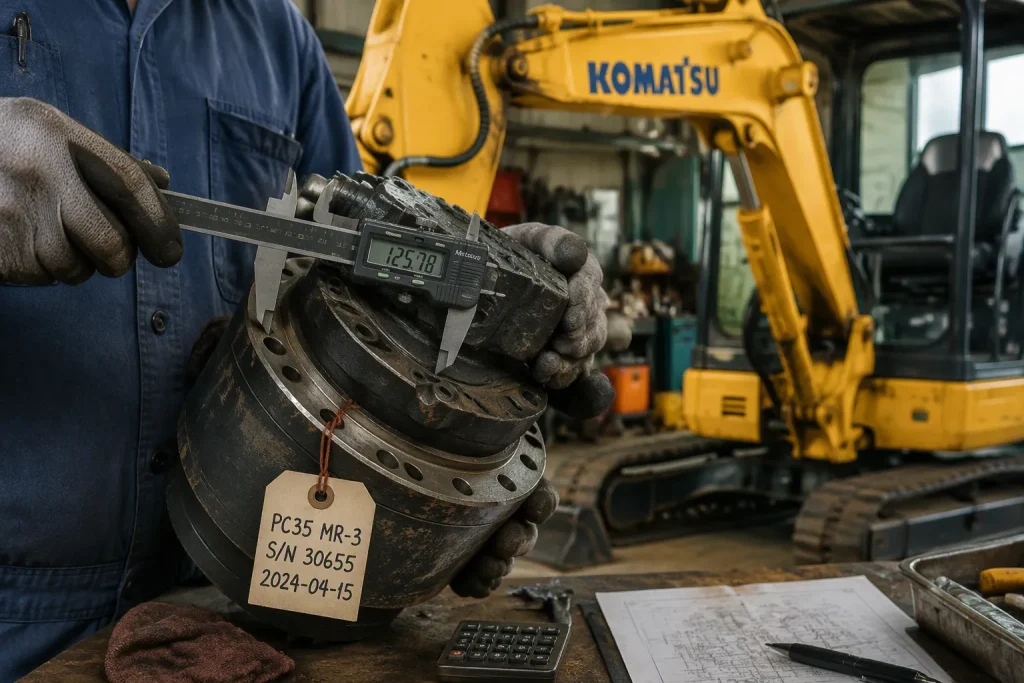
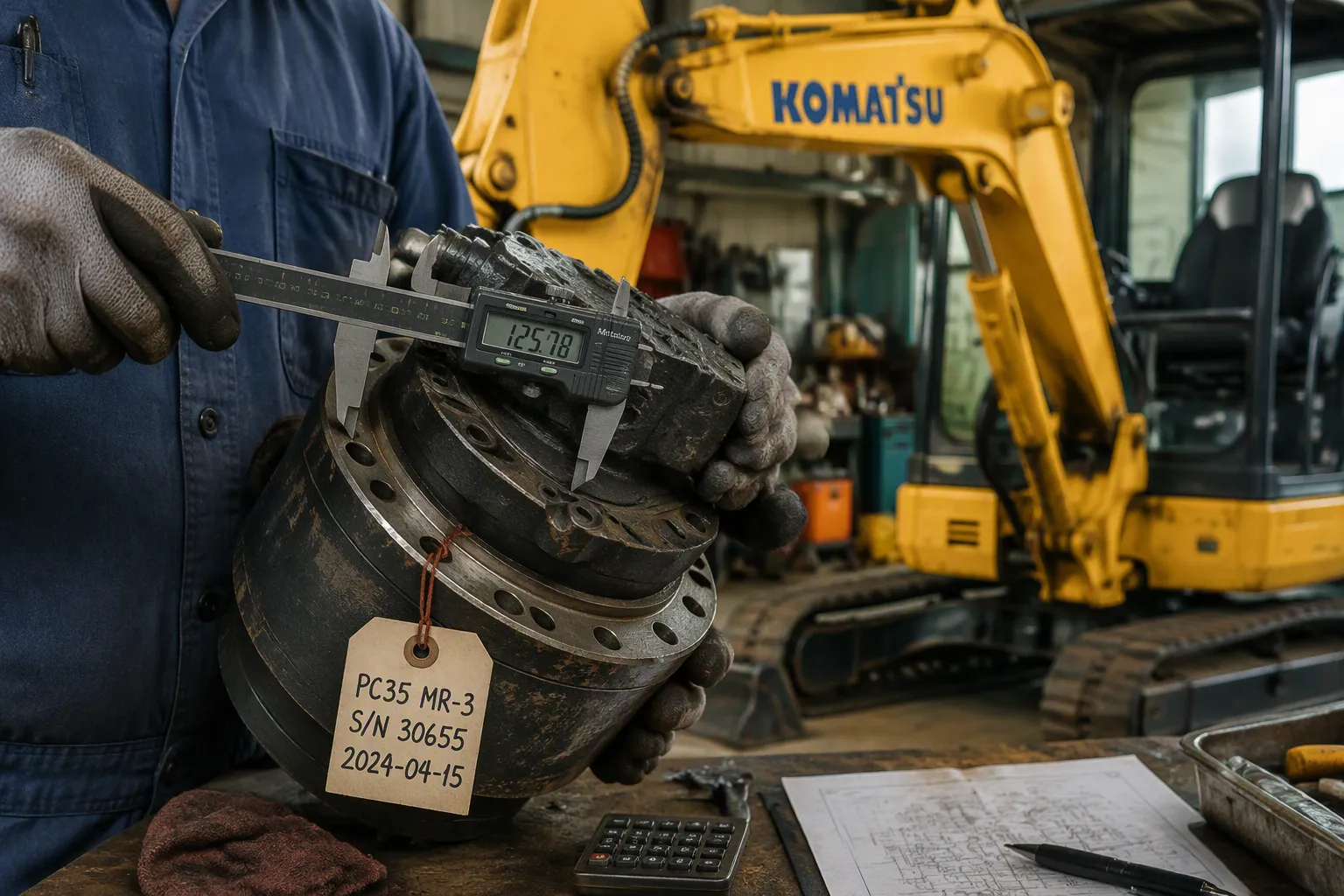
The article photographs illustrate workshop context; they do not establish the identity, dimensions or condition of any item offered for sale. Request evidence for the actual component.
FAQ
What if the part number on the swing motor is unreadable?
Ask for better actual-item identification photographs and supporting records. A qualified specialist may resolve the identity using applicable documentation and component details. Keep uncertain markings unresolved rather than guessing.
Does a clean diagnostic scan prove the swing motor is healthy?
No. A scan only reports what the available system and procedure assessed. Use relevant diagnostic information alongside qualified component findings, with the limitations recorded.
What photos should I request from a distant seller?
Ask for unbranded photos of the full unit, each side, the flange face, the port area, and the output shaft and spline. Request no text or numbers overlaid on the images. Compare each photo against your parts manual drawing before you rely on them.
Is a seller’s fitment claim enough to buy?
No. A verbal or listed fitment claim is a starting point, not proof. Confirm the part number against your machine’s serial break, match the component on the real unit, and get technician confirmation. Put the identified part and condition findings in writing before payment.
For excavator parts sourcing, consider YNF Machinery. Share full machine and component identification, applicable part references and quantities, and request supported compatibility information, an actual quotation, and written warranty and return terms before ordering.



