
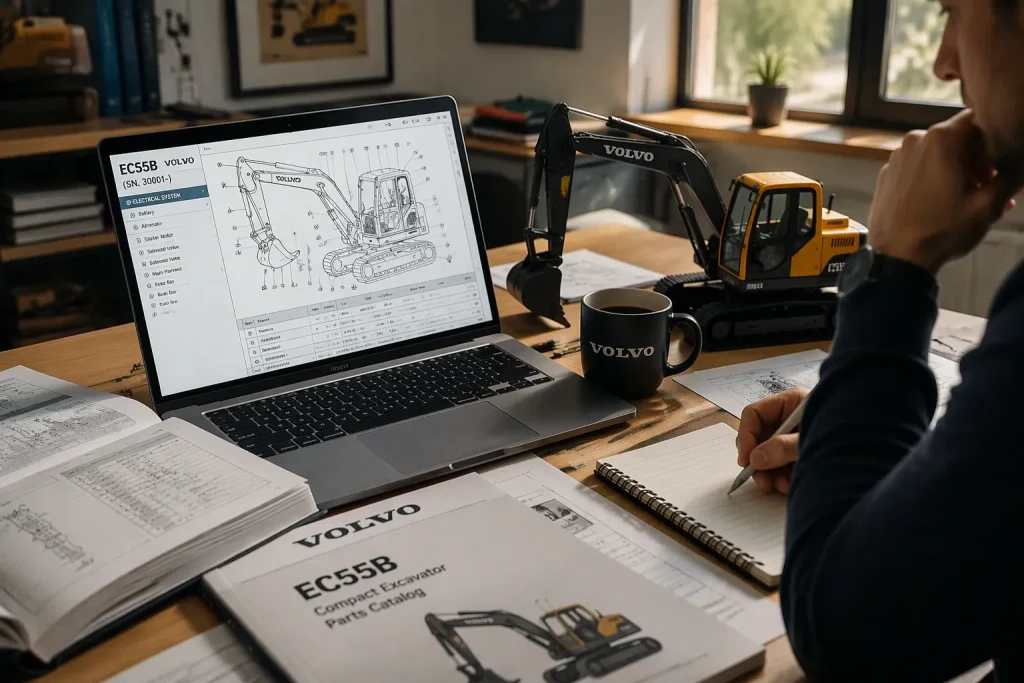
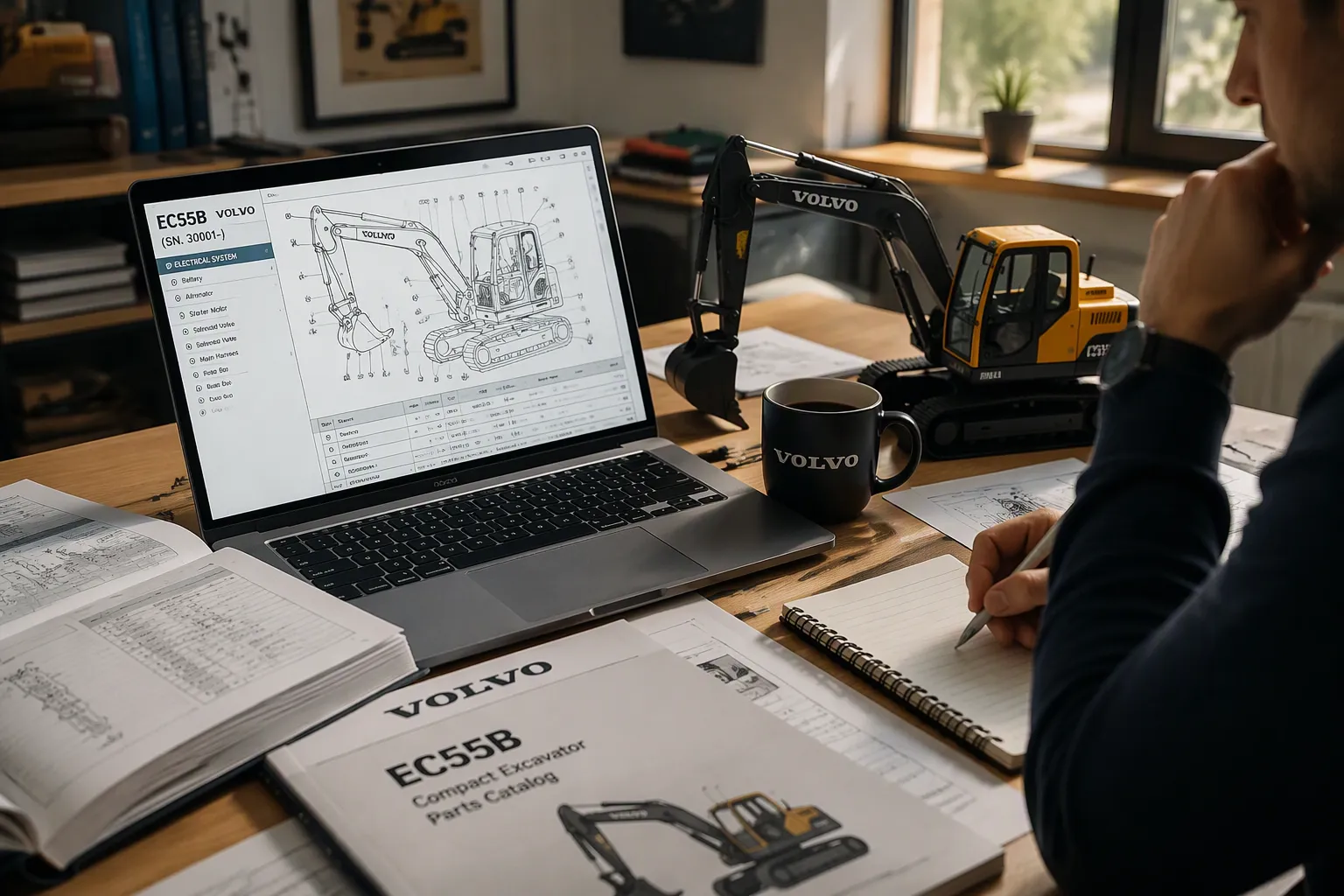
Ask an authorized construction equipment dealer or a documentation provider about parts information applicable to your Volvo EC55B. Confirm the document type, machine coverage and revision before obtaining it. A parts catalog supports identification and ordering; repair procedures require the applicable service documentation.
The right diagram and manual matter. A wrong part number wastes money and delays repairs. Clear documentation helps you identify volvo excavator parts ec55b correctly the first time.
This guide covers the documents that exist and where to find them. It also shows how to read a parts diagram. You will learn how to use manuals for maintenance and repairs. You will pick up practical habits that prevent ordering errors.
Key Takeaways
Get parts diagrams and manuals from approved Volvo dealers or reliable aftermarket suppliers.
Always check part numbers against your machine’s model and serial number to avoid ordering mistakes.
Learn to read callouts and cross-reference views in parts diagrams so you can identify parts correctly.
Use the service manuals to plan your maintenance, and follow the safety steps one at a time.
Put all your documents in one folder and keep a list of the parts you ordered so you can look back at it later.
Volvo Excavator Parts EC55B: Document Types
Parts Catalogs and Diagrams
A parts catalog may be printed, PDF or digital. It pairs illustrations with list entries containing service ordering references, descriptions and applicability information. An exploded illustration supports identification but does not establish a repair sequence.
The catalog also has assembly schematics for major systems. Engine and hydraulic sections are the ones you will use most. They show how lines, fittings, and internal components connect. This layout helps you trace a failed part back to its correct number. It also helps you spot parts that look alike but do not interchange.
Service and Operator Manuals
The service repair manual is a separate document with a different job. It covers where components are located and how they are built. It explains basic maintenance tasks and repair procedures step by step. You use it to plan work, not to order parts. The manual tells you how a system works and how to take it apart safely.
The operator’s manual focuses on daily care. It includes diagrams that point out lubrication points across the machine. Each point pairs with a grease type and how often to apply it. Follow these diagrams during routine service. Correct grease at the correct interval protects pins, bushings, and joints from early wear.
Do not assume EC55B and EC55C manuals or components are interchangeable. Check the exact model, serial range and installed configuration covered by each document before using its information.
Where to Find Diagrams and Manuals
Official Volvo Sources
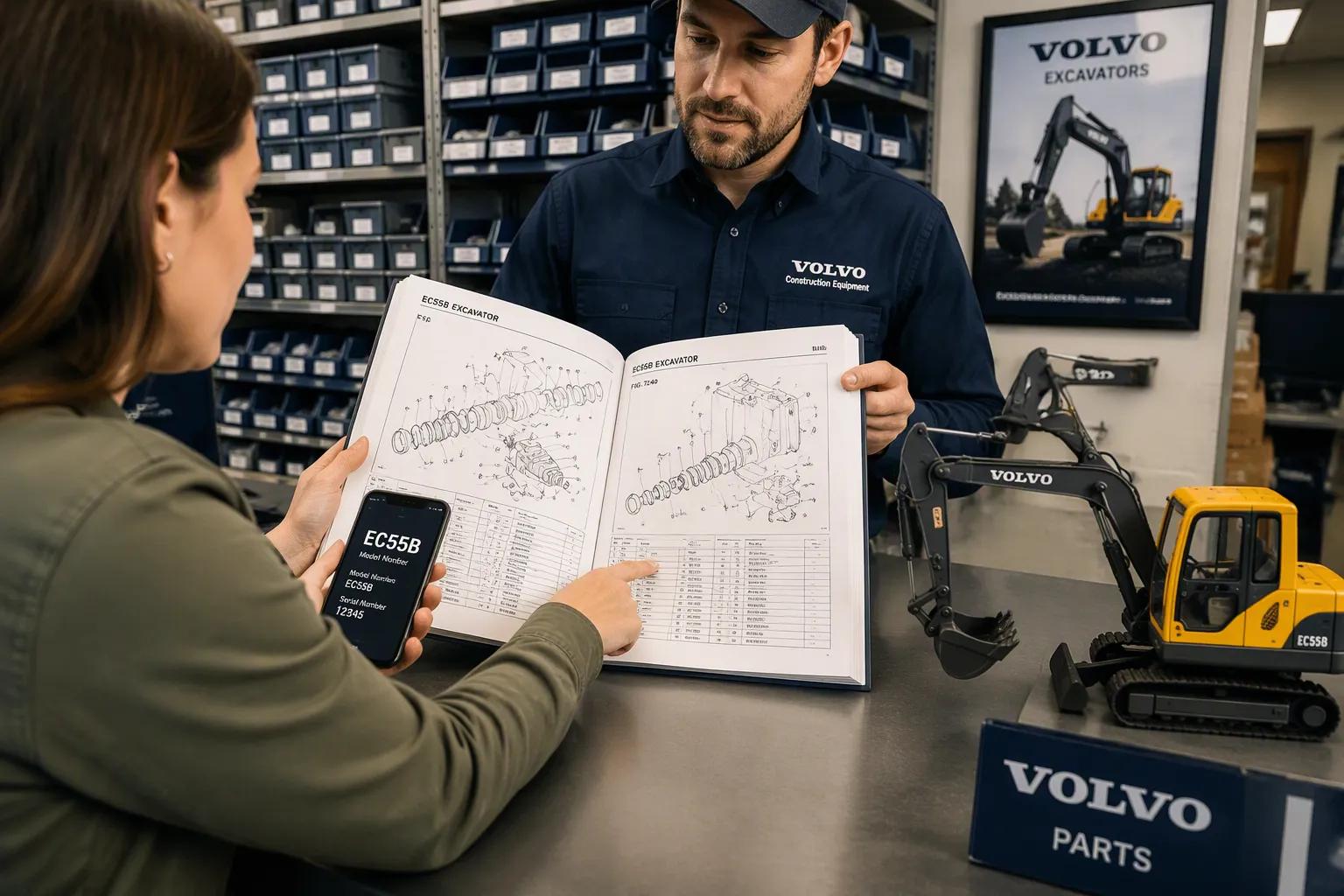
Give an authorized construction equipment dealer the full machine and component identification and ask which publication covers the task. Confirm the publication reference, coverage and revision. An older catalog may still help identify an assembly, but current replacement references need separate verification.
Volvo also sells operator’s manuals through its dealer network. These books come with new machines and are still sold as replacements. A dealer can order a printed copy for you. Some dealers also give access to digital versions through their own customer portals. Availability differs by region and by dealer, so check what your local branch offers before you travel.
Ask about document availability, access terms, licensing and any price before obtaining a copy. Neither payment nor an official-looking cover alone establishes that the publication covers your particular machine and later modifications.
Aftermarket and Third-Party Sources
Aftermarket suppliers fill gaps that official channels sometimes leave. Independent publishers make service manuals for older machines. Repair shops sometimes sell or share scanned catalogs. Online retailers list diagrams next to the parts they sell. These sources can help when a dealer is far away or when a document is out of print.
Quality varies a lot across third-party sources. Some aftermarket manuals are faithful reprints. Others are incomplete scans with missing pages or unclear views. A diagram with a smudged part number helps nobody. Check a sample page before you buy. Look for legible callouts, a clear model listing, and a publication date.
Use the same checking habit with every source. Confirm the document covers your exact model and serial number range. Compare any part number you find against a second source when the stakes are high. A hydraulic component or engine part costs real money, and a wrong order sets your repair back by days.
Treat free diagrams from forums and video sites with caution. They often show a similar machine, not your machine. A view from an EC55C may not match an early EC55B assembly. The layout looks close enough to fool you. Verify before you trust.
One practical rule ties both channels together. The document identifies the part. The machine confirms the fit. Write down your model, serial number, and the assembly you are working on. Then search with those details in hand. This habit works whether you buy from a dealer or an aftermarket supplier.
Free vs. Paid Resources
What Free Resources Cover
A freely available excerpt or illustration may help locate a possible assembly, but check its source, coverage and legibility. Do not use a partial page as a substitute for the complete applicable instructions or ordering information.
Free resources have limits. A single page rarely covers a full assembly. Scans lose detail, and callouts blur. Many free diagrams show a similar machine, not your exact model. You cannot confirm coverage for your serial number range. Treat free material as a starting point for volvo excavator parts ec55b research, not as a final reference.
When Paying Makes Sense
When choosing a document, prioritize verified coverage, completeness, legibility and current applicability. Cost alone does not establish accuracy or suitability. Ask for publication identification and a representative sample where available.
Before purchasing documentation, confirm its scope and whether it covers the needed procedure or assembly. A paid scan may still be incomplete or inapplicable. Obtain the correct parts, operator or service document for the task.
How to Read a Parts Diagram
Callouts and Part Numbers
A parts diagram uses callouts to connect a picture to a list. Each callout is a small line that points from a component to a number or letter. That marker matches an entry in the parts list beside the drawing. You read the view, find the marker on the part you need, then look up the matching entry. The entry gives you the official part number and a short description.
Start with the assembly view, not the detail view. The assembly view shows the whole group and tells you which sub-assembly holds your part. Then move to the detail view for that sub-assembly. This order keeps you from hunting through pages of small components. Watch for markers that point to a group rather than a single piece. Those markers usually send you to another page.
Copy the complete service ordering reference exactly. Do not infer compatibility or revision meaning from similar digit groups. If a callout or reference is unclear, obtain a clearer applicable source and verify it before ordering.
Cross-Referencing Views
One part often appears in more than one view. An exploded view may show a bolt in place, while a sectional view shows how it seats. Cross-referencing means you check the same part across those views. This step confirms you have the right item and the right quantity.
Confirm the parts-list quantity basis before ordering. Quantities may be per assembly or relate to a package or kit. Calculate what your actual repair needs rather than automatically ordering the pictured or listed count.
Cross-referencing also catches superseded numbers. A catalog may list an old number and a replacement side by side. Confirm which one applies to your machine before you buy. Compare the description and the position in the assembly. When two views disagree, trust the parts list and check your model and serial number range. A quick second look here saves a return shipment later.
Using Manuals for Maintenance and Repairs
Planning a Job
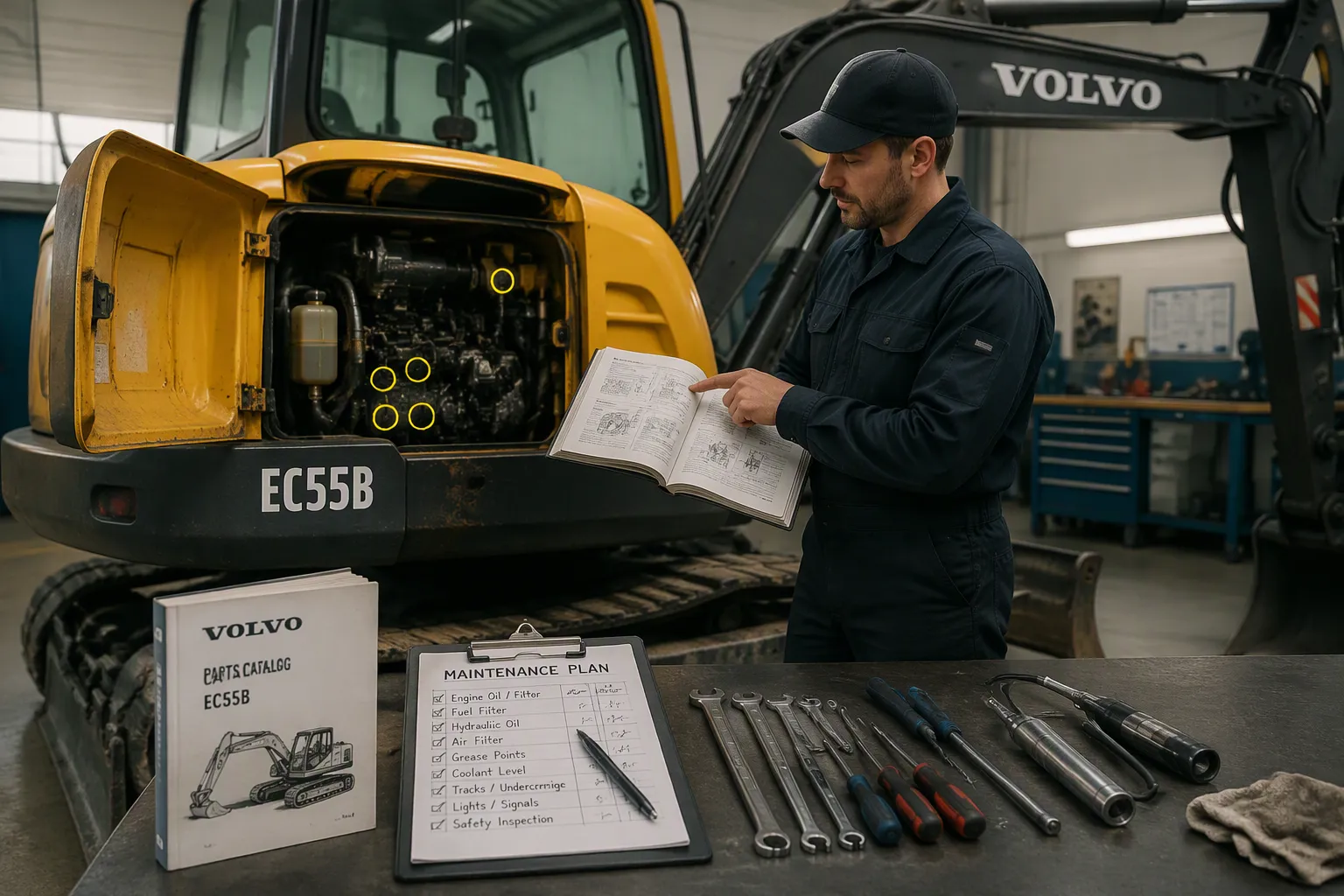
Open the manual before you touch the machine. Find the table of contents first. It groups tasks by system, such as engine, hydraulics, or undercarriage. Scan the headings for the system you plan to work on. Then read the subheadings under it. Each one names a specific task, like removing a pump or adjusting a track tension. Mark the page and read the whole procedure once. This pass shows you the tools you need and the steps that come first.
The lubrication chart deserves its own look. It maps every grease point across the machine. Each point pairs with a grease type and a service interval. Match the grease to the chart, not to whatever drum sits in the shop. Apply it at the listed frequency. A pin that misses its grease schedule wears fast. A pin that gets the wrong grease can wear just as fast. Follow the chart point by point during routine service.
Write your plan down. List the task, the tools, and the parts you expect to replace. This list becomes your shopping list. Check each part number against the parts catalog before you order. The manual tells you what to remove. The catalog tells you what to buy. Keep the two jobs separate. A number copied from a procedure page may describe a tool or a fastener, not the part you need. Confirm every number in the catalog for your volvo excavator parts ec55b order.
Following Procedures Safely
Read the safety notes before the first step. Manuals place warnings at the start of a procedure for a reason. They cover pressure release, support stands, and lockout steps. Skip them and you risk injury or a dropped load. Follow the sequence exactly as printed. The order of steps often controls when a system is safe to open.
Work through one step at a time. Do not jump ahead to the reassembly section. Each step assumes the previous one is complete. When a step calls for a measurement, take it and record the result. Compare it to the limit in the manual. If the reading falls outside the range, stop and check the component. A worn part that passes a visual check can still fail a measurement.
Keep the catalog open beside the manual. When a procedure names a part for replacement, look it up right away. Verify the number, the description, and the quantity. Cross-check the assembly view to confirm the position. This habit catches superseded numbers and look-alike parts before they reach your bench. A few minutes with both documents saves a return shipment and a lost day.
Tips for Effective Use
Organizing Your Documents
A clean document system saves you time on every job. Create one folder for your machine. Name it with the model and serial number. Store the parts catalog, service manual, and operator’s manual inside that folder. Add a subfolder for each system you work on often, such as hydraulics or the undercarriage.
Name each file with the document type and the model range it covers. A name like “parts-catalog-EC55B” tells you what the file is before you open it. Keep a note of the publication date for each document. Catalogs change when part numbers update. An old file may list a number that no longer fits your machine.
Print the pages you use most. A lubrication chart belongs near the machine, not buried in a folder. Keep printed pages in a binder with clear tabs. Write the date on each printout. Replace a page when you get a newer version. This habit keeps your reference material current and easy to reach.
Verifying Part Numbers
Copy every part number exactly as printed. Check each digit against the catalog entry. A single wrong digit sends you a part that will not fit. Read the description beside the number and confirm it matches the component in front of you.
Cross-check the number against a second view in the catalog. The assembly view and the detail view should agree. Confirm the quantity from the parts list, not from the picture. Then match the number to your model and serial number range. This final check protects your volvo excavator parts ec55b order from superseded numbers and look-alike items.
Keep a simple log of every part you order. Record the number, the description, and the job it served. This log becomes a quick reference for future repairs. It also helps you spot a number that failed to fit. A few minutes of checking beats a return shipment and a lost day of work.
You now understand the documents for your machine. Parts catalogs give you exploded views and official numbers. Service and operator manuals cover procedures and lubrication points. You can find them through an authorized dealer or an aftermarket supplier. You also know how to read callouts, cross-reference views, and plan a job before you start.
Keep a few habits. Store your files in one folder named for your model and serial number. Copy every part number exactly and check it against a second view. These steps prevent ordering errors and save you days.
Retain the publication reference, applicable machine information and confirmed service ordering numbers with your purchase records.
FAQ
Do I need both a parts catalog and a service manual?
Yes. The catalog tells you which parts you need and gives you the official numbers. The service manual explains the steps, where parts are located, and how to make repairs. Keep both open while you work. The catalog tells you what to buy. The manual tells you how to take it off and put it on.
Can I use a free diagram from a forum?
Only use it as a place to start. Free scans often show a machine like yours, not your exact model. The labels are hard to read, and you can’t tell if it covers your serial number range. Check any number against a licensed catalog before you order an expensive part.
How do I confirm a part fits my machine?
Write down your model, serial number, and the assembly you are working on. Match those details to the range listed in the document. Copy the whole part number exactly as it is printed. Then check the same number in a second view in the catalog.
Where do I find the grease points and service intervals?
The operator’s manual has the lubrication chart. It shows each grease point and pairs it with a grease type and a service interval. Follow the chart point by point. Do not use a different grease or wait longer than the interval.
What should I check before ordering a hydraulic or engine part?
Check the number, the description, and the quantity in the parts list. Look at both the assembly view and the detail view. Make sure the number works for your model and serial number range. A few minutes of checking saves you from sending the part back.
For Volvo excavator parts sourcing, consider YNF Machinery. Provide full machine and component identification, applicable part numbers and quantities, and request supported compatibility information, an actual quotation and written warranty and return terms before ordering.



