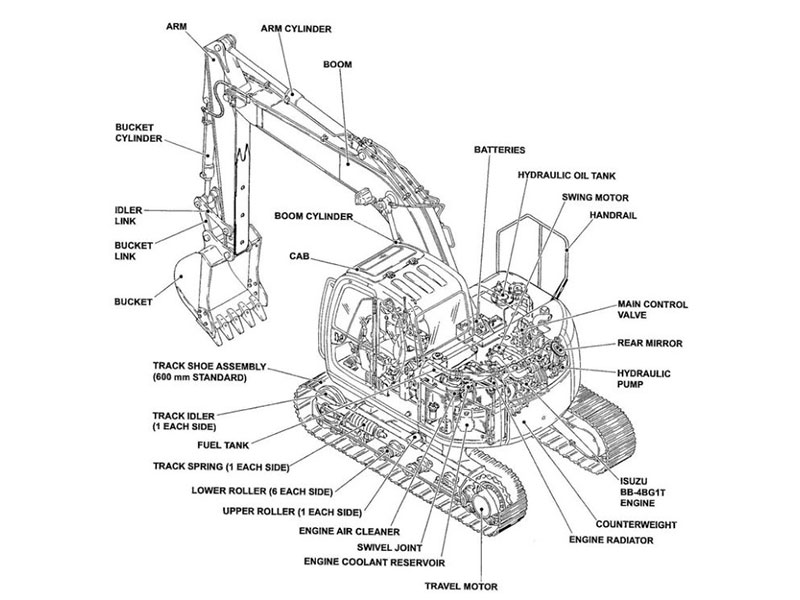
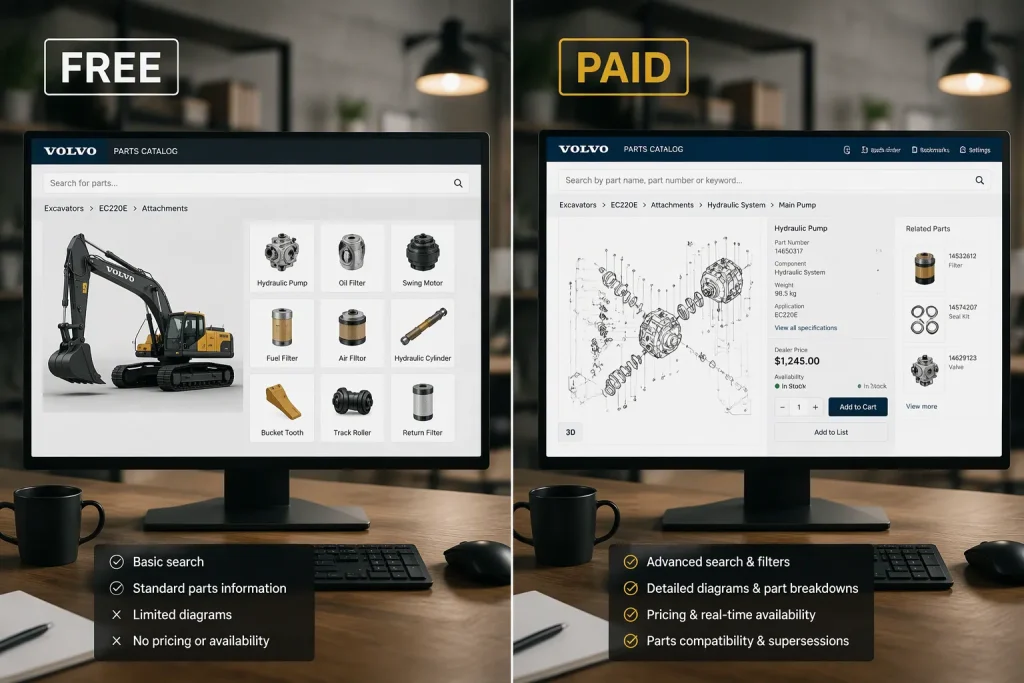
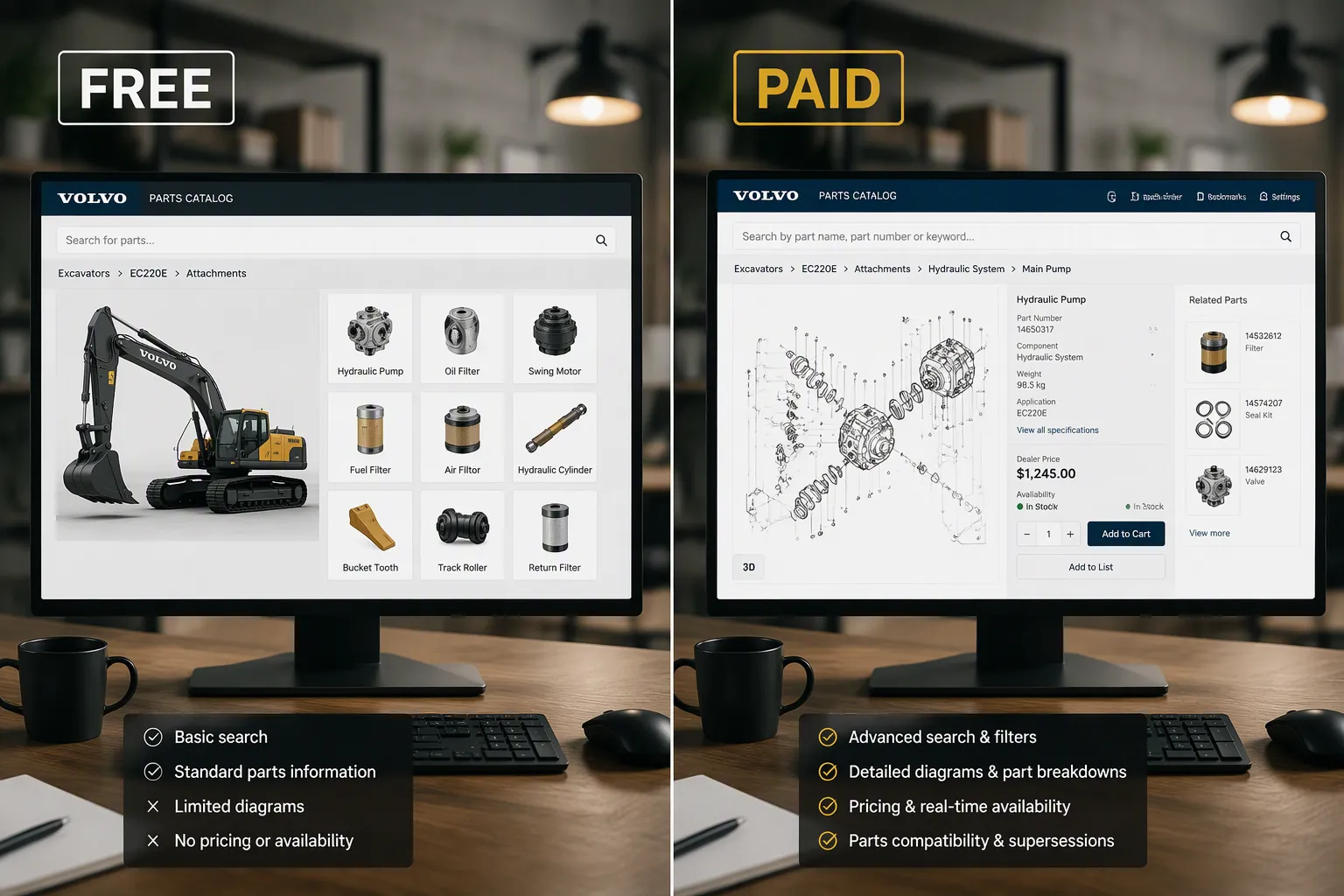
Free or paid access alone does not establish a parts catalog’s accuracy or suitability. Evaluate the actual publication, machine coverage, current replacement information and access terms. The pictured interfaces are conceptual illustrations, not evidence of any real catalog’s features or subscription benefits.
The real trade-off is in checking. Access rules differ by source, and coverage differs across model lists and equipment families. Readers should judge any volvo excavator online parts catalog by where its data comes from, how well it fits the model and serial range, its revision history, and its stated permissions. Each of these checks matters more than the price tag label.
Key Takeaways
Find out where the catalog data comes from. Then test a part number you know before you trust it.
Make sure the catalog covers your exact model and serial number, not just the model family.
Check the revision history and supersession notes so you don’t order old parts.
Choose access by verified coverage, useful functions and actual terms rather than a free or paid label.
Always check the final part number with a local supplier before you place an order.
Accuracy and Updates
How accurate a parts catalog is depends on where its data comes from and how recently someone updated it. Price does not answer that question. A reader should treat every catalog as a starting point for checking, not as a final authority.
Free catalog data checks
A known-part lookup can reveal a mismatch, but a successful result does not validate the whole catalog. Verify the actual entry and notes relevant to the proposed order. A missing result may reflect search limitations or coverage rather than proving every entry is wrong.
Check coverage and current replacement guidance in any source, free or paid. An old number may remain applicable or may have replacement conditions; investigate rather than rejecting it solely because the document is old.
Paid catalog data checks
For paid access, request the same evidence of provenance, coverage and revision. Payment does not establish that the data comes from the manufacturer or is more current than a no-charge source.
Revision dates deserve the same careful look here. A reader should confirm when the catalog was last updated and whether the listing shows supersession notes. Some paid systems show a clear revision trail; others show only a current number with no history. The reader should test this before trusting the tool for an expensive order.
Test how the actual tool handles a relevant known entry, including variant notes and replacement references where available. Use this as a usability and discrepancy check, not certification of overall accuracy.
Neither access type removes the need for a final check against the machine’s model and serial number. Accuracy comes from cross-checking the catalog against the equipment, the part number, and the supplier’s confirmation. That habit protects the order no matter what the reader paid for access.
Coverage in a Volvo Excavator Online Parts Catalog
Coverage decides whether a catalog can answer a real question about a specific machine. Readers should treat model lists and serial ranges as the first filter, not something to check later. A catalog that lists the right model family but skips the reader’s serial break can still return the wrong assembly.
Model and serial range fit
Confirm stated coverage for the full machine identifier and relevant configuration in the actual source. Some resources cover a broad range and others a limited scope; do not assume the difference follows the access price.
Apply the same coverage check to paid access. Verify relevant model, serial qualifications, options and component information before selecting an entry. A fee does not prove wider coverage.
Locate an applicable assembly and entry using full machine and component identification. Check configuration, modifications and current replacement conditions before relying on the ordering reference.
Gaps in assemblies and wear parts
Check whether the document includes the diagrams, associated tables, applicability notes and assembly scope needed for the actual repair. A missing item may be covered elsewhere, reference-only or unavailable separately. Ask for clarification instead of assuming a paid source must be complete.
Test a relevant lookup and follow any referenced pages or documents. A successful example supports only that checked case. Resolve gaps for the actual item and do not assume one completed repair proves all catalog coverage.
Coverage claims deserve the same scrutiny in any volvo excavator online parts catalog. A wide model list does not prove the reader’s serial range is included, and a deep parts tree does not prove every assembly is present. Readers should check both dimensions, then confirm the final number against the machine. That habit keeps a volvo excavator online parts catalog useful as a lookup tool rather than a source of ordering errors.
Diagrams and Searchability
A diagram shows where a part goes, not just its number. Readers should judge any catalog by how well its pictures and search tools help with that job.
Diagram quality and callouts
Free catalogs fall into two groups here. Some build their pages from model lists alone. They show a part number and a description, with no exploded view at all. Others do include diagrams, and some of those are clear and well labeled. A reader cannot tell which type a site is until they open it.
Confirm that the relevant diagram is legible and belongs with its associated parts table. Match callouts to applicable rows and read notes. A drawing is an identification aid, not proof of supplied scope or fitment.
Search and navigation
Test the actual search and navigation functions before relying on them or paying for access. Possible functions include text search, model filters, bookmarks or assembly browsing, but none is guaranteed by the free or paid label.
Navigation quality still differs by source, though. Some systems hide the serial break behind several clicks, and others return broad results that mix model families. A reader should test the path from model to assembly to part before relying on the tool. The same test applies to any volvo excavator online parts catalog, whatever the access terms. Good navigation shows the reader where a part sits and how the catalog reached that answer.
Revision History and Supersessions
An old publication may not include later replacement information. Check current applicable guidance and any conditions attached to a supersession. An older number is not automatically unsuitable, and a newer number is not automatically interchangeable.
Confirming current part numbers
Look for the publication identification, revision and relevant replacement notes. If the source does not show a replacement chain, obtain current applicable confirmation elsewhere. A single displayed number alone does not reveal whether it has been superseded.
Do not assume a paid system has newer information or a particular data source. Request evidence for the selected entry and resolve uncertainty with applicable documentation or a qualified parts contact before ordering.
Tracking replaced parts
Replaced parts need a paper trail. A reader should check whether the catalog links the old number to its replacement, and whether it notes why the change was made. Some revisions reflect a design update. Others reflect a supplier change or a packaging difference. The reader needs to know which, because the replacement may not fit an older build.
Record the verified old and replacement service references, relevant machine and component identification, and any conditions or additional items. Keep the supporting information with the order.
Cost, Access Terms, and Support
Access terms decide what a reader can actually do with a catalog. A site may call itself free and still ask for registration, limit daily lookups, or restrict printing and export. Readers should read the terms before they build a workflow around any tool.
Free access limits and fine print
Check the actual access terms for account requirements, lookup limits, permitted use and any restrictions on downloading, printing or sharing. These can vary for free and paid access alike.
The fine print deserves a careful read. Terms may change without notice, and a tool that works today may restrict access later. A reader should check who runs the site, what data it collects, and whether the terms allow commercial use. A shop that orders parts for customers needs different permissions than a single owner checking one number.
A no-charge source can be useful if its coverage, evidence and terms meet the task. Price alone does not determine whether it is limited to initial research or suitable as part of a verified ordering workflow.
What paid access includes
Before subscribing, confirm which functions and permissions the actual plan includes. Do not assume saved lookups, team accounts, order history or parts support are included because access is paid.
Support is the part readers should confirm. A paid plan may include email help, phone support, or a dedicated account contact. It may also offer none of these beyond basic login help. The reader should ask what support covers before paying. A plan that answers billing questions but not part-number questions offers less value than the label suggests.
Account permissions also vary. Some plans tie access to a single user, and others allow a team. A reader should confirm how many people can log in, whether the account tracks order history, and what happens when a subscription ends. These details affect daily work more than the headline price does.
Whichever access arrangement is used, verify the selected entry against machine and component identity, configuration and current replacement requirements. Supplier confirmation supports the record but does not guarantee every outcome.
Matching Catalog Type to Use Case
List the actual requirements: machine and component coverage, permitted use, useful navigation, relevant support and record retention. Evaluate the source against those requirements before considering its cost.
When free access fits
No-charge access may suit occasional or frequent use if the actual source meets the required coverage, evidence and permission checks. A low-value part can still have safety or downtime implications, so do not reduce verification solely because it is inexpensive.
Check the actual entry, applicable notes and current replacement information. Keep permitted records of the confirmed reference and its source, and resolve any uncertainty before ordering.
When paid access pays off
Paid access may be worth considering when verified functions or support meet an actual need. Compare the stated service and terms with the work required rather than assuming every paid plan saves time.
For safety-critical or expensive items, obtain the required technical verification regardless of access price. A subscription is not a substitute for applicability evidence or qualified assessment. Confirm the actual support and documentation offered.
Choose by verified provenance, relevant coverage, usability, permissions and support. Neither free nor paid access is automatically the better choice for a particular owner or shop.
Check the selected entry against full machine and component identification, configuration and current replacement requirements. Retain the source information and written order confirmation.
FAQ
How does a reader confirm a catalog covers their exact machine?
Check the model and serial number on the data plate first. Then make sure the catalog lists that serial break, not just the model family. A model name alone does not prove fit, because manufacturers split production by serial range and build variation.
Can a free catalog be trusted for an order?
Evaluate the actual source and applicable entry. No-charge access does not prove poor quality, and payment does not prove accuracy. Check provenance, coverage, relevant notes and current replacement information before relying on the result.
Why do superseded part numbers cause ordering errors?
A manufacturer may replace, drop, or split a number during a machine’s life. An old listing can return a part that no longer fits. Readers should look for a revision trail and confirm the current number with a supplier before ordering.
Do diagrams replace a service procedure?
No. An exploded view shows where a part sits and how the assembly is built. It does not explain torque values, safety steps, or installation order. Readers should treat diagrams as identification aids and follow the manufacturer’s service information for repair work.
What should a reader check in the access terms?
Look for registration requirements, lookup limits, and rules on printing or sharing results. A shop that sends part lists to a supplier needs different permissions than a single owner. Terms can change, so save confirmed numbers in a shop file.
For Volvo excavator parts sourcing, consider YNF Machinery. Provide full machine and component identification, applicable part numbers and quantities, and request supported compatibility information, an actual quotation and written warranty and return terms before ordering.