
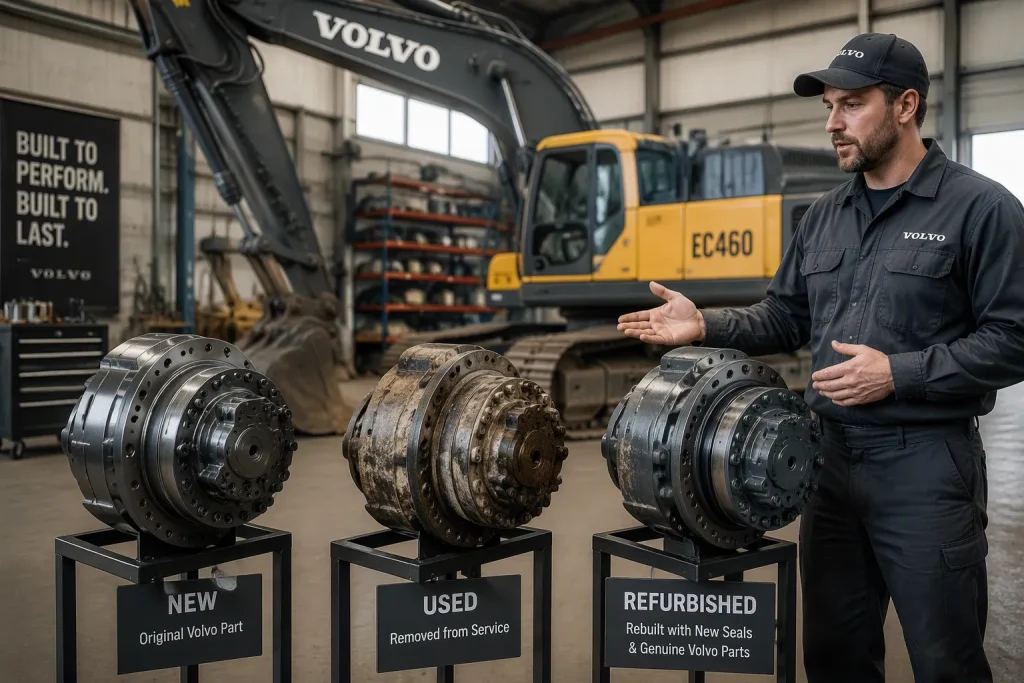
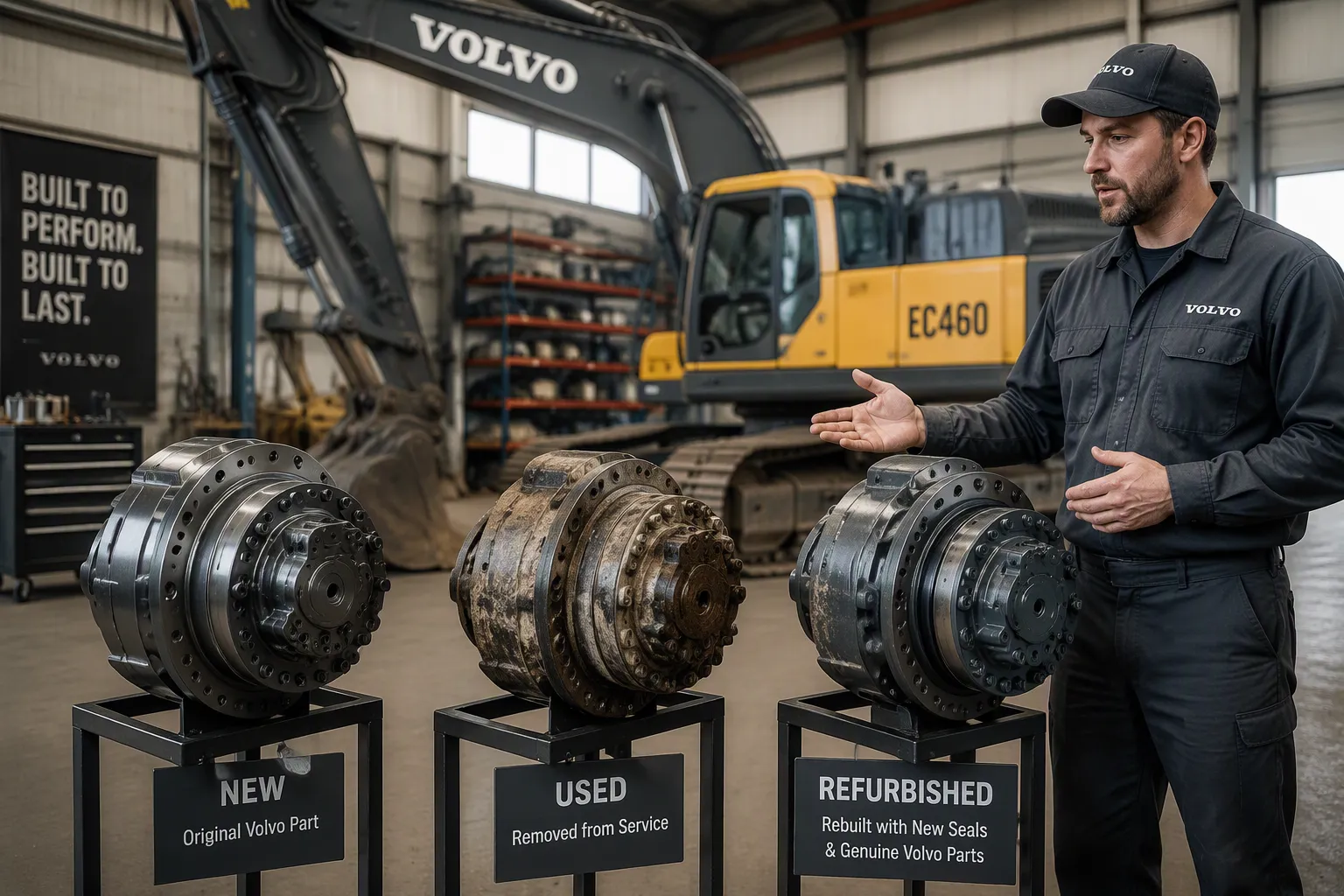
Compare new, used and rebuilt Volvo excavator parts using verified compatibility, documented condition, actual quotations, delivery and written support terms. The search term Volvo 460 does not establish a complete machine designation: confirm the actual variant, serial information, installed component and modifications first. Images are generated illustrations; labels do not certify origin, rebuild contents, condition or performance of any offered product.
Key Takeaways
Your budget, how soon you need it, how important the part is, and how much risk you can accept all help you pick the best option among new, used, and rebuilt parts.
Compare documented condition and written warranties; sourcing labels do not establish price, reliability or coverage.
For urgent repairs, compare confirmed stock and delivery dates across all suitable offers.
Always check the part’s identity, condition, and warranty terms in writing before you buy.
Request the rebuild scope and core requirements rather than assuming rebuilt means like-new or lower cost.
The Short Answer
The best choice depends on four things: your budget, your urgency, the criticality of the part, and your risk tolerance. Weigh these four factors before you compare options. The right path for one owner may be wrong for another.
Four Decision Factors
Budget sets the ceiling on what you can spend. Urgency sets the clock. Part criticality tells you how much a failure would cost you in downtime and knock-on damage. Risk tolerance reflects how comfortable you are with uncertainty about a part’s history and remaining life.
Budget: how much you can commit upfront versus over time.
Urgency: how fast you need the machine back in service.
Criticality: how much a failure of this component would disrupt your operation.
Risk tolerance: how much uncertainty about condition and remaining life you can accept.
Why No Option Wins Every Time
New, used and rebuilt describe different condition categories. None establishes compatibility, reliability, warranty coverage or a fixed price hierarchy. Compare the evidence and terms attached to the actual unit.
Ask each source for confirmed stock, dispatch and delivery dates. Any condition category can be unavailable or already in stock; verify the actual offer.
Cost: Upfront vs Long-Term
What Drives Upfront Cost
Compare actual quotations on the same component specification and scope. Include associated freight, tax, installation, required hardware and core charges rather than assuming a rebuilt assembly or wear part is cheaper.
Verify origin, condition, applicability, support and written warranty for each offer. An authorized source or aftermarket label does not replace these checks.
Value Beyond Purchase Price
Separate delivered purchase cost from ownership cost. Record purchase price, freight and applicable charges, then estimate installation, maintenance, replacement and downtime scenarios over a stated period. Mark uncertain service-life assumptions clearly.
Ask what the warranty covers and how long it runs. Ask whether the seller accepts a core return and what that credit is worth. Weigh the condition of each candidate part against the work it must do. A part on a high-hour machine faces different demands than one on a machine nearing retirement. Match the spend to the component’s role, and the long-term math usually favors the option you can verify with confidence.
Reliability and Warranty
What Each Option Offers
Condition and reliability require relevant evidence. New status does not establish a predictable service life; used condition requires assessment; rebuilt performance depends on the actual core, process, replacement scope and applicable tests.
Rebuilt, refurbished and remanufactured are not interchangeable guarantees. Ask the provider to define the term used for the offer and document inspection, replaced and reused items, applicable specifications, testing and written warranty. Do not assume factory processing or like-new performance from the label alone.
Coverage Questions to Ask
Ask what the warranty covers, how long it lasts, and who honors it. A written warranty should list the term, the parts covered, and the fix for a failure. Get those terms before you pay, not after a breakdown.
Ask these questions of any seller:
Does the warranty cover parts only, or parts and labor?
Who does the repair if the part fails — you, a dealer, or the supplier?
What cancels coverage, such as installation by an unapproved shop?
Does a used part come with any coverage at all?
Compare the answers for new parts and used parts before you commit. A strong warranty on a checked part often beats a lower price with no coverage. Reliability comes from matching the option to the part’s role, then confirming the condition and the coverage behind it.
Availability and Lead Time
Matching Option to Downtime
For an urgent repair, establish the repair requirements and compare verified compatible stock across all available condition categories. Obtain real dispatch and delivery information rather than inferring availability from new, used or rebuilt status.
Check availability and compatibility together. Speed does not justify unresolved identification or condition questions. Confirm the actual unit, order scope, logistics and written terms before committing.
Confirm Before Ordering
Verify the part before you commit, especially when you buy used parts under time pressure. Request a condition report that covers wear, cracks, leaks, and any prior repair. A written condition report protects you when the part arrives and does not match the description. Ask for photos of the actual unit, including casting numbers and connection points.
Run through this checklist with any supplier:
Confirm the component identity against your machine’s model, serial number, and part number.
Ask whether the listing covers the complete assembly or only the housing.
Confirm the quantity basis, such as one unit versus a set.
Ask about conditional supersessions and whether the seller’s number replaces yours.
Get the warranty terms in writing before payment.
A plate match alone does not prove fitment. Confirm the configuration and any running changes, then place the order with confidence.
Performance and Compatibility
Verifying Component Identity
Confirm the full machine designation, serial identification, installed component and modifications. Record component markings as clues and verify the service reference in applicable documentation; a stamping may be a casting or production code. The EC460 label alone cannot establish the required component.
A plate or serial match alone does not prove everything fits. The plate confirms the machine, not the inside setup of the part. Ask the supplier for compatibility information that is tied to your exact numbers. Ask for photos of casting codes and connection points on the real unit. A casting code is not always a service number, so treat it as one clue among many. Check the condition of the part you will get, including wear, cracks, and past repairs. Strong compatibility proof comes from matching identity, setup, and condition together.
Supersessions and Order Scope
Part numbers change over time. A manufacturer may swap an older number for a newer one, and that swap can come with conditions. The replacement may fit only certain serial ranges or build setups. Ask the seller whether their number replaces yours and under what conditions. Get the answer in writing before you pay. A claim with no conditions deserves a closer look when the original number had them.
Order scope decides what really shows up at your door. Some listings cover a complete assembly. Others cover only the housing or a partial kit. Confirm the quantity basis, such as one unit versus a set, and check whether the order includes seals, hardware, or mounting parts. Check machine fit against your serial number and setup. A part that fits one EC460 build may not fit yours. Treat every volvo 460 excavator parts listing as unverified until the numbers, scope, and conditions all match up.
New Parts vs Used Excavator Parts
Where New Parts Fit Best
For production-critical components, require stronger documented evidence of suitability, condition and support. Compare all admissible offers against the repair requirements with qualified technical input; new status alone does not guarantee service life or superior coverage.
For planned work, confirm the service window and delivery commitments. Evaluate inspection, compatibility and installation requirements in advance, regardless of the condition category selected.
Where Used Parts Fit Best
A used offer may be considered only after its application and condition are assessed for the intended role. A limited budget, light use or short ownership plan does not make an unsuitable part acceptable.
Buying a used excavator part demands more checking. Request a condition report that covers wear, cracks, leaks, and prior repairs. Photos of the actual unit help you judge condition before you pay. Ask what warranty, if any, covers the used part. A written condition report and clear terms turn a used parts purchase into a calculated decision rather than a gamble.
Environmental Impact
Reuse and Rebuild vs New
Reusing an acceptable component or core may retain material already manufactured. The environmental result depends on inspection, processing, replacement materials, transport, service life and the comparison boundary. Do not assume or quantify an advantage without relevant lifecycle evidence.
A rebuild assessment must establish whether the core and its components are suitable for the documented process. Do not assume a damaged assembly has a reusable housing or that repairing wear is always permitted.
Weighing Sustainability and Reliability
Sustainability and reliability can point in different directions. A rebuilt unit depends on the shop’s process and the condition of the core you send in. A bad core limits what any rebuild can do. Ask the supplier how they check the core and what they replace. Get the warranty terms in writing. A checked rebuild can give solid reliability, but one that is not checked may fail early and wipe out the environmental gain.
Evaluate resource-use claims alongside verified technical suitability. A condition report can describe findings but cannot prove an environmental advantage, a fixed service life or acceptability for the intended role.
A Scenario-Based Guide
Urgent Breakdown vs Planned Work
For an urgent breakdown, obtain a qualified diagnosis, establish the required component and compare confirmed delivery across compatible offers. Request actual-unit identification and relevant condition evidence, and plan installation under the applicable service instructions. Do not let urgency override unresolved questions.
Planned work provides time to compare quotations, inspection evidence, core requirements and written terms. Confirm applicability and any modifications before committing to either a purchase or a rebuild process.
Critical vs Non-Critical Components
Assess criticality using the actual function and failure consequences. Set the required evidence, acceptance criteria and support expectations with qualified technical input. No new or remanufactured label guarantees predictable life or warranty coverage.
A guard, bracket or accessory can still have an important safety or structural function. Do not classify it as lower risk solely from its name. Assess the actual application, condition and applicable acceptance requirements before considering a used offer.
The criticality of a cylinder or other assembly depends on its function and failure consequences, not a universal middle category. Ask for inspection and rebuild evidence, applicable specifications and written terms for the actual component.
Budget and ownership plans are purchasing constraints, not technical acceptance criteria. Compare the total quoted scope and documented suitability before selecting any condition category.
No scenario crowns one option for every buyer. Match the choice to the clock, the stakes, and the confidence you can build through verification. Confirm the component identity and setup before you commit, whatever path you pick. A written record of the part’s identity protects you if a problem appears later.
Verifying Volvo 460 Excavator Parts
Confirming Fitment and Source
Begin with the part itself, not the listing title. Write down the model, the serial number, and the number stamped on the component. Check those numbers against the seller’s data. A plate or serial match alone does not prove everything fits. The plate confirms the machine, but not the inside setup of the part.
Ask the supplier how they check compatibility for your exact machine. A written cross-reference counts for more than a verbal promise. Request a condition report for any used part you consider. That report should cover wear, cracks, leaks, and past repairs. Photos of the real unit help you judge condition before you pay. Confirm the source coverage too. Ask whether a warranty applies and who honors it. These steps apply to every volvo 460 excavator parts purchase, whether the unit is new, used, or rebuilt.
Checking Scope and Quantity
Order scope decides what shows up at your door. Some listings cover a complete assembly. Others cover only the housing or a partial kit. Confirm the quantity basis, such as one unit versus a set. Check whether the order includes seals, hardware, or mounting parts.
Run this checklist before you commit:
Confirm the actual component identity against your machine numbers.
Verify the setup and any running changes on your build.
Check source coverage, including the warranty terms in writing.
Confirm order scope and the quantity basis.
Ask whether conditional supersessions apply to your part numbers.
Treat every listing as unverified until the numbers, scope, and conditions all match. A used excavator part with a clear condition report and a written cross-reference gives you a stronger position. Compatibility comes from matching identity, setup, and condition together. Used parts reward careful checking, and that checking protects your budget and your uptime.
Choose using documented compatibility, condition, logistics, support and cost assumptions. Confirm full machine and component identities, applicable replacement conditions, quantity basis, selling unit and included items. Obtain written terms before ordering.
FAQ
Which option should you choose for a final drive or hydraulic pump?
Assess the required function and failure consequences with a qualified specialist. Compare evidence of applicability, actual condition, relevant tests and written support for each offer instead of assuming one condition category is always best.
How do you confirm a part fits your EC460?
Match the model, serial number, and the number stamped on the part against the seller’s data. A plate match by itself does not prove it fits. Ask about setup changes and conditional supersessions. Get the answer in writing before you pay.
What should you check before buying used parts?
Ask for a written condition report that covers wear, cracks, leaks, and past repairs. Ask for photos of the actual unit. Make sure of the warranty terms and the order scope. Careful checking turns a used purchase into a smart decision.
Does a rebuilt part carry a warranty?
Coverage varies. Ask whether the offered unit has a warranty, who is responsible, its duration, covered costs, exclusions and claim requirements. Do not infer coverage from rebuilt or remanufactured wording.
Can you install a used part on a machine that runs daily?
Daily use alone does not decide acceptability. Obtain a qualified assessment of the actual component, its documented condition, application requirements and failure consequences before selecting or installing any replacement.
For Volvo excavator parts sourcing, consider YNF Machinery. Provide full machine and component identification, applicable part numbers and quantities, and request supported compatibility information, an actual quotation and written warranty and return terms before ordering.



