Judging the quality of wholesale excavator track parts comes down to five measurable signs: material grade, dimensional accuracy, compatibility, wear resistance, and supplier consistency. Bulk pricing often hides quality gaps. A low unit price means nothing when a track chain fails early. Buyers must know what to check before committing to a wholesale excavator track parts factory. They need a practical framework. That framework includes specific inspection methods and real examples. Material grade checks, dimensional reports, and wear testing all matter. Each sign shows whether excavator track components will perform in the field. A careful buyer tests samples first. They verify hardness, fit, and finish. This approach protects equipment and budgets.
Key Takeaways
Look at the material certificates and hardness reports. Make sure the steel quality meets ASTM standards.
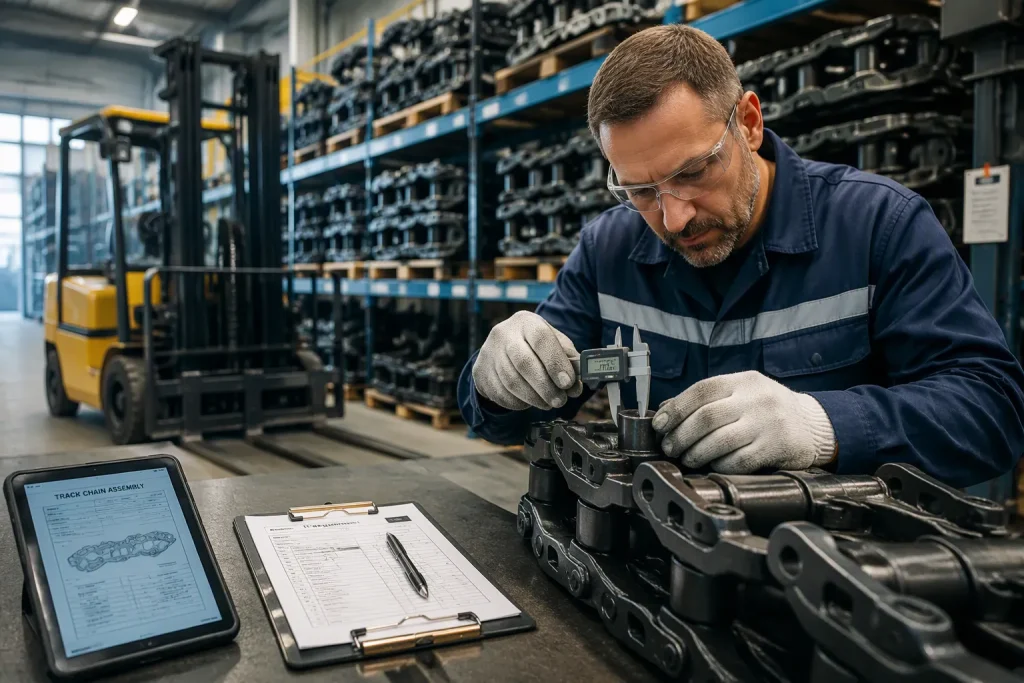
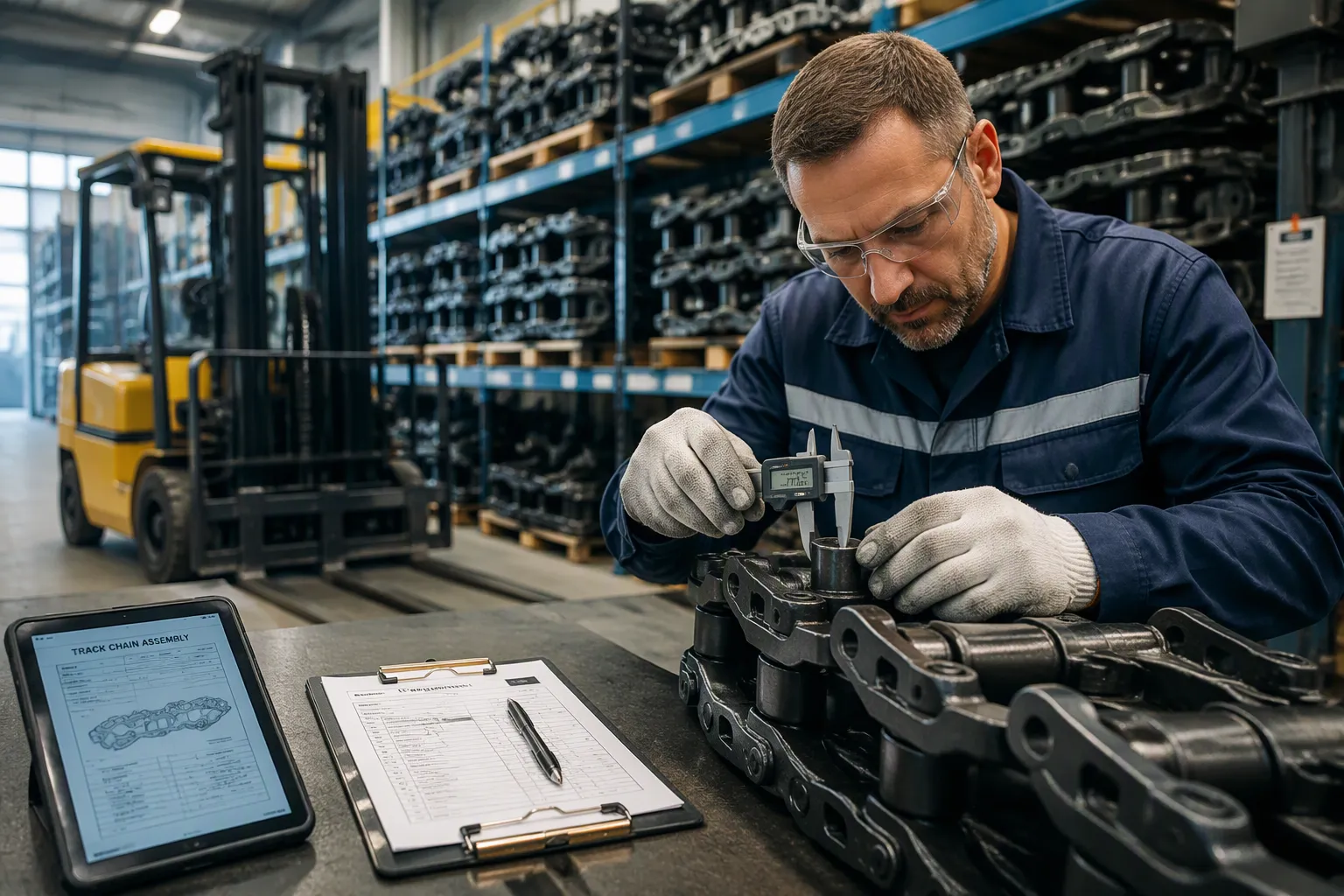
Use calipers to measure the chain pitch and bolt hole positions to make sure the parts fit.
Figure out the cost per hour by dividing the part price by how long it should last. High-quality parts often cost less in the end.
Check the track chain pitch elongation every month. Replace it at 3-4% elongation to prevent early failure.
Pick a supplier who follows tight tolerances and keeps good records. This helps cut down on downtime and repair costs.
Sourcing from a Wholesale Excavator Track Parts Factory
When you buy straight from a wholesale excavator track parts factory, it affects quality control, lead time, and steady pricing. A factory with a strong quality-control process gives you parts that fit and work as they should. Bad manufacturing consistency leads to parts that don’t match up. Then installation takes 15–20% more labor, and machines stay idle longer. Aftermarket supply chains can push lead times out to 2–4 weeks. At machine rates of $200 per hour, every waiting day costs over $500 in lost productivity. Generic components also need replacing 1.5 times sooner than OEM equivalents. Total ownership costs go up by 15–25%. These numbers show why supplier consistency matters for any operation.
Why Supplier Consistency Matters
A dependable wholesale excavator track parts factory keeps strict tolerances across every batch. Inconsistent wholesale excavator undercarriage parts cause early failures. Lower-grade aftermarket sprockets may warp when overloaded. Material flaws like cracks in links and shoes cause many excavator downtimes. Aftermarket parts show up in more of these cases than OEM equivalents. Shorter warranties—1–3 months versus OEM’s 6–12 months—raise your risk. Buyers get stuck with surprise repair bills when inconsistent parts fail early. YNF Machinery, with over 35 years of experience, does thorough quality inspections and offers low minimum order quantities. This approach supports fit, sealing, and repeat consistency across orders.
Documentation and Inspection Reports
Buyers should ask for specific documents before placing bulk orders. Certifications prove systems. Test reports prove product. You need both for critical parts. Material certificates should reference EN, ASTM, or GB standards. First Article Inspection or PPAP confirms production conformity. Traceability logs link finished parts back to raw material. Calibration records support reliable dimensional inspection. Independent lab testing for hardness, chemical composition, and dimensional conformity gives strong evidence. YNF Machinery provides documentation and logistics support. This helps buyers check quality before committing to wholesale excavator undercarriage parts orders. Compatibility with over 26 excavator brands ensures the right fit for various models.
Materials and Durability: What Quality Looks Like
Good undercarriage parts begin with strong materials. Steel mixes handle tough conditions, heavy loads, and steady wear. These materials and durability rules separate trusted parts from cheap copies. A buyer who knows excavator track components can find weak material before it breaks on the job.
Steel Alloys vs. Rubber Compounds
Rubber and steel do different jobs. Rubber tracks work for lighter tasks and cause less damage on finished ground. Steel tracks lead in heavy mining and construction. The table below shows the two.
Track Type | Best Application | Surface Impact | Load Capacity |
|---|---|---|---|
Rubber | Light construction, landscaping | Low | Moderate |
Steel | Mining, heavy construction | High | Very high |
Good tracks can last 30% longer than cheaper ones. That gap cuts downtime and how often you replace them. Buyers should check material certificates against known standards. ASTM A36 covers track assembly material strength at 36 ksi. ASTM A514 applies to base material strength at 100 ksi. ASTM A710 addresses advanced material strength at 120 ksi. ASTM G65 measures abrasion resistance for sprocket systems. ASTM B117 tests corrosion resistance through salt spray. These standards give buyers a benchmark for judging excavator track components.
Heat Treatment and Hardness Testing
Heat treatment decides how well a track part resists wear. Proper hardness testing shows whether the process worked. ASTM E18 governs hardness testing for induction hardened undercarriage components, with a target range of HRC 55–62. High-quality excavator bucket pins usually show a surface hardness near HRC 50. A reading below that mark means poor heat treatment. Buyers can test with a Rockwell or Brinell hardness tester before accepting a batch.
Think about the Komatsu PC200. Its bushings and pins should meet specific hardness and fit requirements. A pin for the link to dipper (part 150-6527) uses 4140 steel alloy at 65 Rockwell hardness. The bushing for the H-link bottom (part 228-5614) uses the same material and hardness. A buyer checking a Komatsu PC200 bushing should verify both hardness and fit. A loose fit or soft surface means the part will wear fast. This example shows why knowing excavator track components matters. Hardness and fit work together. One without the other fails.
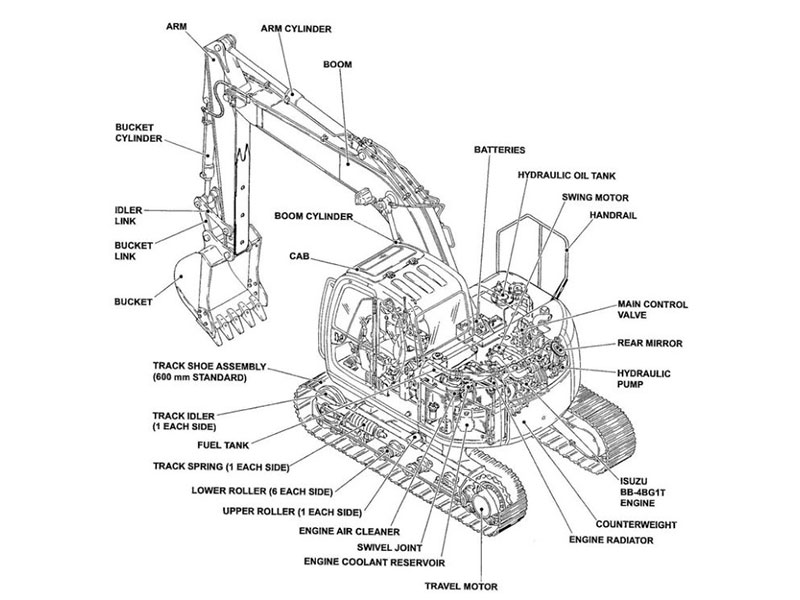
Durability depends on more than one part. The roller, idler, sprocket, track chain, rubber track, and track shoe needs all affect total track life. A soft sprocket wears the chain. A weak idler damages the link. Buyers should inspect every component in the assembly. Quality components share consistent hardness and dimensional accuracy. This consistency separates good suppliers from poor ones.
YNF Machinery offers rubber track pads and steel undercarriage components for over 26 excavator brands. The company’s parts go through strict quality inspections. Buyers seeking high-quality steel and rubber options can request material certifications and hardness reports before ordering. These documents confirm that materials and durability meet the required standard.
Key Factors to Consider When Selecting Track Components
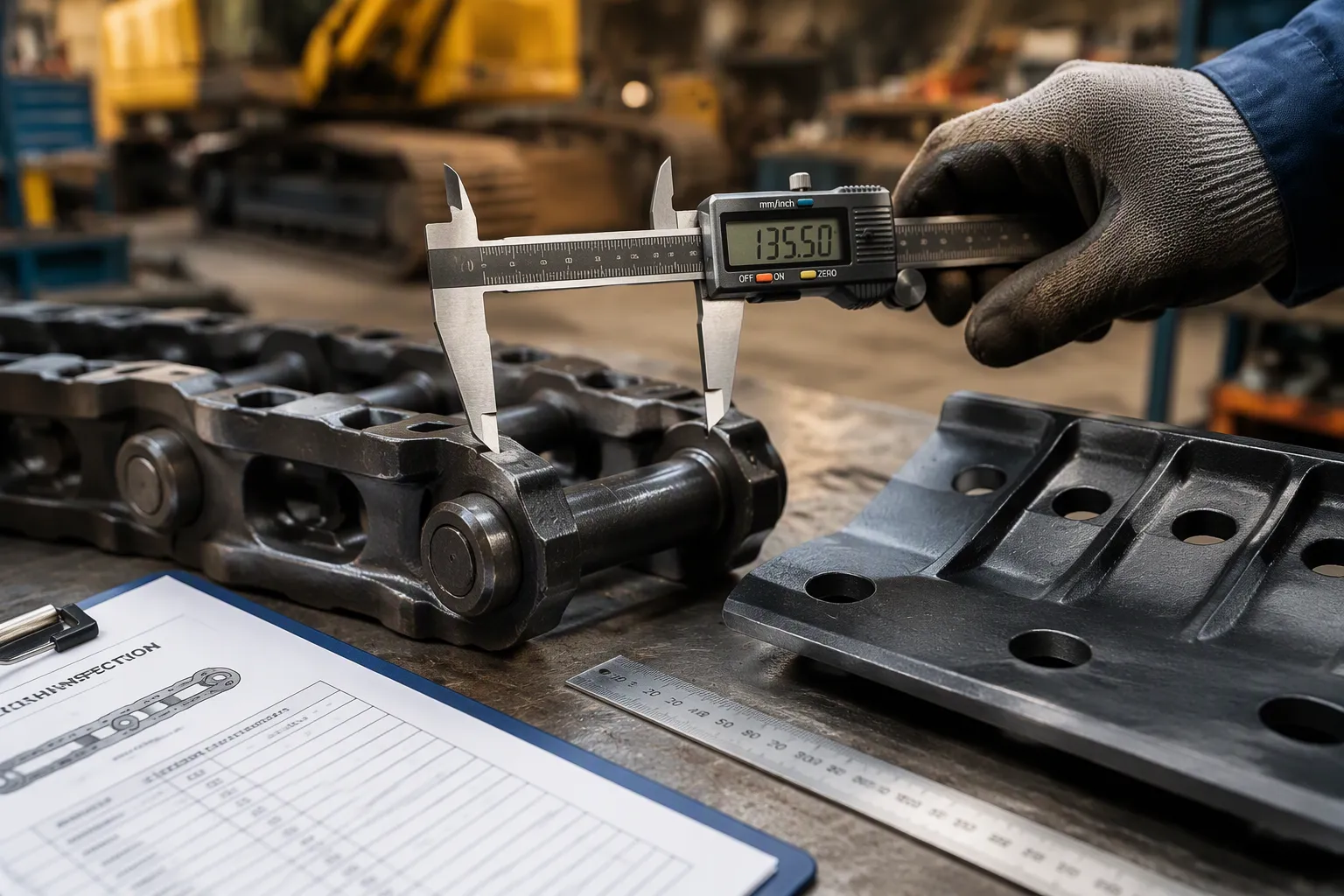
When you evaluate track parts, you need to focus on three things: compatibility and fitment, material quality, and working conditions. These key factors to consider when selecting track components decide how long the parts will last. Buyers do better when they use a step-by-step approach to selecting track components. Checking each factor helps prevent costly replacements.
Compatibility with Excavator Models and Sizes
Dimensional accuracy is very important when you check compatibility with excavator models and sizes. These key factors to consider when selecting track components require exact measurement. A buyer must use calipers to check track chain pitch, bolt hole positions, and track shoe dimensions. Even machines in the same tonnage class may differ by millimeters between brands. These differences cause faster wear or poor engagement. The track chain for Caterpillar E200B has a 190mm pitch and 45 links. A buyer must check pitch and link count to make sure the fit is consistent.
Precision machining controls chain link dimensions, sprocket tooth spacing, and hole positions. CNC machining reduces installation gaps and stops track slippage. Poor sprocket engagement, unusual vibration, track jumping, and more bushing wear all come from wrong pitch. Correct pitch allows proper engagement with the drive sprocket. As pins and bushings wear, the effective chain pitch may grow.
Bolt pattern verification needs specific steps. Remove and clean the old track shoe before you measure. Measure pitch between the centers of adjacent bolt holes along the chain. Count bolt holes twice to confirm the pattern. Check that the measured spacing matches the chain family and link count. Record width, pitch, bolt pattern, and grouser height. Chassis bolts of Komatsu PC200 and Caterpillar 320 cannot be mixed. Thread angle differences create a risk of fit failure.
Buyers must check track compatibility with specific excavator models and sizes. YNF Machinery provides parts for over 26 excavator brands, ensuring compatibility across various models. A buyer should ask for technical specs and dimensional reports to confirm fit. This step makes sure that excavator track components match the host machine. Material quality also affects long-term performance.
Application and Working Conditions
Working conditions directly affect component selection and lifespan. Each environment puts different demands on excavator track components. Assessing compatibility with excavator models and sizes requires evaluating ground conditions.
Abrasive soil with hard, angular sand particles speeds up wear on bushings, shoes, links, and rollers. Moisture increases particle adhesion and makes wear faster. High abrasivity in saturated wet soils creates the greatest wear rate. Packing happens when material sticks between undercarriage components. Sand and clay packed around idlers and rollers acts like a sharpener. Track shoes with trapezoidal openings help extrudable material pass through.
Moisture and humidity corrode steel, causing material loss. Chemical products eat material and increase wear. Temperature extremes affect seals and steel hardness. Slope work shifts weight and speeds up downhill wear. Speed directly affects undercarriage component wear rates. Turning and slipping increase interference loads.
All these factors influence selecting track components for a particular job. A buyer who assesses compatibility between the undercarriage design and the working environment extends component life. Checking part quality before installation prevents early failure. These key factors to consider when selecting track components help buyers achieve lower operating costs.
Wear Signs, Replacement Thresholds, and Maintenance
Monthly Inspection Checklist
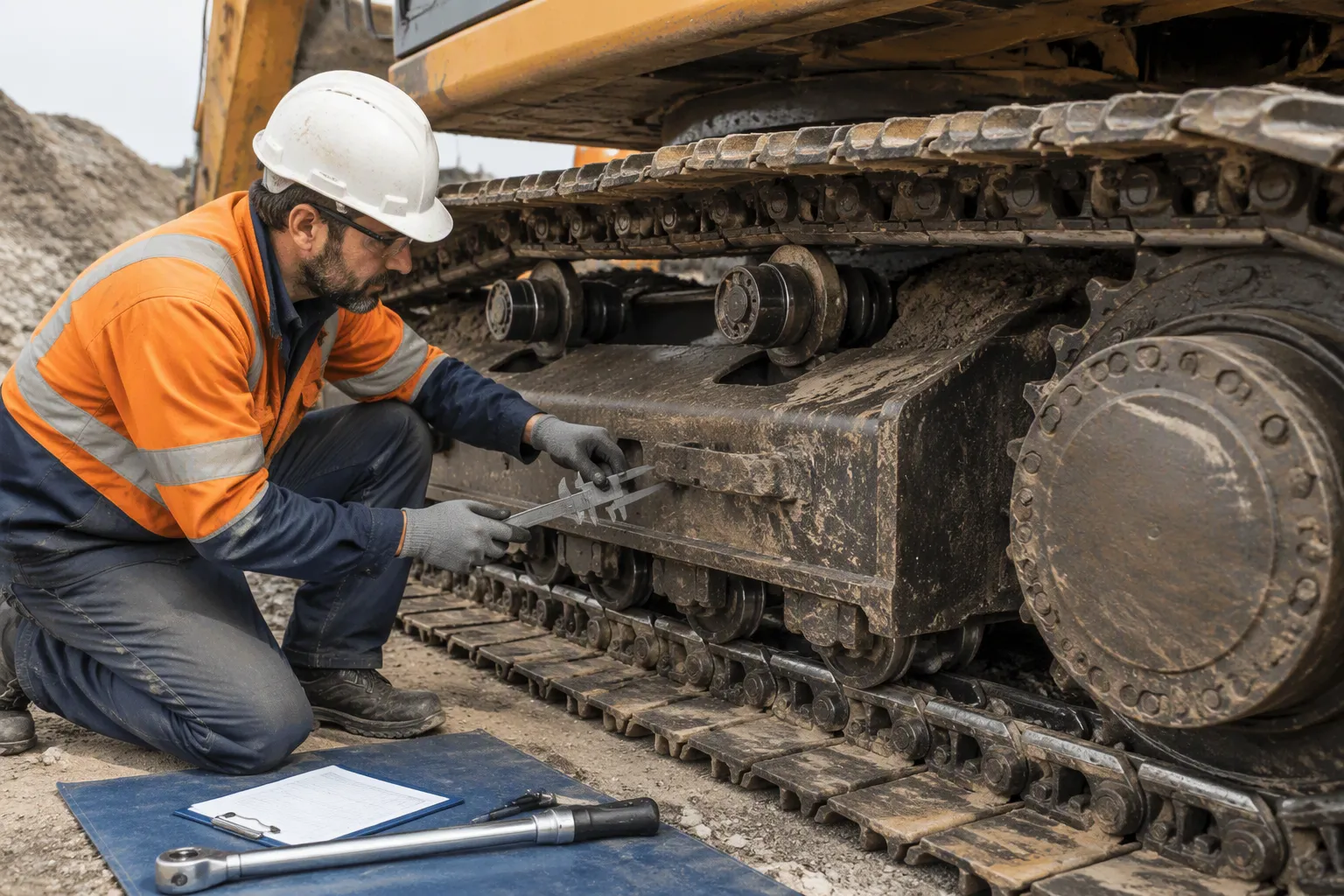
Operators who catch wear early can avoid costly downtime. Track component wear analysis starts with a steady monthly routine. Technicians first measure track chain pitch elongation. Industry rules set the replacement limit at 3–4% pitch elongation on machines using percent-of-pitch measurement; about 6–8 mm on a standard track. Past that point, the whole undercarriage needs replacement.
A full monthly checklist covers 13 inspection points. Technicians check track tension and look at recoil springs for cracks. They turn bottom rollers by hand to feel for roughness. Carrier rollers need checks for seal leaks and wobble. Sprocket teeth need a visual check for hooking or sharp points. Track shoe bolts need torque checks with a calibrated wrench. Grouser height must stay at or above 50% of original. Link rails and bushings need visual checks for flats and cracks. Chain pitch measurement must show growth of 0.5% or less from new spec. Debris removal and guard alignment finish the routine. A good inspection routine stops small issues from turning into major repairs.
The table below shows early-wear signs and root causes for each major component.
Component | Early-wear indicator / typical limit | Common root cause |
|---|---|---|
Track chain (pin & bushing) | Pitch elongation of ~2.5–3.0% versus new-chain spec; too much lateral play | Dirty environment, wrong tension, poor lubrication |
Rollers & carrier rollers | Flat spots, gouges, axial movement or slop in the bearing, oil leaks at seals; replacement at ~20% diameter loss | Contamination, seal failure, impact damage |
Idlers | Uneven wear, not enough flange thickness, cracks | Misalignment, abrasive debris |
Sprockets | Hooked or pointed teeth, missing teeth, uneven wear; more than 25% tooth height lost | Misalignment, or running a new sprocket with a worn chain |
Track shoes & bolts | Cracks, too much thinning, loose or missing bolts, bent or broken grousers | Abrasive ground conditions, improper usage |
Frame & structure | Weld cracks, bent sections, missing welds, track running off-center | Undetected structural damage causing uneven wear |
Final drives & lubrication | Contamination or metal particles in oil, non-working grease fittings, leaks | Internal wear, missed OEM service intervals |
A trained technician does this monthly visual inspection. The broader inspection plan also includes a per-shift operator walk-around, a 6-monthly competent-person inspection that produces an eight-metric measurement report, and a 12-monthly major measurement. Mining carriers on high-cycle production duty move the schedule up to 3-monthly. Any track derailment or sudden bushing failure triggers an out-of-cycle inspection before the machine goes back to work. When replacing bucket pins, bushings also need close inspection. Worn bushings speed up pin wear and lower excavator track components‘ overall durability.
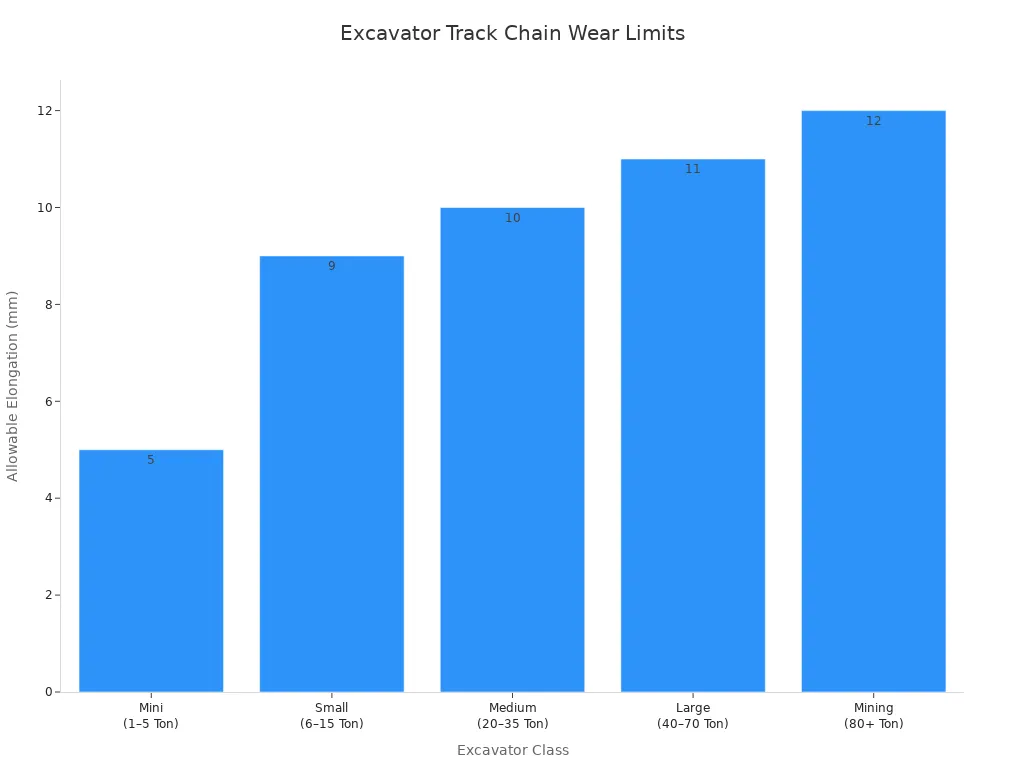
Expected elongation limits change by machine class as shown below.
Extending Track Life Through Maintenance
Track maintenance practices directly affect how long components last. Research shows that excavators working in muddy conditions with poor cleaning can suffer a 30% to 50% reduction in undercarriage life compared with machines that get thorough daily cleaning. That measurable number proves cleaning is a low-cost step with high returns. Operators should flush packed debris from sprocket valleys and between rollers after every shift in wet or abrasive environments.
Track tension adjustment also affects durability. Chains that are too loose cause slapping and faster bushing wear. Chains that are too tight overload bearings and seals. Operators should check sag against OEM specifications each month. Left and right sides must stay within ±5 mm. This simple check improves track component wear across the whole assembly. Proper adjustment also boosts the durability of sprockets, rollers, and idlers.
A quality maintenance program that combines daily cleaning, monthly inspections, and correct tension settings lowers total cost of ownership. Operators who track these metrics make informed decisions about rebuild versus replacement. That discipline protects equipment investments and extends excavator track components’ service life. Consistent attention to track component wear analysis helps avoid early failures and keeps machines productive for more hours per dollar spent.
Cost-Benefit Analysis: Price vs. Long-Term Value
The lowest price you pay at first rarely gives you the lowest cost over time. Buyers who look only at unit price often pay more later. They lose money through downtime, early failures, and buying the same parts again. A good cost-benefit analysis compares the first cost with service life, reliability, and how it affects your work. This method shows the real link between cost and quality.
Calculating Cost Per Hour of Track Life
Cost per hour of track life gives you a clear number to compare your options. The formula is easy: total part cost divided by expected hours of use. A $400 premium roller that lasts 2,000 hours costs $0.20 per hour. A $250 cheap roller that fails at 800 hours costs $0.3125 per hour. The premium option is cheaper per hour even though it costs more at first.
Part Type | Lifespan (hrs) | Price Range | Estimated Cost-per-hour |
|---|---|---|---|
Standard Steel Track Shoes | 1,200–1,800 | $50–$100 | $0.028–$0.083 |
Heavy-Duty Hardened Shoes | 2,000–3,000 | $120–$180 | $0.04–$0.09 |
Heavy-duty shoes can reach a cost-per-hour as low as $0.04. Standard shoes may need to be replaced before 2,000 hours, which raises their real cost. This math shows the true link between cost and quality.
When Cheap Wholesale Parts Cost More
Poor quality undercarriage parts often come from cheap materials and outside suppliers. These shortcuts cause early failures in every brand. A client in Dubai saw track shoes get strange pin-hole wear in under 200 hours. The cause was not enough heat treatment. A fleet in Southeast Asia had frequent pin seizures because aftermarket track shoes had bad seals and pins and bushings that did not fit the same way.
Reactive maintenance models show the money damage. For 20 machines, yearly downtime reaches 800–1,200 hours. The average repair cost each time runs $4,200–$9,800. Predictive models cut downtime to 180–280 hours and repair costs to $800–$2,400. A fleet manager in the Middle East switched to a premium aftermarket supplier with higher surface hardness. Service life went up a lot, and less downtime saved a large amount of money. A terminal renovation in Europe faced customs delays when a low-cost supplier could not give CE marking papers. The delay cost more than the price gap.
YNF Machinery offers competitive prices without lowering quality. Low minimum order quantities help buyers keep key parts in stock. This approach helps with cost vs. quality choices and long-term durability.
Judging the quality of wholesale excavator track parts comes down to five measurable signs: material grade, dimensional accuracy, compatibility, wear management, and cost-per-hour value. Buyers should ask for material certifications, dimensional reports, and sample testing before placing a bulk order. These steps confirm that excavator track components meet the required standard. A careful review of hardness, fit, and wear thresholds protects equipment and budgets. The cheapest upfront price rarely gives the lowest long-term cost. For reliable parts and documentation support, YNF Machinery is a trusted supplier with over 35 years of experience and low minimum order quantities.
FAQ
What is the most reliable method to test track chain quality before purchase?
Use calipers to measure chain pitch. Check hardness with Rockwell testing. Ask the supplier for material certificates. When samples give the same readings, you can trust the undercarriage quality.
How does a buyer verify compatibility without installing the part?
Ask the supplier for dimensional reports. Compare track chain pitch, link count, and bolt hole positions with OEM specifications. YNF Machinery gives you documents to confirm the fit.
What factors cause premature track wear?
Bad material quality, wrong tension, rough soil, and not enough maintenance. Track component wear analysis shows dirty environments can cut service life by 30% to 50%.
How long should steel excavator track components last?
Standard track shoes last 1,200 to 1,800 hours. Heavy-duty hardened shoes reach 2,000 to 3,000 hours. Service life depends on working conditions and how often you do maintenance.
What documentation confirms parts quality from a wholesale supplier?
Material certificates that meet ASTM standards, dimensional inspection reports, heat treatment records, and hardness test results. These documents prove the quality of all components.