Your excavator’s undercarriage can eat up almost 50% of its total repair budget. That makes it a top target for cutting operating costs. Buying wholesale excavator track parts is a proven way to save. You get lower prices, parts that last longer, and less downtime. The undercarriage is about 20% of an excavator’s purchase price. Yet it causes half of all maintenance spending over its life. Wholesale sourcing is not just about a cheaper price tag. It is a full plan for managing your fleet. Ordering in bulk can get you 15–25% volume discounts. Aftermarket parts often cost 30–50% less than OEM options. This article gives you real steps to reach these savings without losing quality or reliability.
Key Takeaways
Wholesale parts cost 30-50% less than OEM parts, and bulk orders give you an extra 15-25% off.
Check the quality and fit of parts using serial numbers and measurements to avoid costly mistakes.
Find reliable suppliers with certifications and negotiate bulk orders for better prices and shorter lead times.
Routine care, such as daily cleaning and tension checks, can lower costs by 45% and make parts last longer.
Track your costs for each hour you run the machine. This shows real savings and keeps your excavator working.
Direct Savings from Wholesale Undercarriage Parts
Wholesale Pricing Model
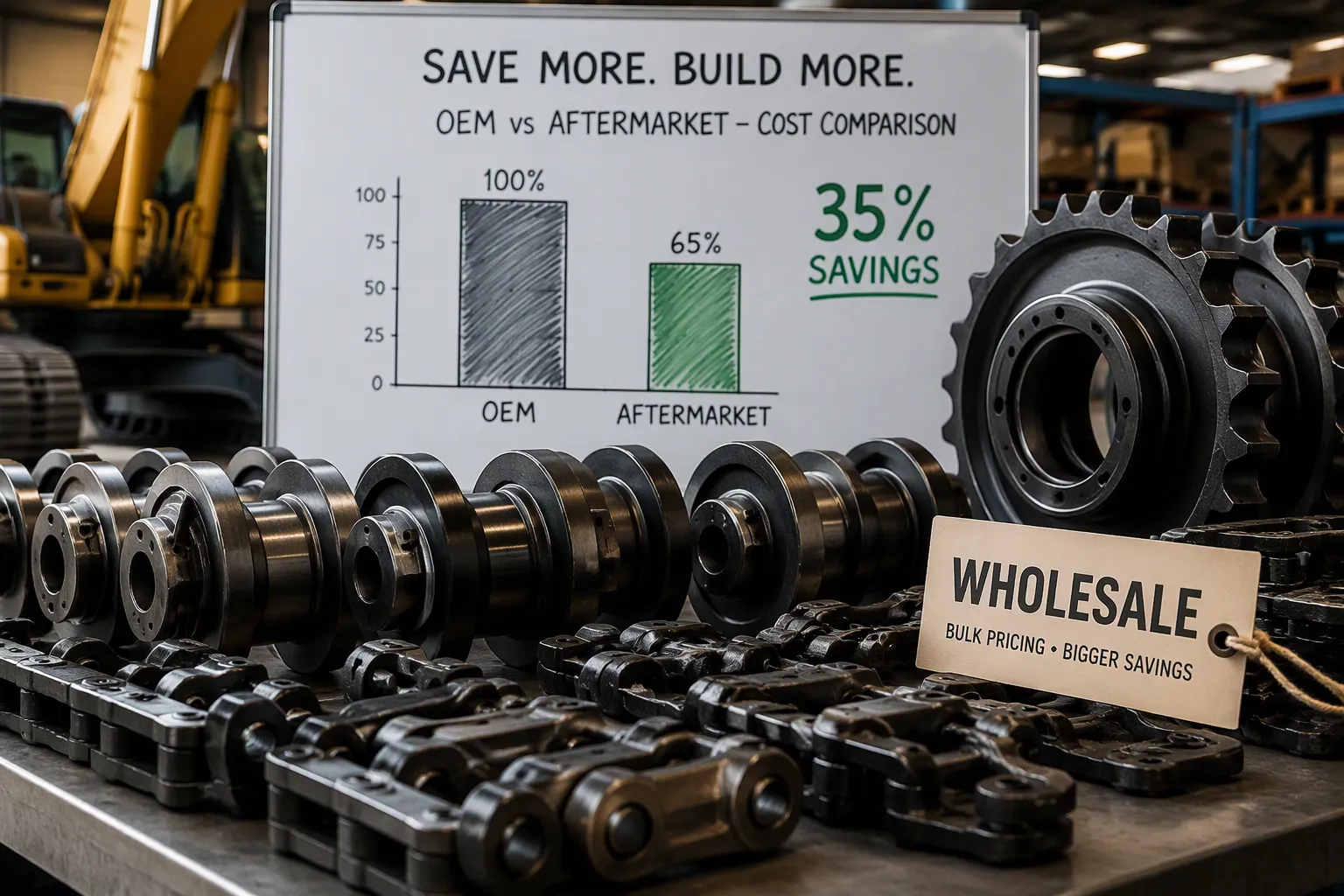
Wholesale pricing is based on volume. When you buy more parts at one time, the supplier lowers the unit price. A manufacturer sells straight to you and cuts out the middleman markup. That direct path removes distributor margins and retail overhead. Many suppliers use tiered pricing, so a bigger order earns a deeper discount. You can also lock in a price for a whole season of replacements.
The model rewards planning. When you predict your undercarriage wear, you order early and pay less per part. You also avoid emergency purchases at retail rates. A mid-sized fleet with 10 excavators can save about $50,000 a year on parts and labor by switching to wholesale undercarriage components. That number comes from lower part prices and fewer repair hours.
Cost Comparison: Wholesale vs. OEM
The table below compares OEM parts with premium aftermarket parts. It shows where your money goes and what you get back.
Attribute | OEM Undercarriage Parts | Premium Aftermarket Undercarriage Parts |
|---|---|---|
Fitment | Exact factory-spec match | Configurable for custom applications |
Materials | Consistent, warranted | Same steel grades (40Mn2, 35MnB) and HRC case depths |
Upfront price | Premium/high tier | Significant savings (good value) |
Supply chain | Slower logistics | More adaptive/faster |
Quality risk | Low (peace of mind) | Varies among uncertified suppliers |
Lifecycle implication | High initial cost, predictable life | OEM-level wear metrics at lower cost if ISO 9001:2015 certified; “economy” low-price parts fail fast and raise total cost |
The upfront price gap is real. Aftermarket parts often cost 30–50% less than OEM options. XMGT track rollers cost 20–40% less than OEM equivalents and last 1.5 times longer, based on industry benchmarks. A Middle East mining client compared Kobelco SK200 track rollers from a Chinese supplier against OEM parts. The Chinese parts lasted about 80% of the OEM life but cost only 30% of the price. On a cost-per-hour basis, the Chinese rollers were more economical.
Value isn’t just about lowest cost—it’s cost per operating hour. A $400 roller lasting 2,000 hours costs less per hour than a $250 unit failing at 800 hours.
That quote captures the real math. Look at the numbers below.
Part Type | Price | Lifespan | Cost Per Hour |
|---|---|---|---|
OEM roller | $100 | 2,000 hours | $0.05 |
Chinese (wholesale) roller | $30 | 1,600 hours | <$0.02 |
The wholesale roller wins on cost per hour even with a shorter life. But price alone can fool you. A nickel mine chose a lower-priced China OEM alternative to Hyundai track rollers to cut upfront procurement costs. Within months, many rollers leaked oil from seal failure. Several excavators stopped working. The lost productivity was greater than the original part savings. Emergency replacements had to be air-freighted, which added major logistics costs. The total cost of ownership for the cheaper rollers was several times higher than if premium-quality parts had been bought from the start.
A detailed cost-per-hour analysis is essential. Standard components with lower upfront costs may yield a higher CPH due to shorter lifetimes, while premium heavy-duty components with greater initial investments often deliver significant long-term savings.
So the first purchase price is only one part of the savings equation. Your real cost savings come from the cost per operating hour. That number combines price, lifespan, and downtime. Buy wholesale excavator track parts with certified quality, and you protect both your budget and your uptime. Track your cost per hour for every undercarriage component. Then compare wholesale excavator track parts against your current supplier. The gap will show you where the money goes.
Quality and Compatibility of Each Excavator Undercarriage Part
Buying wholesale parts saves money at the start. But saving money means nothing if the part breaks early. You need good parts that fit your excavator. This section shows how to check quality and make sure parts fit. Follow these steps to avoid wasting money and keep your machines working well.
Quality Checks for Undercarriage Parts
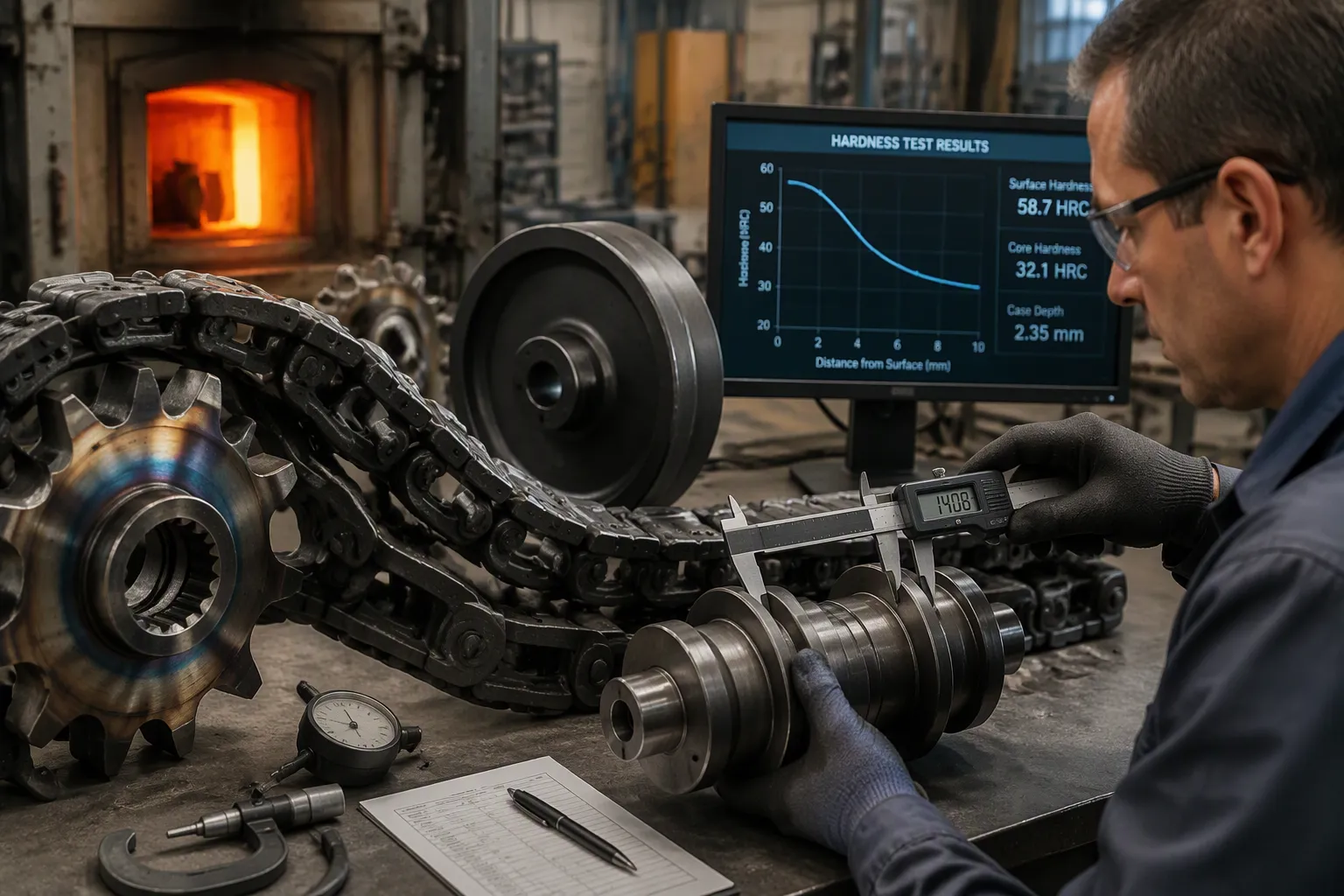
Quality starts with the steel. Good manufacturers use certain material grades for different machine sizes. Medium carbon alloy steel like 40Mn2 works well for small and medium machines in light conditions. The 45Mn grade gives higher strength and hardness for medium-sized machines. For large machines facing harsh loads, manufacturers pick 50Mn high carbon alloy steel.
Heat treatment decides how long a part lasts. Quenching heats the part to about 850–900°C, changing its structure into austenite. Fast cooling in water or oil makes a hard, wear-resistant martensite surface. Tempering then reheats the part to between 150°C and 500°C, then cools it slowly. This step relieves internal stresses and brings back toughness. The exact temperatures and cooling rates depend on the steel grade and target hardness. A premium excavator undercarriage part goes through precise heat treatment to balance hardness and durability.
Track rollers and idlers usually go through induction hardening. Electrical currents heat the outer surface exactly, followed by computer-monitored quenching. This makes a deep, hardened shell that resists abrasive wear and soil friction. Internal drive components get deep carburizing and quenching. Carbon spreads into the surface at high temperatures, creating a hard outer case around a tough core.
Manufacturing processes also matter. Forged sprockets give better shape precision than cast ones. Friction welding creates strong bonds with low distortion. Robotic CO2 welding ensures consistent quality. CNC machining delivers tight tolerances for easier assembly. A premium excavator track chain benefits from these advanced processes, giving longer service life and better wear resistance. Well-made track chains keep proper tension and reduce stress on sprockets. As one senior R&D engineer noted, “We design for the lowest cost per service hour.”
Certifications prove quality. Look for ISO 9001 certification, which shows documented procedures and consistent standards. Material certificates confirm durability. Testing methods like magnetic particle flaw detection and ultrasonic testing catch hidden defects. A 12-month warranty shows confidence in the product. Regular maintenance extends the life of quality undercarriage parts.
Beware of low-quality parts that fail early. An economy track chain may cost less but wears out quickly. The lost productivity and emergency replacement costs often exceed the initial savings. You must balance price with quality. Choosing cheap parts without verification often leads to higher total costs over the life of the machine.
Verifying Undercarriage Compatibility
Even quality parts cause problems if they do not fit your excavator. Compatibility verification prevents costly mistakes.
Start with the machine serial number. Find the serial number plate on your machine. This number links to the correct build specification and specific part revisions. Do not assume the same model name guarantees identical specifications. An unrecorded mid-production engineering revision can change mounting geometry.
Next, take physical measurements on worn parts. Use a digital caliper to measure idler bolt circle diameter or pin bore. Compare these measurements against supplier specifications. Ask your supplier to verify. Reputable providers cross-check measurements and keep detailed data sheets.
A real example shows why this matters. A full set of parts for an EX300 rebuild arrived with correct part numbers. Yet the idler bolt holes did not align by just three millimeters. An unrecorded engineering revision had changed the mounting geometry. The return air-freight cost exceeded the part value. Serial number range checks would have caught the revision.
Cross-reference against multiple sources. Track engineering changes from the manufacturer. When in doubt, ask for a physical sample before ordering bulk quantities. This approach saves you from expensive returns and downtime.
Sourcing Wholesale Excavator Track Parts Effectively
Finding Reliable Suppliers
You need a supplier who gives you good parts on time. First, look at their experience and reputation. Suppliers with over ten years in the business and long-term customers are trustworthy. They know various excavator models and give correct solutions. Certifications like ISO 9001, CE, or OEM approval show they follow standard methods. Production ability and on-time delivery are important for big orders. You need steady capacity to keep your project on track. After-sales support and technical help cut downtime when problems happen. Global client references prove the product quality and trustworthiness.
Use online sourcing platforms to look at supplier profiles, ratings, and verification info. Third-party inspection reports and certifications help check suppliers. Ask for hardness test reports to make sure wear parts are between 50‑54 HRC. Get dimensional inspection sheets and okay a sample before big production. Request pre-shipment inspection records and photos. Ask for proof of material, hardness, and heat treatment. Approve a real or photo sample before you order full volume. Check packaging, labeling, and lot tracking in writing.
Negotiating Bulk Orders
How much you order affects your costs and how long you wait. Small orders have to wait for a production slot, which can add weeks to lead times. Bigger orders get their own production runs with set schedules. Orders at the minimum order quantity (MOQ) have a higher price per unit because they cover more fixed costs. As you order more, the price per unit drops a lot.
Order Volume | Setup Cost per Unit | Lead Time Reliability | Quality Check Level |
|---|---|---|---|
Below MOQ 10 | High per unit | Not stable | Only sample checks |
At MOQ 10 | Medium per unit | Standard | Full batch check |
Bulk Order | Low per unit | High | Full batch check plus extra checks |
A trader in Southeast Asia once combined different SKUs to reach the MOQ of 10 per item. While this got better prices, it caused customs delays because the HS codes were not separated clearly in the documents. Clearance time took twice as long as shipments with only one SKU.
Talk about payment terms early. Suppliers rarely give Net 30 to new buyers. Start with small orders paid by T/T to build a history. After you have a track record, ask for a trial period of Net 30 on part of an order. You can also look for suppliers who will match payments with the shipping timeline, like a small deposit and the rest paid against a copy of the Bill of Lading. Building long-term relationships gets you steady prices and priority service for your wholesale excavator track parts orders.
How to Reduce Undercarriage Costs with Maintenance
Essential Undercarriage Maintenance
Good ways to take care of your excavator undercarriage begin with daily habits. You should do visual checks before work starts each shift. Clean the undercarriage and tracks well at the end of every day. This step removes dirt, debris, and materials that cause faster wear. Regular cleaning also helps you spot problems early. Check track tension every 10 hours during your walk-around. Look for oil leaks at roller and idler seals, loose shoe bolts, and clear damage. Detailed measurement checks should happen every 250 hours. At that same 250-hour mark, adjust track tension and grease all pivot points, including the swing bearing and track adjuster grease nipple.
A planned approach greatly extends the service life of the undercarriage system. The importance of excavator undercarriage maintenance shows in the numbers. One mining operation cut component costs by 45% and extended average track life from 2,800 to 4,200 hours. Their program combined monitoring technology with a smart parts inventory. You can get similar results with steady preventive maintenance. Train your operators to avoid track spinning, which wastes fuel and speeds up wear. In muddy conditions, clean more than once per shift. Packed material puts more strain on rollers, idlers, and links.
Extending Undercarriage Part Life
Replacing parts on time matters for your budget. Putting off a needed repair leads to higher long-term undercarriage costs. A worn excavator undercarriage part puts stress on connected components. This chain reaction raises expenses across the whole system. Proper tension of the track protects your pins and bushings from too much load. Check track sag often and keep it within specification. Worn parts make the machine work harder, which increases fuel burn. You can reduce maintenance costs and avoid downtime through consistent care.
Metric | Documented Result |
|---|---|
Reduced operating costs | 40% |
Annual savings per machine | $3,500 |
Reduction in component costs | 45% |
Extended component life | 50% |
Fewer unexpected failures | 75% |
“Implementing a structured undercarriage management program reduced our component costs by 45% while extending average track life from 2,800 to 4,200 hours. The combination of monitoring technology and strategic parts inventory has transformed our maintenance operations.”
— David Patterson, Fleet Manager, Mining Operations Inc.
Proper maintenance improves fuel efficiency and cuts unexpected downtime. Debris buildup increases internal friction and fuel consumption. A clean undercarriage runs cooler and smoother. Monitor wear of wheels and tracks during every inspection. Replace worn track chains before they damage sprockets. This proactive approach protects your investment and keeps your excavator productive.
Using wholesale undercarriage parts to cut operating costs is a smart plan. You have to balance price, quality, and maintenance all at once. Three main things drive your savings: lower upfront costs, longer part life, and less downtime. A good maintenance program saves thousands and makes your excavator last longer. Start by looking at what you spend on undercarriage now. Then find a wholesale partner you can trust. YNF Machinery sells quality excavator undercarriage parts at wholesale prices. This plan helps lower costs across your whole fleet. Your equipment will stay productive and profitable for years to come.
FAQ
How much can I save with wholesale parts?
Buying wholesale parts can save you 30 to 50 percent compared to OEM prices for excavator undercarriage parts. Volume discounts give you another 15 to 25 percent off. One fleet with 10 excavators saved $50,000 each year on parts and labor.
Will cheaper parts wear out faster?
A premium wholesale part with ISO 9001 certification wears just like OEM parts. Keep track of cost per operating hour. A $30 roller that works for 1,600 hours costs less each hour than a $100 roller that works for 2,000 hours.
How do I know a part fits my machine?
Match your excavator’s serial number with the supplier’s data. Measure old parts with a digital caliper. Ask for a sample before buying large amounts. This avoids costly returns and downtime.
What maintenance extends undercarriage life the most?
Clean the undercarriage each day to remove debris. Check track tension every 10 hours. A structured program cut component costs by 45% for one fleet. Consistent care protects your investment.