
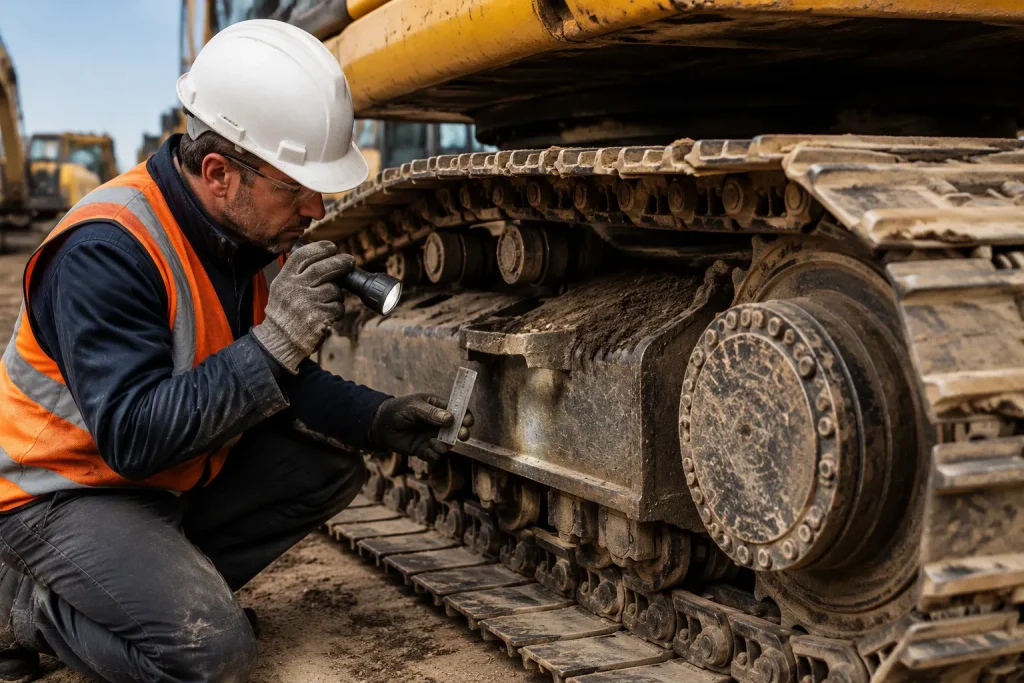
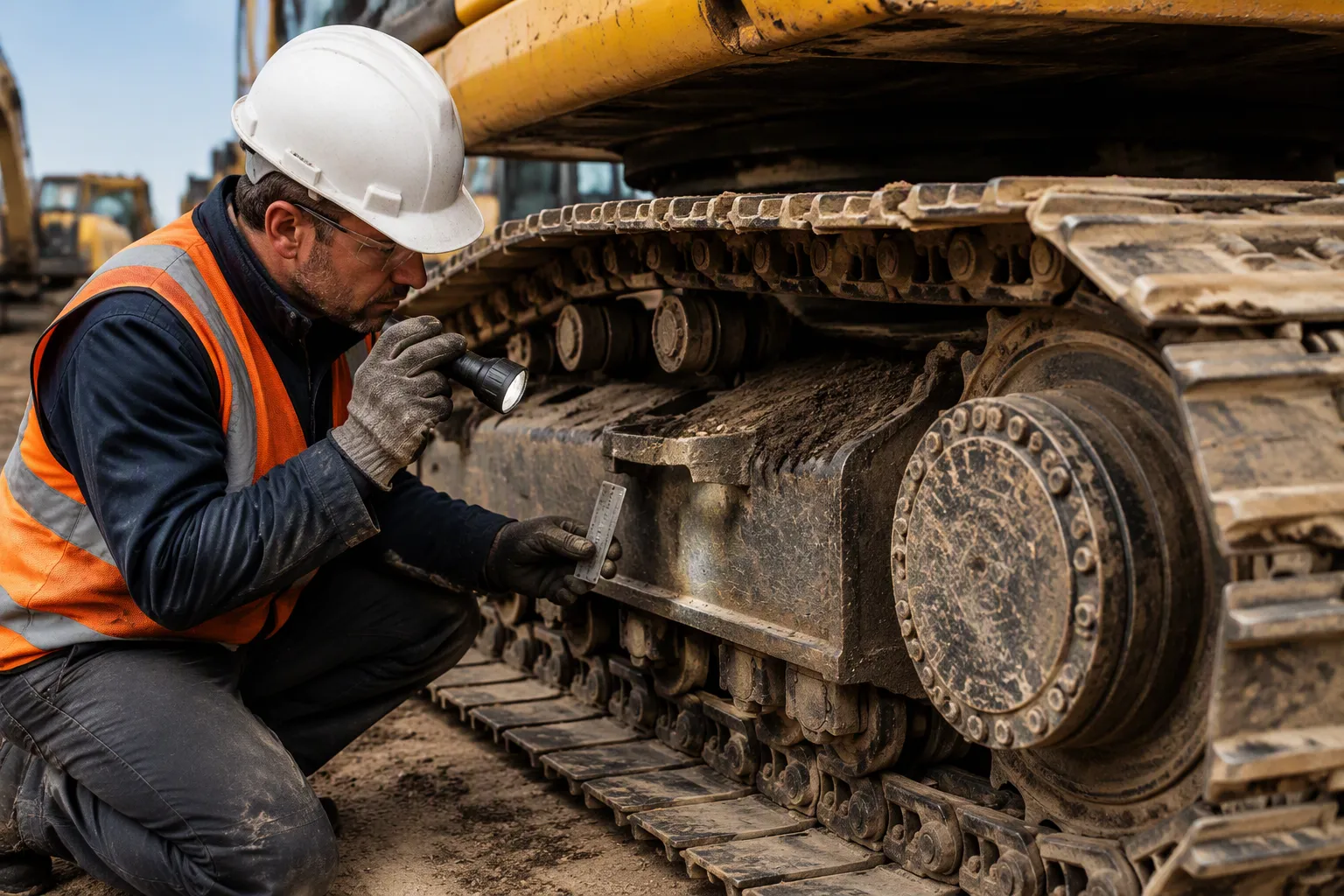
Used excavator undercarriage parts need to match the machine they will serve. A similar shape or a familiar model name does not confirm fitment. Before buying, identify the receiving machine and the exact component, inspect the actual part, and compare available evidence with documentation for the correct configuration.
A careful review separates what you can see from what still needs confirmation. Record the full machine model and serial number or PIN, the part number and revision, visible condition, measurements when relevant, and the written terms of the order. Pause if an important detail conflicts or cannot be verified.
Confirm the machine and component
Start with the machine that will receive the part. Record its complete model designation and serial/PIN from the machine records or identification plate. Keep all prefixes, suffixes, and characters. A similar model or a donor machine’s identity does not prove that a component fits yours.
Identify the needed undercarriage part by its proper name and location. Depending on the job, you may be reviewing a track chain, track shoe, roller, idler, sprocket, or another component. Record the complete part number, revision, casting mark, and other identifiers that apply. Compare them with parts information that covers the receiving machine’s serial range and configuration.
If a part number has changed, request documentation connecting the old and current references and showing that the change applies to your machine. Do not treat a partial number, a verbal match, or a photograph as confirmation. Keep the part identity separate from any diagnosis of the machine’s condition.
Inspect the actual undercarriage part
Ask to review the actual component being considered. Clean, well-lit photographs can help show its markings and visible surfaces, but use them as inspection evidence rather than proof of internal condition. Check surfaces relevant to that part for visible cracks, deformation, corrosion, damaged threads, impact marks, missing pieces, or signs of repair.
For a track shoe, look at the shoe body, mounting area, and bolt holes. For chain links, rollers, idlers, and sprockets, focus on the contact surfaces, mounting points, and features that matter to that specific component. These are examples of areas to inspect; a single checklist does not apply equally to every part. Describe what is visible and ask for clarification about anything obscured or unclear.
Confirm what is included with the component. Fasteners, seals, guards, fittings, or related pieces may be listed separately. Compare the stated scope with the actual photos and the written description so you know which items are part of the order.
Compare measurements with the right specifications
Take measurements when they are relevant to the component and can be made reliably. Record what was measured, the tool or method used, and the result. Then compare the reading with service or parts documentation for the exact component and machine configuration.
Do not apply one wear threshold to every excavator model or undercarriage part. Reference values can vary with component design and machine setup. A measurement without an applicable comparison value cannot establish that a part is acceptable. If the correct specification is unavailable, note that limitation and request documentation for the specific part rather than relying on a general range.
Review condition and test evidence
If an inspection or functional test is available, make sure the record identifies the unit being considered. Check the date, what was inspected or tested, the relevant method or conditions, and the findings. Evidence for a different unit or a general statement about a group of parts does not establish the condition of this component.
A photograph can show an external surface at one moment. It cannot establish every internal wear point, hidden damage, or future service life. A test report also covers only the items it lists. Ask what the evidence does and does not show, and keep any response with your inspection notes. Do not treat a document, photo, or broad quality statement as a guarantee of fitment or performance.
Put fitment and order details in writing
Before proceeding, provide the complete machine model and serial/PIN, the component name, full part number and revision, and relevant configuration details. Ask the parts supplier or other party offering the component to confirm fitment against those exact references in writing. Resolve mismatches before ordering.
Document the stated condition, known repairs, included and excluded items, price, delivery arrangements and timing, and applicable return terms. Keep the response, photos, parts references, and order details together. This record makes it easier to compare the component that arrives with what was described.
FAQ
What information should I provide when checking a used undercarriage part?
Provide the machine model and serial/PIN, the component name, complete part number and revision, and configuration details that affect fitment.
Can a similar-looking part fit my machine?
Appearance alone cannot confirm fitment. Compare identifiers and specifications with parts information for the receiving machine and resolve differences before ordering.
Should I use a universal wear limit?
No. Compare measurements with documentation for the exact component and machine configuration. Do not assume one value applies to every model or part.
What should an inspection or test record include?
It should identify the specific component, the date, what was inspected or tested, the method or conditions when relevant, and the findings. Check what the record does not cover as well.
What should I confirm before ordering?
Confirm written fitment, stated condition, included items, price, delivery details, timing, and applicable return terms.



