
A used excavator component can appear to match your machine and still differ in its part number, revision, configuration, or connection points. A careful review starts with the receiving machine and the actual component, then checks condition, records, included items, and fitment evidence.
When comparing used excavators parts for sale, broad listings and similar photos are not enough to establish compatibility. Use the machine model and serial/PIN, the complete component reference, and information that applies to the correct configuration. If a key detail conflicts or cannot be confirmed, pause before making a decision.
Identify the receiving machine and component
Record the machine’s full model designation and serial number or product identification number (PIN) exactly as shown in its records or identification plate. Keep every prefix, suffix, letter, and digit. A similar model name does not establish that two machines share the same component setup.
Next, identify the component you need. Write down its common name, assembly location, and any part number from the machine’s parts information. If the component has a readable label, stamped number, casting mark, or serial identifier, capture each one separately. Do not treat a donor machine’s model as proof that its part fits your machine; it is supporting history only.
Use parts documentation that covers the receiving machine’s serial range and configuration. If the plate is damaged or its information is incomplete, compare service records and other machine documents, then resolve any uncertainty before relying on a proposed match.
Verify the part number and configuration
Compare the complete component number, including suffixes and revision marks, with the relevant parts information. If an older number has been replaced, ask for documentation that connects the original and replacement references and shows that the change applies to your machine’s configuration. A verbal similarity or a partial number is not enough to establish that relationship.
Check the interfaces that matter for that component. Depending on the part, these may include mounting points and hole spacing, hydraulic ports, shaft or spline dimensions, electrical connectors, orientation, or included fittings. Use measurements and applicable specifications as comparison points. The correct details vary by component, so avoid assuming that every part uses the same checks.
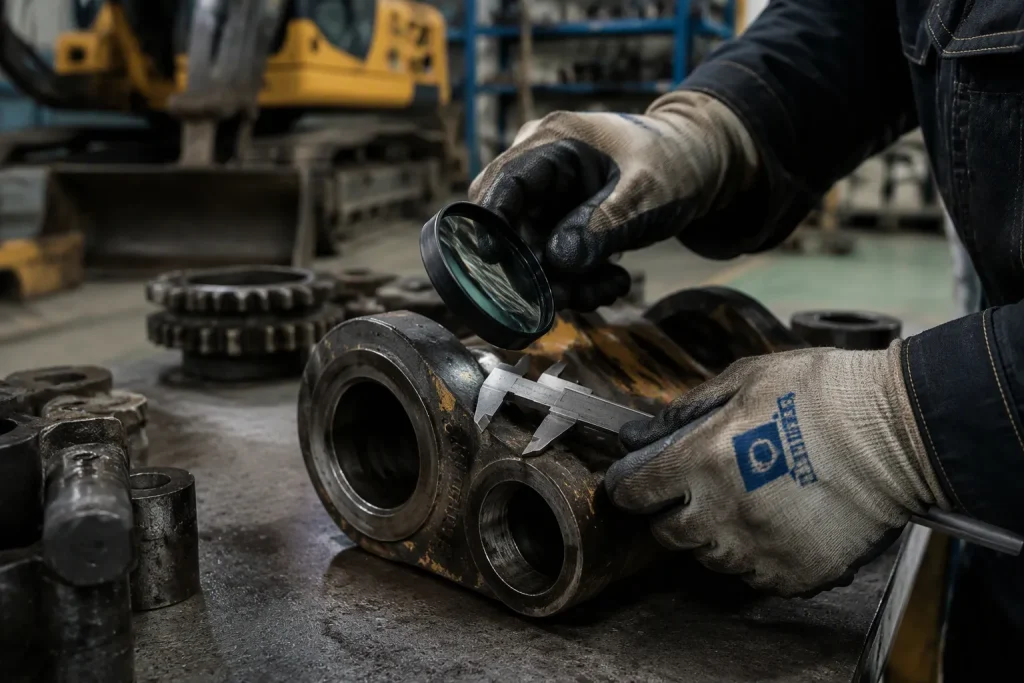
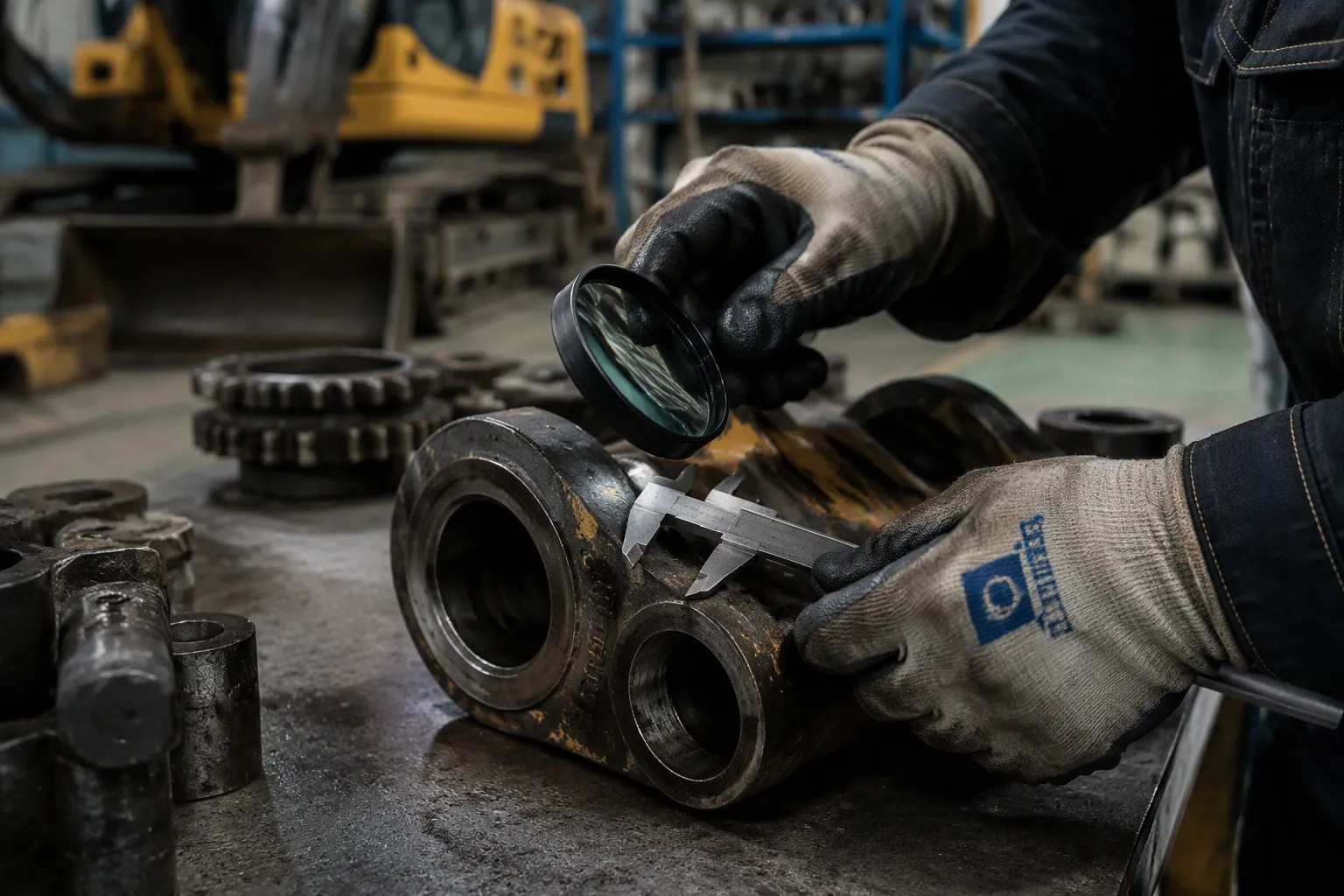
Compare a replacement with the existing component when practical, but do not rely on appearance alone. A housing can look similar while an internal revision or connection differs. If a feature cannot be measured or read clearly, record the uncertainty and request confirmation tied to the full machine and component references.
Inspect the actual part and included items
Review the actual component, not only a general product description. Look for cracks, deformation, corrosion, damaged threads, worn contact surfaces, missing fittings, loose connections, or evidence of repair. Focus on areas relevant to that part’s mounting and operation. The inspection should describe what is visible without claiming to reveal hidden internal condition.
Check seals, hoses, connectors, shafts, or other features only when they apply to the component. Note staining, leakage residue, impact marks, fresh paint, or repaired areas and ask what work was done. These observations are useful questions for follow-up; by themselves, they do not prove a component will perform or fit.
Make a written list of what is included and what is not. Brackets, sensors, wiring, seals, hoses, fasteners, and fittings may be separate from the main assembly. Ask for clear photographs of the actual item and its markings when needed, while remembering that photographs cannot verify every dimension, internal wear point, or operating result.
Review condition evidence and test records
For a component that can be functionally tested, request records tied to the specific unit being considered. Check the identifier on the report, what was tested, the test date, the method or conditions, and the reported results. A document for a different unit or a general inspection statement may not answer questions about this component.
Testing depends on the part. Some components may need a suitable bench or functional check; others may be assessed through inspection, measurements, or service documentation. Ask what evidence is available and what it does not cover. Do not assume that a photograph, a short description, or a broad quality statement proves internal condition or machine compatibility.
If records mention repairs or replacement pieces, compare them with the component markings and the stated configuration. Ask for clarification when the report omits the part number, does not identify the tested unit, or leaves a result unexplained. Keep the response with your inspection notes.
Confirm fitment and purchase details in writing
Before proceeding, send the full machine model and serial/PIN, the component number and revision, and any relevant configuration details. Request a written fitment response that addresses those exact identifiers. If a number, dimension, connector, or serial range does not match, resolve it before committing rather than assuming that the difference is minor.
Confirm the component’s stated condition, the included items, and any known repairs in the same written record. Also document the agreed price, delivery arrangement and timing, and the applicable return conditions. Clear records make it easier to compare what was described with what arrives and to follow up if an important detail differs.
Keep the machine identification, parts reference, inspection notes, test documents, photographs, written fitment response, and order terms together. A consistent record helps you explain why a component was selected and what evidence supported the decision.
FAQ
What information should I provide when checking a used excavator part?
Provide the complete machine model and serial/PIN, the component name and full part number, and the configuration details relevant to the part. Clear photos of readable markings and interfaces can help, but use applicable parts information to confirm the match.
Can a similar-looking component fit my machine?
Appearance alone cannot confirm fitment. Compare the complete number, revision, configuration, interfaces, and relevant serial range. Resolve any mismatch against documentation for the receiving machine before proceeding.
Do photographs prove the internal condition of a used part?
No. Photographs can show markings and visible external condition, but they cannot establish every internal wear point or functional result. Request inspection or test evidence suitable for the specific component.
What should a component test record include?
It should identify the actual component, describe what was tested and when, and report the relevant method or conditions and results. Ask for clarification if the record cannot be tied to the part being considered.
What should I confirm before ordering?
Confirm written fitment details, the component’s stated condition, included and excluded items, price, delivery arrangements, timing, and return conditions. Keep these details with the machine and inspection records.



