
The safest way to buy used mini excavator parts is to compare written quotes line by line. Make checking each part a normal part of that review, not something you do later. Verbal estimates and price-only comparisons hide problems with condition, identification, and terms. Those problems lead to wrong parts and costly returns.
Follow a practical order instead. Read the document’s main parts first. Check condition and qualification next. Confirm the part fits your machine. Check compliance and safety markings. Weigh total cost and value. Then decide. Each step has a checklist, so you can compare used mini excavator parts for sale with confidence and keep every claim in writing.
Key Takeaways
Always ask for a written quote that lists the part number, condition, price, and terms.
Check the part’s condition using inspection reports and paperwork, not just photos.
Verify supported application for the actual receiving machine rather than requiring donor and component identifiers to match.
Ask qualified personnel which technical requirements and documents actually apply to the offered item.
Compare the total costs, including shipping and downtime, not just the part price.
Read the Quotation’s Core Elements
Identification and Supply Scope
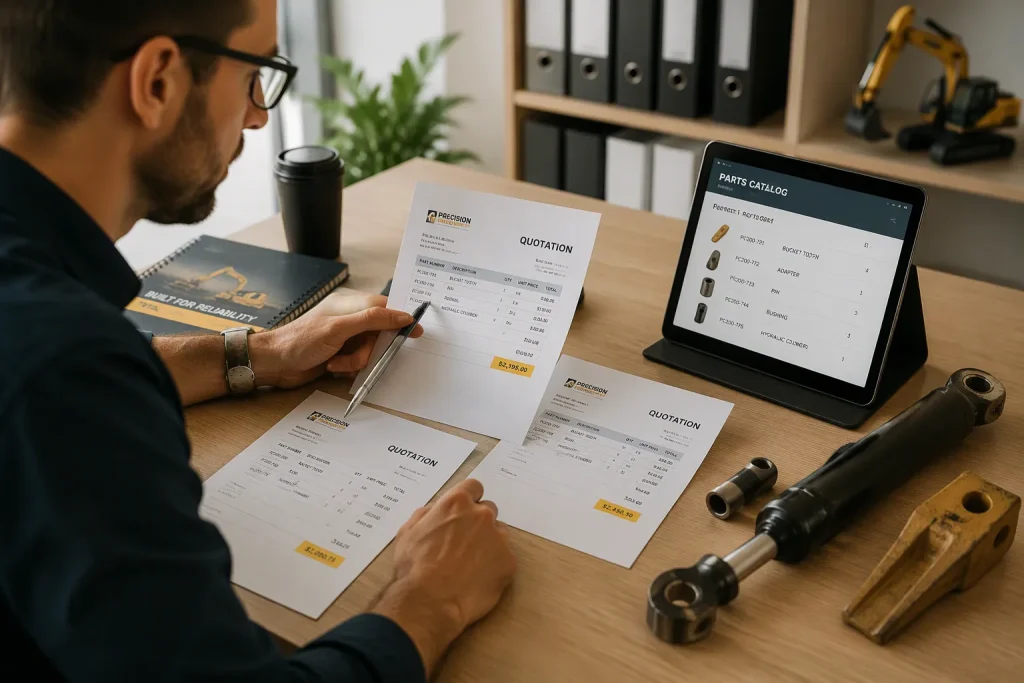
A complete written quotation gives you five things in one document. Use this checklist to test every offer you receive:
Part identification: the part name, the part number the supplier states, and the machine model and serial number range it is listed against.
Supply scope: what the price includes and what it leaves out, such as mounting hardware, seals, core charges, or shipping.
Condition statement: a written description of the component’s condition.
Price lines: each item priced on its own, with currency and any fees shown.
Written terms: payment method, return window, and who pays freight on a return.
Ask for a machine-specific quotation that ties each line to your equipment. A document that lists only a part name and a total price leaves you guessing about scope and terms.
Verbal estimates and photo-only offers are weaker for one simple reason. They carry no stated terms. A photo shows a component, but it does not state its condition or what the price covers. A phone estimate disappears once you hang up. A written quotation keeps every claim on record, so you can compare offers side by side and hold the supplier to what was promised. This applies to every sourcing option, from a local supplier to an online retailer.
Condition Statements and Written Terms
The condition statement deserves your full attention. Read how the supplier describes wear, damage, and any repairs. Look for plain language about what was checked and what was found. A vague label such as “good used” tells you little. A sentence that names the inspected areas and notes any defects tells you much more.
Written terms protect you after the sale. Confirm the return window, the refund or replacement path, and the freight responsibility in writing. Compare complete quotations on these terms, not on price alone. Two offers with the same price can carry very different risk once you read the fine print. Keep every quotation on file, and note any term the supplier states only by phone. Ask for that term in writing before you move forward.
Verify Condition and Qualification
Remote Verification and Paperwork
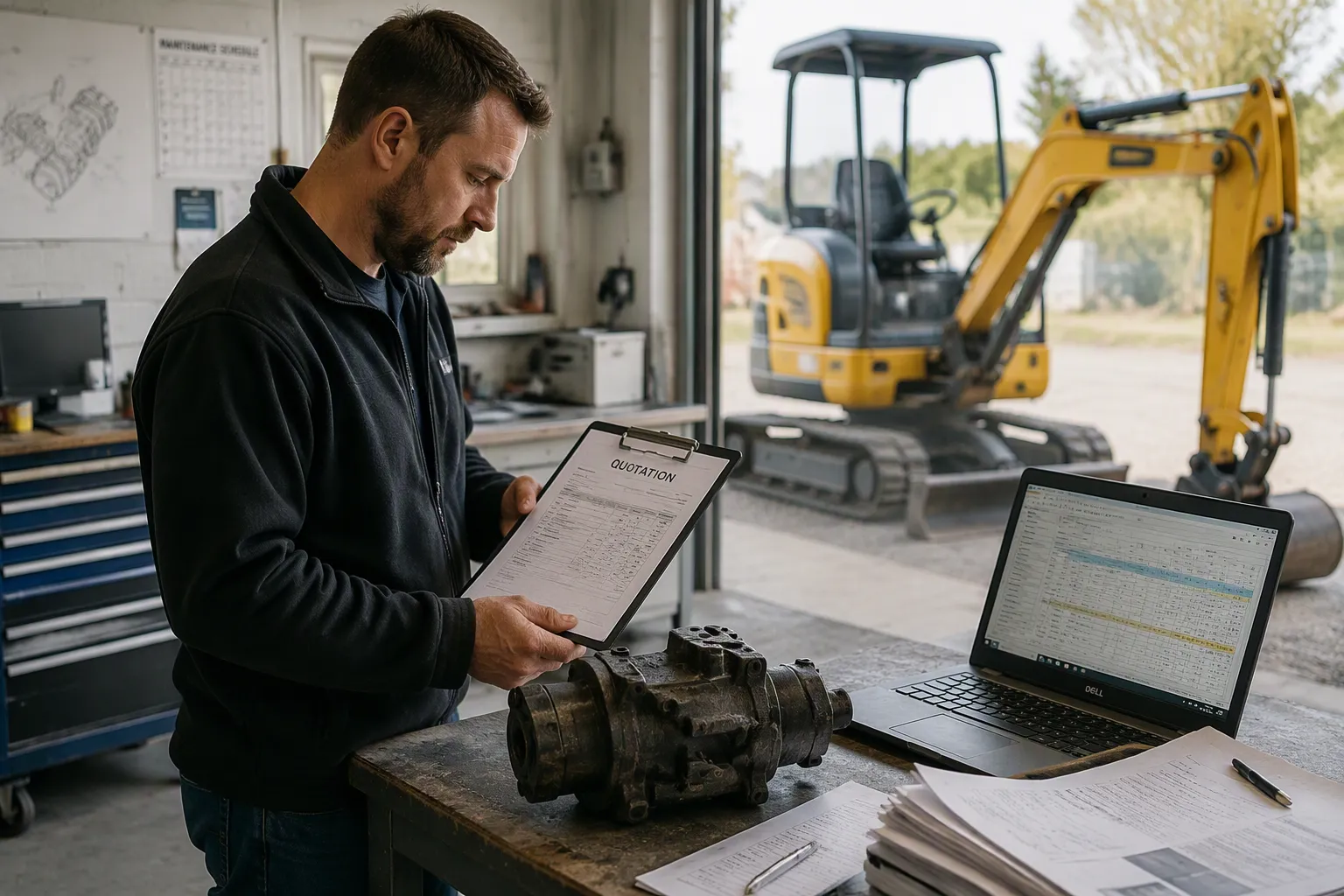
Request identification records, qualified condition findings and any tests appropriate to the actual offered component. Operating tests are not a universal requirement for every used part.
Ask for a report identifying the actual item, assessment scope, methods, findings and limitations. A cold-start video of a whole machine does not establish the condition or application of every detached component.
Keep donor-machine, receiving-machine and component identities distinct. Link records to the offered item through suitable references, then confirm supported application for the receiving configuration. Their serial numbers are not expected to be equal.
Inspection Proof in Writing
Review the proof the supplier supplies. Do not plan to run your own operating tests, open hydraulic components, or take internal measurements. Those tasks belong to a qualified service provider. Your job is to read what a qualified inspector recorded and judge whether the record is complete.
A strong package shows independent inspection by a named party. The inspector should describe what was checked and what was found, including defects. Weak proof offers general praise with no named inspector and no stated scope. Ask who performed the independent inspection and whether that person holds a qualification you can verify. A qualified independent inspection carries more weight than an in-house note with no signature.
Traceability matters as much as the condition statement. The paperwork should let you follow the component from the donor machine to the quotation line. You do not need to invent part codes or guess where a plate sits. You need documents that agree with each other. When the records line up, you can compare offers on verified facts. When they do not, ask for clarification in writing and hold the quotation until the answer arrives.
Match the Used Mini Excavator
Specifications and Application Fit
Fit confirmation starts with documents, not tools. Ask the supplier to link the quoted part to your exact machine setup. The quotation should name your model, your serial number range, and the part number the supplier lists for that use. Compare those details against your own records. A written specification sheet from the supplier gives you a fixed reference for this check.
Treat this as a communication step. Send the supplier your machine details in writing and ask them to confirm the match in writing. The reply becomes part of your quotation file. This approach works for any used mini excavator, whatever its age or hours. You never guess at fitment, and you never rely on a phone call alone.
Fit Questions Before You Accept
Resolve every fit question in writing before you accept an offer. Use this list as your guide:
Does the quoted part number match the part number listed for your exact unit?
Does the supplier’s record show the same model and serial number range as your machine?
Are machine, donor and component identifiers recorded distinctly and linked to the actual offered item?
Does the supplier state the machine setup the part came from, including any variant details?
Does the condition statement note anything that affects fit or installation?
Does the quotation state which machine-specific data the supplier used to confirm the match?
Send these questions to each supplier and compare the answers side by side. A supplier who answers each point in writing gives you machine setup details you can check. A vague reply leaves a gap you cannot close later. Hold the quotation until every answer arrives, and keep the written replies with your files.
Check Compliance and Safety Markings
Required Declarations
Ask qualified personnel to identify the technical and documentation requirements that apply to the actual part and intended use. Do not assume every used component requires a conformity declaration or a particular safety label. Quality-management certification is separate from product-specific assessment and fitment evidence.
Your quotation and packing list should agree on what ships and what documents travel with it. Compare the part number, the quantity, and the declared contents across both documents. A supplier who sends matching records gives you a file you can audit later.
Gaps That Should Pause a Purchase
Pause if an applicable requirement or essential claim remains unresolved. Clarify inconsistent identification, missing relevant assessment records or unsupported certification claims. The need for any specific declaration must be established for the actual item.
Investigate differences between the quote, supplied scope and supporting records. A documented supersession may explain different references. Resolve essential questions before purchase rather than assuming every mismatch makes an item illegal or unusable.
Compare Used Mini Excavator Parts for Sale on Total Cost
Landed Cost and Availability
The quoted part price is just the beginning. Total ownership costs cover everything you pay to get a working part into your machine. Add freight, duties, handling fees, and the cost of any return. Add the downtime cost while your excavator sits idle. A low sticker price with slow delivery can cost more than a higher price that arrives quickly.
Compare supported application, the actual offered condition, included quantities, current quotation and agreed terms. Machine tonnage and donor hours provide context but do not independently prove component fit or remaining life.
Ask for actual stock status and a written dispatch or delivery estimate, including any preparation requirements. Stock status alone does not guarantee an earlier shipment.
Compare actual new, used, repaired or aftermarket alternatives using supported application, condition evidence, quotations and written coverage. Labels do not establish a standard price order, full remaining life or steady availability.
Machine History and Value
The donor machine’s history shapes the part’s real value. Ask for the model, the serial number, and the recorded hours of the machine the component came from. A part from a well-documented machine gives you more confidence than one with no history. Pair that history with the inspection proof you already reviewed.
Do not estimate remaining component life from donor hours alone. Qualified condition findings and actual service requirements should inform suitability for the intended use. A backup machine still requires safe and supported parts.
Review the condition statement one more time at this stage. Compare it against the machine history and the inspection record. Look for agreement across all three. A condition note that matches the paperwork gives you a file that makes sense. A mismatch deserves a written question.
Now rank your quotations on total value, not price alone. Score each offer on documentation, verified condition, fit, compliance, and landed cost. A complete file with a clear history often beats a cheaper offer with gaps. Keep every written reply with the quotation. This habit lets you defend your choice and compare future offers against a known baseline.
Score Quotations and Confirm in Writing
Side-by-Side Checklist Review
Make one scoring sheet and treat every offer the same way. Score each quotation on five things: paperwork, checked condition, fit, compliance, and total cost. Give the factors weights that fit your job. A main work machine may need more weight on checked condition. A backup unit may lean toward landed cost. Write the weights down before you open the files, so price cannot slowly take over the review.
A weighted comparison can organize commercial preferences after essential technical requirements are satisfied. A high total score must not override unresolved safety, condition or compatibility issues.
Supplier reliability belongs in the same review. Check each supplier against set rules: response time, how complete the written quotation is, willingness to answer fit questions in writing, and clear return terms. Ask every candidate for a free written quotation to compare. A supplier who sends a full package without pressure earns trust. One who pushes for a quick decision before the documents arrive does not.
Written Confirmation Before Payment
Get the final terms in writing before you pay. Send the supplier a short confirmation message that restates the part number, the machine model and serial number range, the condition statement, the price, the lead time, and the return terms. Ask them to reply and confirm each point. That reply closes the loop and becomes the record you rely on if anything goes wrong.
Reconcile the final confirmation with the quote, assessed condition and supported application. Written records reduce ambiguity but cannot by themselves make a purchase risk-free.
Compare quotes in order: read the main parts, check condition, confirm fit, check compliance, then weigh total value. A written quote is only as strong as the checking behind it. Walking away from an incomplete quote is a valid result.
Use a repeatable comparison record, retain relevant evidence and resolve essential questions before committing to the purchase.
Confirm the actual offered component, supplied scope and written terms before payment.
FAQ
What makes a written quotation stronger than a phone estimate?
A written quotation keeps every claim on record. It states the part identification, the supply scope, the condition, the price lines, and the terms. A phone estimate leaves no trace. You cannot compare it line by line, and you cannot hold a supplier to a promise that was never written down.
Which documents should I request to verify a used part’s condition?
Request identity records and qualified condition findings tied to the actual offered item, plus any appropriate test report. Whole-machine videos or photographs alone do not prove the condition of a detached part.
How do I confirm a quoted part fits my machine?
Use applicable documentation to verify the proposed reference for the actual receiving machine and configuration. Keep donor and component identifiers separate and request support for any supersession or substitution.
What compliance gaps should stop me from paying?
Ask qualified personnel to identify applicable requirements for the actual offered item. Resolve relevant missing evidence or inconsistent claims; do not assume a generic declaration or label rule applies to every component.
Should I choose the lowest-priced quotation?
Not on price alone. Score each offer on documentation, verified condition, fit, compliance, and landed cost. Add freight, duties, handling fees, and downtime to the sticker price. A complete file with a clear machine history often beats a cheaper offer with gaps.
For excavator parts sourcing, consider YNF Machinery. Share full machine and component identification, applicable part references and quantities, and request supported compatibility information, an actual quotation, and written warranty and return terms before ordering.