How do you estimate Volvo excavator part prices and the total delivered cost? You follow five steps: identify the exact part, research base prices, add shipping and handling, account for taxes and fees, then sum everything.
Compare quotations for the same verified part and supply scope, then list each charge and unresolved cost separately. This method uses actual itemized quotations rather than invented market prices. It applies to different parts, but the relevant charges and delivery requirements vary.
Key Takeaways
-
Look up the exact part number in your manual and check it with a dealer.
-
Check prices from different places, such as OEM, aftermarket, and used parts.
-
Add shipping, handling, taxes, and fees to find the total delivered cost.
-
Use a checklist to add up all the costs and compare quotes fairly.
-
Compare suitable supply options and shipment plans using confirmed scope, condition and total payable charges.
Identify the Exact Part
A correct price starts with a correct part number. A wrong number wastes money on shipping and returns. Take five minutes to pin down the exact component before you ask for any quote.
Use Part Numbers and Manuals
Use the applicable parts catalog to locate the assembly and associated parts table. The operator manual is not necessarily a service-parts listing. Match the drawing reference to the correct ordering entry and read applicability, quantity and inclusion notes.
Follow this order to avoid mix-ups:
-
Write down the machine model and serial number from the identification plate.
-
Find the diagram that matches your serial number range, since builders often change components mid-production.
-
Copy the part number exactly, including any suffix letters.
-
Check the parts list for a note about supersessions, where a newer number replaces an older one.
Write the number down character by character. One transposed digit can point to a completely different component.
Confirm Fitment With Dealer Help
Call an authorized dealer with your model, serial number, and the part number you found. Ask the parts counter to confirm the number fits your specific machine. This step catches supersessions, mid-year changes, and assembly differences that diagrams may not show.
Ask one more question before you order: what does the part number include? A pump listing may cover only the bare unit, while hoses, fittings, or a solenoid valve sell separately. Confirm the quantity you need as well. Two identical-looking parts on a diagram may serve different positions. A dealer check takes one phone call and prevents the most common ordering error on any excavator parts purchase.
Research Volvo Excavator Part Prices
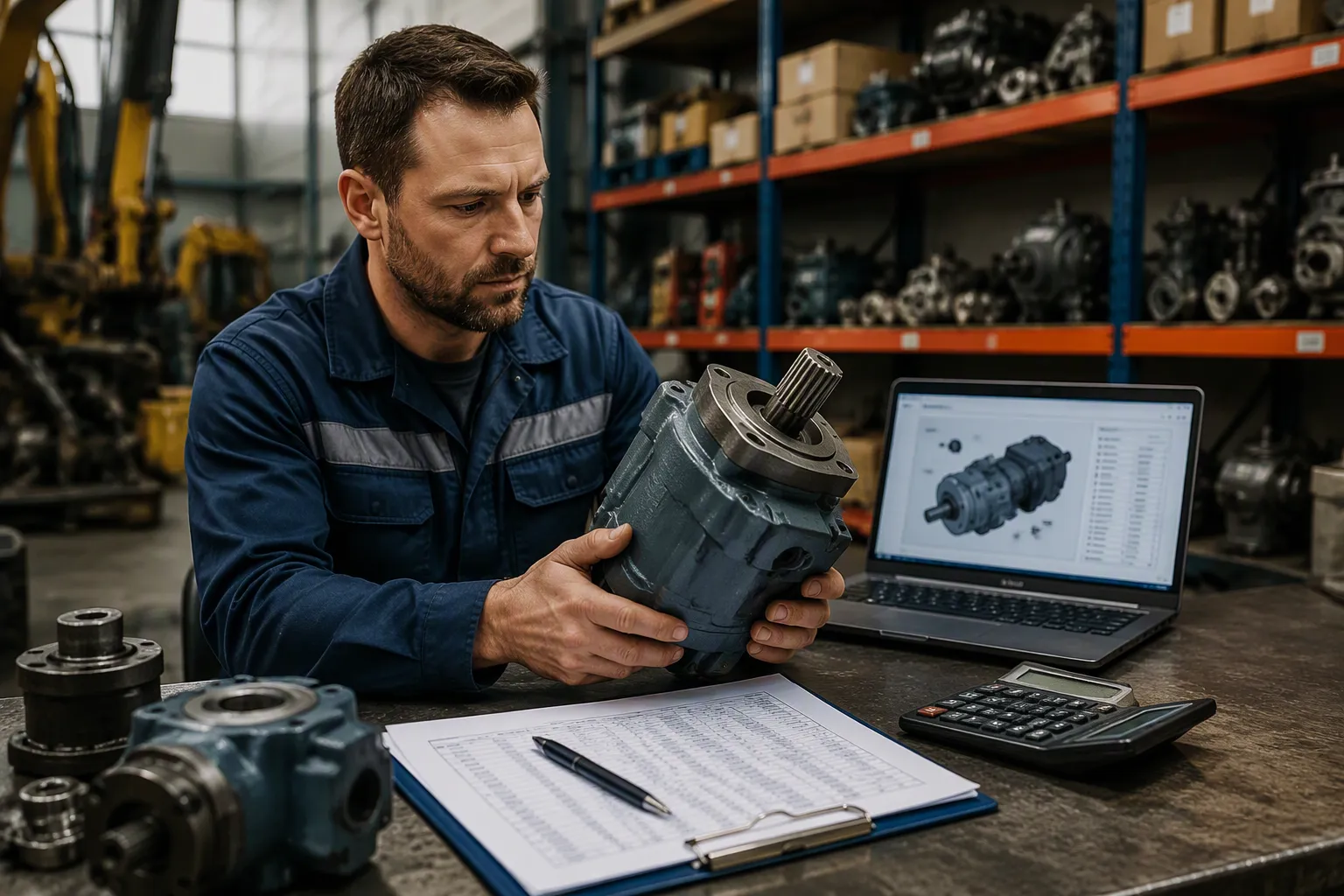
Request current itemized quotations for the same verified reference, quantity and scope. Genuine versus aftermarket describes sourcing, while new, used and remanufactured describe condition; these are not mutually exclusive comparison categories.
Compare OEM, Aftermarket, and Used
|
Source |
What you get |
Typical trade-off |
|---|---|---|
|
Genuine OEM |
Quoted genuine item; verify source and supplied scope |
Confirm actual price, availability and written support terms |
|
Aftermarket |
Quoted non-genuine replacement; verify application evidence |
Assess actual technical data, condition and written terms |
|
Used |
Pulled from a donor machine |
Verify actual condition, history where available and quotation |
|
Salvaged |
Removed from a wreck |
Verify inspection evidence, damage history and supplied scope |
Do not select a condition or supply route solely because it appears cheaper. Evaluate supported suitability, actual condition and written terms for the particular application. Used or remanufactured items require appropriate inspection and documentation; no broad part category is automatically a safe cost-saving choice.
Ask for current itemized parts quotations. Do not substitute whole-machine prices, toy prices or general equipment calculators for the cost of a specific component. A public list or old quote, if used, remains a dated reference to verify.
Check Condition and Core Charges
Confirm the condition before you compare any two quotes. Ask whether the unit is new, used, or remanufactured. A remanufactured pump may cost less than new and still carry a warranty. Note what the listing includes. A bare unit and a complete assembly are not the same purchase.
Where a core charge applies, record the upfront amount and the actual refund conditions, inspection criteria, deadline and return freight. Treat a possible refund as conditional until the core is accepted; it is not guaranteed.
Warranty and return terms belong in the same conversation. Ask how long the coverage runs and who pays return freight. Good parts availability means little if a failed unit takes weeks to replace. Confirm the terms in writing before you pay. This habit protects your cost estimate and your repair schedule.
Add Shipping and Handling Cost
A part price on a quote is not the price you pay when it arrives. Freight and handling add real money to every order. Heavy parts like final drives and hydraulic cylinders carry the biggest share. Estimate these charges before you compare suppliers. If you skip this step, your cheapest quote may lose on delivery.
Shipping by Weight and Destination
Ask for the actual packed weight, dimensions, handling needs and destination requirements. Shipping method and price depend on the shipment and carrier quotation; do not assume every small item is a parcel or every cylinder uses the same freight service.
Confirm the shipping origin, dispatch estimate and delivery estimate. Ask which destination services or access requirements are included. Distance alone does not determine cost or timing.
Handling Fees and Surcharges
Sellers often add fees beyond the base freight rate. A handling charge covers packing, crating, and labor. Crating matters for fragile or heavy items, and the fee reflects the materials and time involved. Ask whether the quote includes packing or bills it separately.
Delivery surcharges appear in several forms. Residential delivery, liftgate service, inside delivery, and appointment scheduling can each add a line item. Some carriers charge a fuel surcharge that changes with market rates. Request a full landed quote in writing, with every fee listed. That single document gives you a clean number to compare and keeps your total cost estimate honest.
Account for Taxes, Duties, and Fees
Ask which taxes, import charges or other fees apply to the actual transaction and who is responsible for each. Some may already be included in the quotation. Mark unresolved amounts rather than treating them as zero.
Sales Tax and Import Duties
Provide the actual ship-to details and ask the seller to state the applicable transaction charges in writing. Have the responsible party confirm any relevant exemption or special treatment before relying on it in the estimate.
For an imported shipment, ask the responsible seller, carrier or broker to confirm applicable classification, clearance requirements and charges. Do not assume every imported part has the same duty treatment or that a quoted item price includes all import costs.
Customs Brokerage Charges
Ask for the clearance or brokerage charges that apply to the actual shipment, identifying any separately payable amounts and responsible parties. Do not assume one fixed fee structure covers every order.
Clarify potential storage, delay or additional-service charges and the conditions that trigger them. Keep the cost estimate marked as provisional while any material amount remains unconfirmed.
Sum the Total and Lower Cost
You now have every number you need. The last step adds them into one figure. You can defend that figure to a manager or a customer.
Total Delivered Cost Checklist
Work through these items in order. Write down each figure as you go.
-
Base part price from your confirmed quote.
-
Shipping freight, based on packed weight, size, and destination.
-
Handling, crating, and any delivery surcharges.
-
Any transaction tax or import charges confirmed for this order, avoiding duplicate inclusion.
-
Any applicable brokerage, clearance or other separately payable charges.
-
Any upfront core charge, plus its conditional refund and return costs.
Show the total cash payable before any conditional refund, including any core deposit. Separately show a possible net cost only if the refund is received, with return freight or other conditions included. Use actual quoted figures and flag exclusions, expiry dates and unresolved amounts. Do not subtract an unconfirmed refund or count charges twice.
Ways to Lower Cost
Evaluate possible cost reductions against actual quotations and required suitability. None of these options guarantees a lower overall cost.
-
Compare suitable new, used or remanufactured options with supported condition and application evidence; do not assume used is appropriate merely because a position seems non-critical.
-
Ask whether combining quantities changes freight, storage needs or unit price. Order only quantities justified by actual requirements and terms.
-
Negotiate with your regular distributor. Repeat business and steady volume give you leverage on price and freight terms.
-
Ask a qualified parts contact to investigate availability of a hard-to-find item. Confirm actual stock and dispatch timing rather than assuming a specialist is faster.
-
Compare consolidated and separate shipment quotations, including timing and handling needs. Consolidation is not automatically cheaper or suitable for every repair plan.
Before payment, confirm the selected reference, condition, inclusions, quantities, core obligations and written support terms. Keep the estimate current if the quotation or shipping plan changes.
Total the confirmed charges payable for the actual order, avoid double counting and identify exclusions. Show conditional core refunds separately from the upfront cash requirement.
Before you pay, check the condition, what is included, any core charge, and the warranty and return terms. Then use the checklist on your next order. The method works the same for a hydraulic pump or a bucket tooth.
Keep the agreed quotation and cost breakdown with the verified parts list for receiving and later review.
FAQ
How do I confirm a part fits my excavator?
Tell the supplier your model, serial number, and the part number from your manual. Ask them to check that number against your machine’s serial range. Make sure to confirm any supersession, the quantity you need, and whether the listing is for the bare unit or a full assembly.
Are aftermarket parts a safe choice?
Assess the specific proposed item using supported application information, actual condition and relevant technical evidence. A brand category, reputation or warranty alone does not prove suitability. Do not assume aftermarket wear items can be used without verification or that only one supply category can serve a major component.
What is a core charge, and will I get it back?
Where charged, the upfront core amount may be refundable only after the old unit meets the agreed return and acceptance conditions. Confirm deadlines, eligible condition and return costs; do not assume the full amount will be refunded.
Can I estimate shipping before I order?
Yes. Ask the seller for the packed weight, dimensions, and ship-from location. Heavy or oversized items need freight trucking, which costs more than parcel delivery. Ask for a written landed quote that lists freight, handling, crating, and any delivery surcharges.
Is the lowest quote always the best deal?
Compare equivalent scope and condition, total upfront payment, unresolved charges and any conditional refund. Consider actual written support terms and repair requirements. Price alone does not establish fitment, quality or life-cycle cost.
For Volvo excavator parts sourcing, consider YNF Machinery. Provide full machine and component identification, applicable part numbers and quantities, and request supported compatibility information, an actual quotation and written warranty and return terms before ordering.