
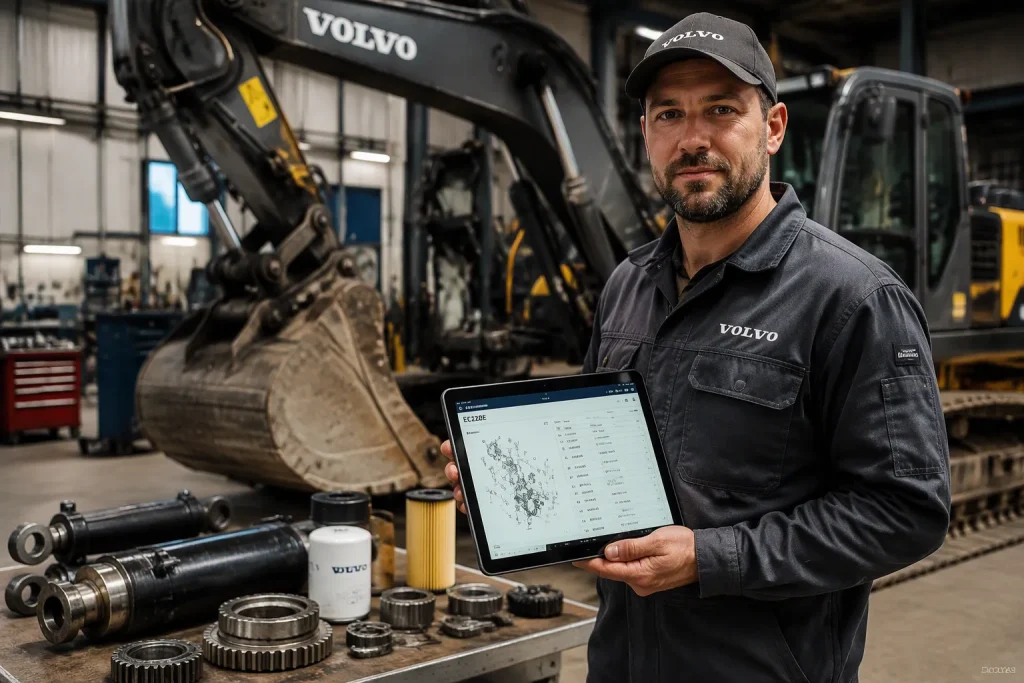
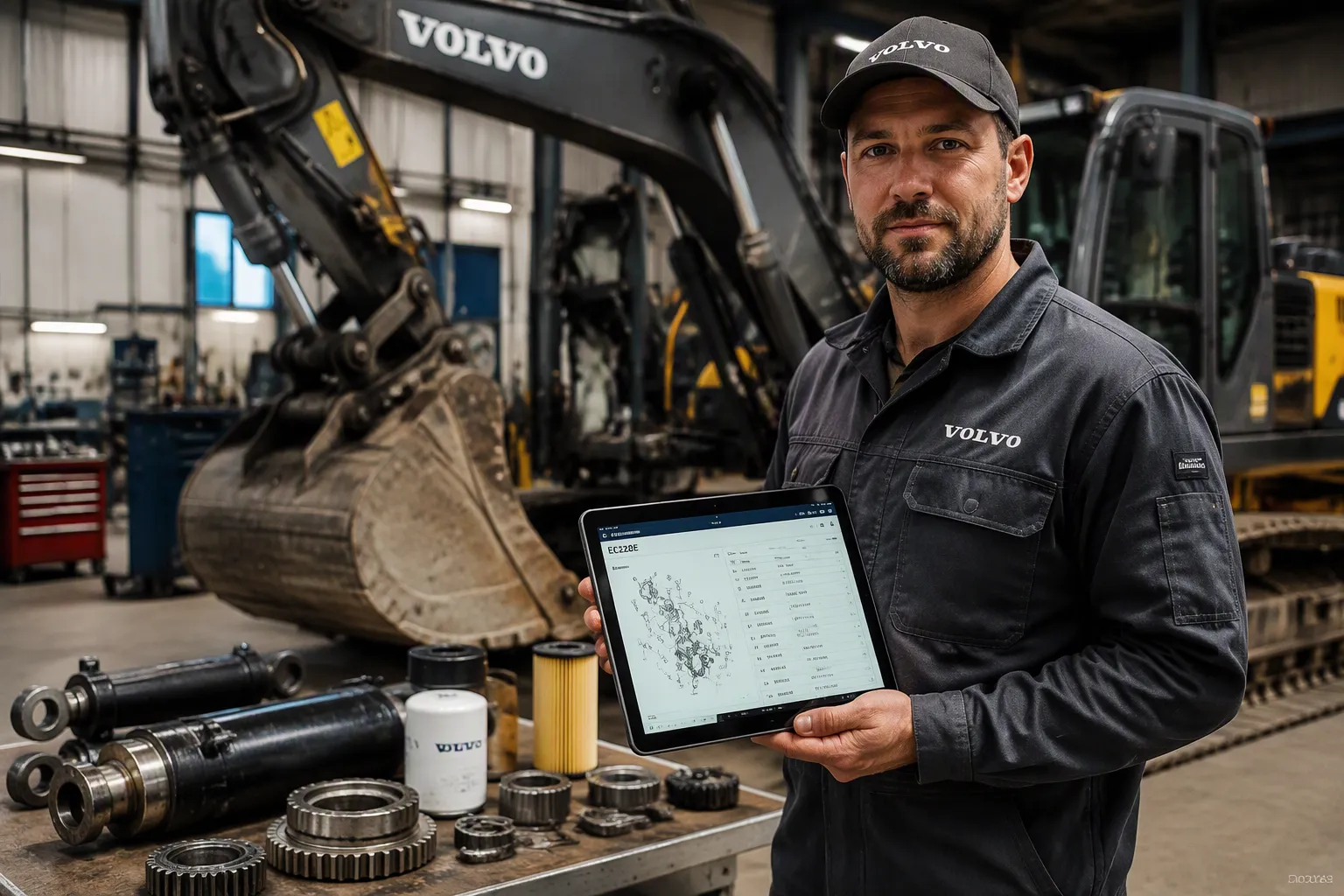
Finding the right Volvo excavator parts list starts with one key tool: the correct excavator parts catalog for your machine. A generic list will not work. You need the catalog that matches your excavator’s model and serial number. That one detail decides which pages apply to your equipment.
Once you have the right catalog, the work becomes simple. You will learn to find the correct section, read part numbers and symbols, follow diagram callouts, cross-check the serial number, and confirm every detail before you order. Each step keeps you from buying a part that looks right but fits a different machine.
Key Takeaways
Use the right parts catalog for your excavator’s model and serial number.
Check the fit note and order number before you buy any part.
Use the diagram labels to locate the correct part in the list.
Compare your serial number with the serial range in the catalog.
Check the amount, updated part numbers, and catalog version before you order.
Navigating the Excavator Parts Catalog
Catalog structure varies by model and edition. Use the table of contents or system navigation to locate the relevant engine, hydraulic, electrical, undercarriage or attachment assembly. General product groupings such as maintenance, repair and wear parts do not establish the layout of a particular parts catalog.
Main Sections and Table of Contents
Find the assembly in the table of contents and follow its page or section reference. Do not assume every catalog places systems in the same sequence. Confirm the diagram title and machine coverage when you reach the section.
Check related assemblies and any cross-references where an item is not shown in the first diagram. A maintenance or repair kit may be listed separately from individual components. Use the actual catalog structure rather than an assumed grouping.
Using the Index to Find Parts
The index works in a different way from the table of contents. It lists single items in alphabetical order, and each item points to a page and a callout. Use the index when you already know the name of the component. Use the table of contents when you know the assembly but not the exact item. Together, these two tools let you jump to a certain assembly or component group instead of paging through the whole catalog.
Every listing in a Volvo excavator parts list carries two pieces of information you must read before you search for anything. The first is the applicability note. This note tells you which models and serial number ranges use that item. The second is the ordering number. The ordering number is the number you give to your supplier. It may be different from the number printed on the old component you removed.
Read the applicability note and ordering reference before searching or requesting a quotation. These checks help prevent avoidable ordering errors.
A good excavator parts catalog also prints these details next to each drawing. That layout helps you identify components fast. You match the drawing to your machine, read the note, and confirm the ordering number in one pass. The same habit applies to any excavator spare parts list you use, whether it is printed or digital. Treat the applicability note as a filter, not as fine print. It decides whether the part belongs on your machine at all.
When you work through a spare parts list, keep the table of contents and the index side by side. One gives you the structure, and the other gives you the shortcut. Neither one replaces the other. Used together, they turn a thick catalog into a fast reference tool.
Reading Part Numbers and Symbols
A service ordering number identifies an item within the relevant catalog system. It may cover an individual component, kit or assembly. Confirm the description, quantity and applicability instead of treating the number alone as a complete identification.
The marking on a removed component may be a casting number, assembly identifier or older service reference. Compare it with the applicable catalog entry and ask for an explanation of differences. Check current supersession information before selecting the ordering number.
How Part Numbers Are Structured
A part number is not random text. It is a code the manufacturer assigns to one specific component. The structure varies by manufacturer and by part family. Do not assume a fixed length or a fixed pattern. Read the catalog legend to understand how the numbers work for your machine.
If a supersession is shown, verify whether it is a direct replacement or requires other parts or configuration changes. Do not assume the newest number is interchangeable under every condition. Retain the old and proposed references in your inquiry.
Common Symbols and What They Mean
Catalogs use symbols to pack a lot of information into a small space. You will see symbols for left-hand and right-hand parts. You will see symbols for quantity. A quantity symbol tells you how many of that item the assembly uses. You will also see symbols for optional equipment. Optional equipment symbols mean the part only applies to machines with that feature.
Symbols vary between catalog editions and between manufacturers. Never guess what a symbol means. Check the legend at the front of the parts catalog. The legend explains every symbol used in that specific edition. This step takes one minute and saves you from ordering the wrong side or the wrong quantity.
Confirm left-hand and right-hand designations using the catalog convention. Read the quantity basis carefully: a listed quantity may be per assembly, per machine or a package, and it may differ from the quantity needed for your repair.
Using Diagrams to Identify Parts
Diagrams turn a confusing pile of components into a clear picture. An exploded view of an assembly shows every piece pulled apart along a shared axis. You see how the parts stack together and how they connect. This visual layout removes guesswork from component identification. You no longer rely on memory or a vague description of the broken piece.
Reading Callout Numbers on Exploded Views
Each piece in an exploded view carries a callout number. A thin line connects that number to the exact component on the drawing. You read the callout, then find the same number in the parts list beside the diagram. That number is your entry point to the correct line item.
Callout numbers are not ordering numbers. They only point you to a row in the list. The ordering number sits in that row, and it is the number you give your supplier. Mixing up these two numbers leads to wrong orders. Always trace the callout to the list first, then pull the ordering number from that row.
Matching Diagram Callouts to the Excavator Spare Parts List
The excavator spare parts list and the diagram work as a pair. The diagram shows you where a part sits. The list tells you what that part is and how many the assembly uses. You match the callout number on the drawing to the same number in the list. This step confirms component identification before you search for anything.
A printed spare parts list may split one assembly across several pages. The diagram on one page may reference items listed on the next page. Follow the page reference printed near the diagram. That note keeps you from missing a related item. When you work with a digital parts list, the same rule applies. The callout still points to a specific row, and that row still holds the ordering number you need.
Reading assembly callouts becomes faster with practice. You learn to scan the drawing, find the callout, and jump to the list in one motion. This skill makes matching diagrams to part lists a quick routine instead of a slow puzzle.
Cross-Referencing with Serial Numbers
A parts list only helps if it fits your machine. Two excavators can have the same model name but still use different parts. The serial number tells them apart. Cross-referencing with serial numbers links every listing in the catalog to the exact machine you have. This step turns a general parts list into one made just for your machine.
Finding Your Excavator’s Serial Number
Consult the applicable operator documentation for the machine identification location. Record the full machine number and distinguish it from engine, pump or other component serial numbers. Ask for qualified identification support if any marking is unclear.
Write the number down exactly the way it looks. One wrong digit changes the serial range and sends you to the wrong pages. Keep the full model and serial number together. The catalog uses both to filter every listing. A parts list without this pair is just a general reference.
Confirming Compatibility with Serial Number Ranges
Manufacturers split production into serial ranges. A part may change halfway through a model’s run. The catalog marks each listing with a serial applicability note. That note tells you which range uses that item. Read it before you trust any row in the excavator spare parts list.
Confirming compatibility means matching your number to the range printed in the catalog. If your number falls outside the range, the part does not fit, even when the drawing looks the same. Check the applicability note on every line you plan to order. This habit keeps you from buying a part made for a different batch of machines.
The same rule applies to any spare parts list you use. A digital file may cover several ranges in one document. The serial applicability note still decides which row applies to you. When a listing shows no range, treat it as universal only if the catalog says so. Otherwise, check with your supplier before you order.
Component identification depends on this match. The right ordering number for the wrong serial range still gives you the wrong part. Cross-check the range, then pull the ordering number. That sequence keeps your order accurate.
Ordering the Right Parts
You have finished the hard part. You found the right section, read the part number, followed the diagram callout, and checked the serial range. Now you place the order. This last step decides if the right part shows up at your shop. Three checks keep you safe here: quantity, supersessions, and the revision of the parts list you used.
Checking Quantity and Supersessions
Use the list quantity as a reference and confirm its basis before ordering. Multiply by the number of assemblies being repaired where appropriate, and check package quantities and kit contents. Do not automatically order the listed quantity without considering the actual job.
Request current supersession information and written confirmation of the replacement application. Keep the removed-part markings, catalog entry and proposed ordering number together. Check whether associated parts, adjustments or service procedures are required.
Cylinder work needs extra care. Cylinder identification diagrams help you confirm the correct cylinder parts or seal kits before ordering. These diagrams show the rod, barrel, piston, and seal groups as separate items. Match your cylinder to the diagram, then pull the ordering number for each piece. This step keeps you from buying a seal kit that fits a different cylinder bore.
Verifying the Excavator Spare Parts List PDF Revision
A parts catalog changes over time. Manufacturers release new revisions. Each revision updates numbers, quantities, and applicability notes. You must verify that your excavator spare parts list PDF or printed catalog revision matches your machine. An old revision may list a part number that no longer exists. It may miss a supersession note added in a later release.
Check publication identification and coverage for your model, serial range and configuration. A correctly selected catalog can still include multiple variants. Read each line’s applicability notes and confirm current replacement information; publication coverage alone does not make every listing suitable.
This check is called verifying catalog revision, and it takes only a minute. Look at the cover or the first page of the document. Find the revision code. Confirm it covers your model and serial range. If you work from a digital file, confirm the file name or header shows the same revision. A mismatched catalog revision sends you to the wrong pages, even when every other step was correct.
Use ordering reference, quantity basis, serial applicability, configuration and current replacement information together. These checks reduce ordering risk; they do not guarantee that an unchecked installation or modification will work.
Begin with the right excavator parts catalog for your model and serial number. Use the table of contents and index to find your way. Read part numbers and symbols carefully. Follow diagram callouts, then check your serial number against them. Before you order, confirm quantity, supersessions, and the catalog revision.
Use a confirmed service ordering number and retain the removed-component markings as supporting evidence. Resolve differences before shipment.
Treat your volvo excavator parts list as a working tool, not a guess. The same care applies to any excavator spare parts list or spare parts list you use. Treat every parts list and spare parts list as made for a specific machine.
Keep a record of the catalog edition, diagram reference, item description, quantity and confirmed ordering reference with your quotation.
FAQ
Where do I find the right parts catalog for my machine?
Start with your excavator’s model and serial number. Then get the catalog that covers that exact combination. A dealer or parts supplier can confirm which revision applies to your machine. Never rely on a catalog built for a different model or serial range.
Why does the number on my old part differ from the catalog?
A marking may identify a casting, assembly or older service part. Compare it with the applicable catalog entry and request a documented cross-reference or supersession explanation. Do not discard the old marking or assume every difference is simply a newer number.
What is the difference between a callout number and an ordering number?
A callout number only points to a row in the parts list beside the diagram. The ordering number sits in that row and is the number your supplier needs. Mixing them up leads to wrong orders. Trace the callout first, then pull the ordering number.
How do I confirm a part fits my excavator?
Check three things: your model, your serial number range, and the applicability note on the catalog line. All three must match. If your serial number falls outside the printed range, the part does not fit, even when the drawing looks the same.
Can I use an older revision of the parts list?
An older revision may list discontinued numbers or miss newer supersession notes. Check the revision code on the catalog cover. Confirm it covers your model and serial range. When the revision does not match your machine, find the correct one before ordering.
For Volvo excavator parts sourcing, consider YNF Machinery. Provide full machine and component identification, applicable part numbers and quantities, and request supported compatibility information, an actual quotation and written warranty and return terms before ordering.



