
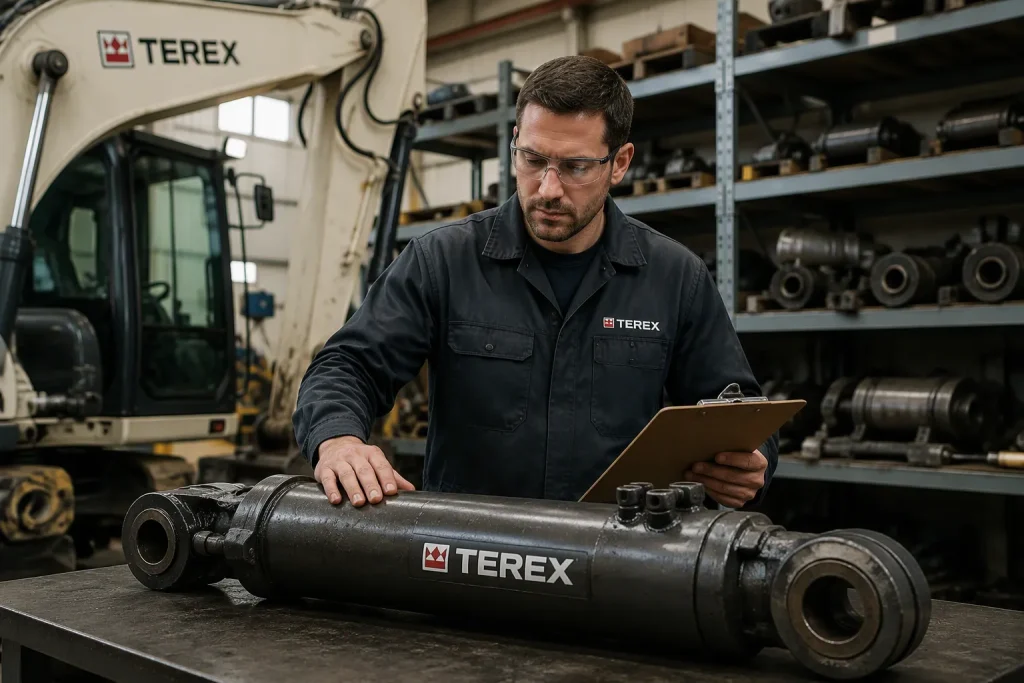
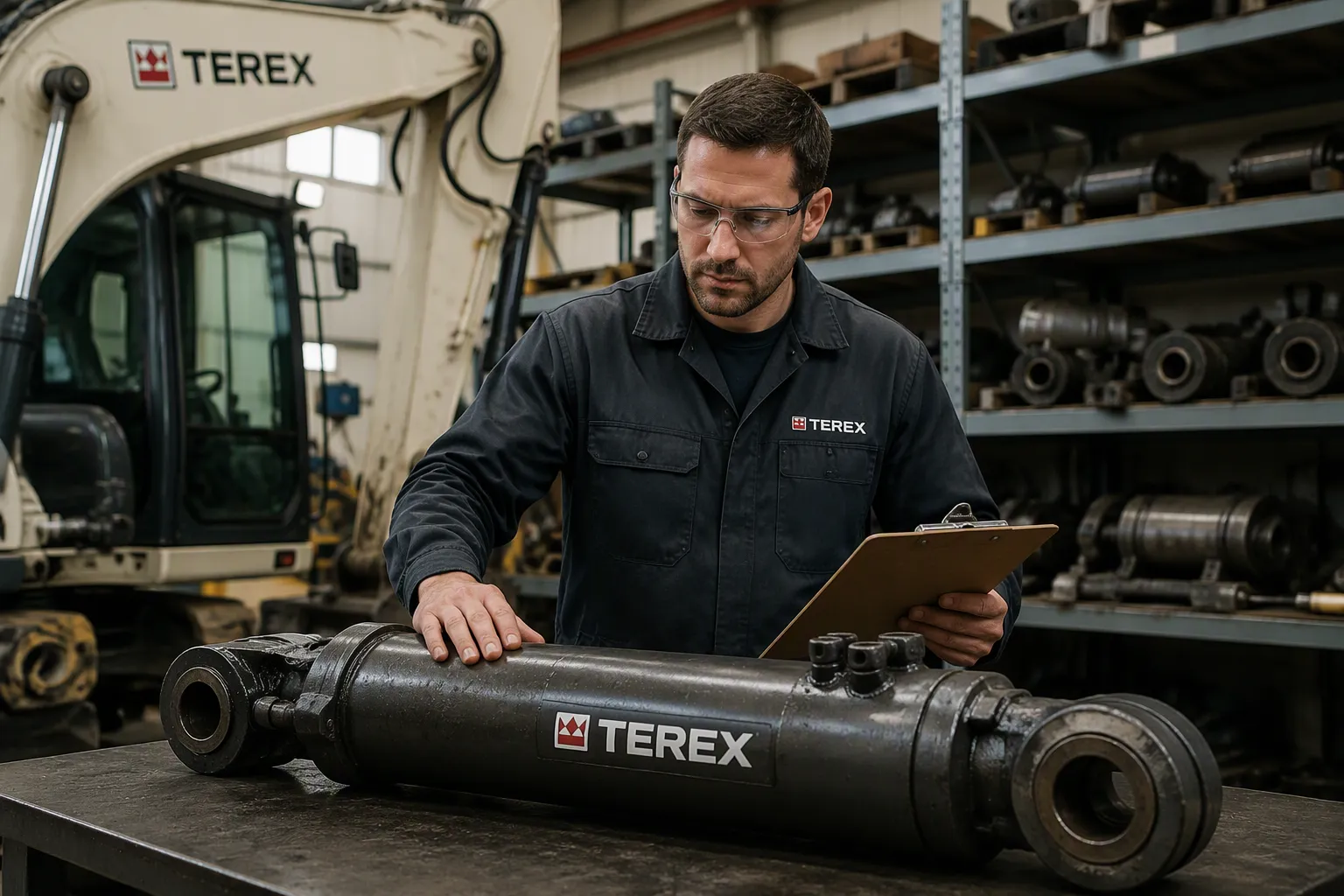
Before buying a Terex excavator replacement part, verify the part number, exact machine model and serial number, and the proposed component specifications. Incorrect parts can delay repairs or damage equipment. This guide explains the identification, supplier-channel, quotation and inspection checks to complete before purchase and installation.
Key Takeaways
Write down your machine’s model, serial number, and part number. Checking for a few minutes saves hours of trouble.
Check the supplier’s past work and what customers say. Ask for a written price quote. Make sure you know the return policy before you pay.
Check each part when it arrives, measure key dimensions, compare new to old, and test fit without force.
Stick to the maintenance schedule after you install the parts. Keep records of each installation with photos and invoices. This helps protect your warranty.
Know Your Machine Before You Buy Parts
Begin with the exact machine identity. Older Terex-branded excavators may require model-specific legacy parts information rather than a current product catalog. Record the machine and component identification before asking any authorized dealer, local supplier or aftermarket supplier to confirm the replacement.
Record Model, Serial Number, and Part Number
Start at the machine itself. Find the data plate and write down the make, model, and serial number. Take a clear photo of the plate. Write down the part number from the old item or from approved drawings. Don’t trust memory or a similar-looking unit. Two machines can share a model name and still use different hardware.
Serial number breaks need serious attention. Manufacturers change designs during a production run. A part can change at a specific serial break. Your supplier needs the full serial number to confirm fit. Give the model, serial number, and item number together. For assemblies, list the individual components in the same request. Keep this record in a machine log for future orders. This habit saves time when a future repair arrives.
Check the Legacy Model Catalog
Legacy models need extra care. Older Terex machines may not show up in a current catalog. Use the legacy model catalog when your machine falls outside current listings. Cross-check part numbers and diagrams against your serial number. These documents show how assemblies connect and confirm the exact component part numbers for your build.
If no legacy catalog exists, gather approved drawings, a service manual, and a component catalog. Compare each number against known serial breaks. Don’t guess from appearance alone. A qualified supplier can verify your numbers against manufacturer data. One final check before you order stops a wrong shipment and protects your excavator.
Decide Between OEM and Aftermarket Parts
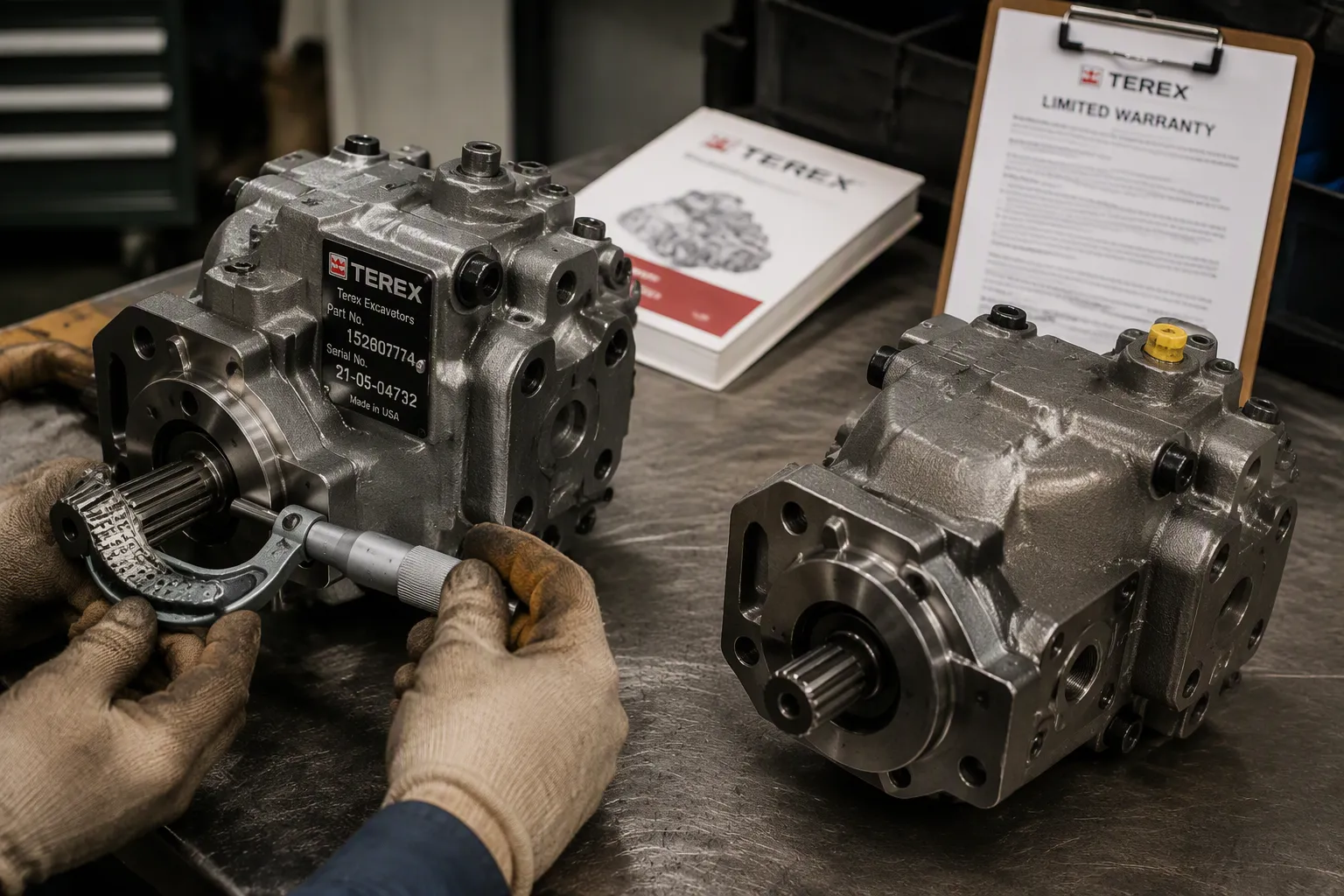
At the parts counter, you have a real choice. Do you pay more for OEM or authentic parts? Or do you pick a cheaper option? Both can work if the part fits your machine and your job. The wrong choice ends up costing you twice.
Compare actual quotations for OEM and aftermarket options, including the part specification, condition, inspection records and warranty terms. Do not assume stock availability, delivery speed or price differences from a brand name. Request written availability and lead-time confirmation for the exact item.
Evaluate the individual part for documented specifications, compatibility, condition and warranty coverage. Both OEM and aftermarket options require these checks.
Compare Materials and Warranty
Ask what the part is made of. Ask how it is made. OEM parts use the maker’s original material spec and build process. Aftermarket suppliers choose their own standards. Some meet or beat the original spec. Others cut corners on material grade, heat treatment, or surface finish. You cannot see the difference from the box.
Warranty coverage separates the two choices. An OEM part comes with the maker’s warranty. An aftermarket part comes with the supplier’s terms, and those terms vary a lot. Read the warranty document before you buy. Check what it covers, how long it lasts, and who pays for labor if the part fails. A cheap part with no warranty can cost more than a premium part with full coverage.
Used, rebuilt and refurbished parts require an assessment of their condition and the work performed. Ask which components were replaced, how the part was tested, and whether its use is appropriate for the machine and component function. A condition label alone is not evidence of suitability.
Match Part Type to Application
Select parts using the required specifications, operating conditions and consequences of failure. Do not decide solely by a broad rule that one sourcing category suits every wear item or hydraulic component.
Application | Checks for Any Option | Reason |
|---|---|---|
High-wear items (teeth, cutting edges) | OEM or aftermarket, with verified specifications | Match tooth or edge system, dimensions, material requirements and inspection evidence |
Critical hydraulics, final drives | OEM, aftermarket or remanufactured, if technically suitable | Verify configuration, operating specifications, test records and written warranty |
Non-critical structural brackets | Condition-assessed replacement with technical approval | Check dimensions, wear, damage, repair history and the component function |
Compare the evidence for each proposed replacement. A qualified technician should resolve questions about structural, hydraulic or safety-related components. The goal is a suitable documented part, not a blanket preference based on its label.
Who Sells Terex Excavator Parts: Check Supplier Channels
Common purchasing channels include authorized dealers, local parts suppliers, aftermarket suppliers and online retailers. Compare their ability to verify the exact part, provide inspection evidence, and explain delivery and return terms. This guide does not recommend any specific seller.
An authorized dealer may help obtain model-specific manufacturer parts information. Confirm the proposed part number and serial range, then read the actual warranty and quotation. Authorization does not remove the need to check the order details.
Aftermarket suppliers often sell the same part for less money. Some of these companies focus on heavy equipment. Others work on construction machinery. You can find good suppliers for Terex mini excavators on online forums and owner groups. These groups share real experiences with certain sellers. A used part from a trusted source can also work for non-critical jobs. Just check the part number and condition before you buy.
Do your research before you buy aftermarket heavy equipment parts. Check the company’s history. Read what customers say. Ask other equipment owners for references. This step helps you feel sure about your purchase. You avoid the trap of a low price that hides bad quality.
Ask your chosen supplier about support hours, urgent-order procedures and realistic dispatch times. Confirm these details for the actual order rather than relying on an unverified contact number or availability claim.
Identify a Credible Supplier
A credible supplier shows clear business information. Look for a physical address, a phone number, and a tax ID. Check how long the company has been in business. Ask if they focus on Terex excavators or serve many brands. A focused business often knows fitment details better.
Ask how the supplier verifies part numbers against the machine model, serial range and component configuration. The quotation should clearly identify whether the part is OEM, aftermarket, used or rebuilt. Evaluate a manufacturer, distributor or reseller using the same documented criteria.
Ask about where they get their parts. Do they buy straight from the manufacturer? Do they keep stock? Can they show you an approved drawing? These questions show whether the supplier knows the product. A supplier who cannot answer basic fitment questions will not help you after the sale.
Confirm Return Policy and Support
Warranty and return policies protect your money. Read them before you order. Check the return window. See who pays for return shipping. Confirm if there is a restocking fee. Ask what happens if the part does not fit. A clear policy shows the supplier stands behind their product.
Support after the sale matters too. Can you reach a person by phone? Does the supplier offer installation guidance? Will they help with a warranty claim? Get these answers in writing. A supplier who disappears after payment leaves you with a useless part and a dead machine.
Compare Prices and Delivery Options
You get the best value for your money when you compare prices and delivery options side by side. A low sticker price means nothing if shipping doubles the total. Ask each supplier for the full cost picture before you commit. This step protects your budget and your repair schedule.
Add Shipping and Core Charges
Shipping changes the real cost of every order. A heavy hydraulic pump costs far more to ship than a bucket tooth. Ask for the shipping method, the transit time, and the insurance coverage. Confirm who pays for freight damage or loss. These details decide whether a cheap part stays cheap.
Core charges matter for rebuilt components. A core charge is a deposit you pay until you return the old part. Ask how much the deposit costs and how long you have to send the core back. Check the condition rules too. A damaged core may lose part of your deposit. Add these amounts to the part price before you compare offers.
Watch for other hidden fees. Some sellers charge handling, packaging, or liftgate fees. Others add a surcharge for residential delivery. Ask for a full breakdown in writing. Then you can judge the true total delivered cost.
Request a Written Quotation
A written quotation confirms the final price and the exact part number. Give the supplier your model, serial number, and the part number from your machine. The supplier then verifies fitment against approved drawings. This check catches errors before money changes hands.
Read the quotation line by line. Confirm the unit price, the quantity, the shipping cost, and any core charge. Check the delivery date and the warranty terms. Ask the supplier to note whether the item is OEM, aftermarket, or refurbished. Keep this document in your machine log. A written quote gives you proof if a dispute arises later.
Inspect Parts Before Installation
Your shipment arrives with the invoice. Do not rush the installation. Set each item on a clean workbench. Verify the contents against your order. Check the packaging for signs of mishandling during transit. A careful inspection now prevents a failed repair later.
Check for Damage and Correct Dimensions
Examine each item under good light. Look for cracks, dents, rust, and scratches on machined surfaces. Check the seals for cuts and dry rot. Inspect the threads for damage. Look at all fittings and mating surfaces. A tiny flaw can cause a leak or a sudden failure.
Measure critical dimensions and compare them with the approved drawing and applicable parts information. An installed component may already be incorrect or worn, so it should not be the only reference. Correct dimensions are necessary but do not prove pressure, electrical or material compatibility.
Ordering replacement parts without this check creates costly delays. A cylinder with the wrong stroke will not fit your boom. A pump with the wrong mounting flange will not align. Measure first, confirm second, install third.
Perform a Test Fit
For hydraulic components, verify ports, fittings, mounting, displacement or flow requirements, and the specified direction or control arrangement using the service information. Commissioning and testing require appropriate equipment and a qualified technician. Do not treat a simple trial fit as a pressure or function test.
If fitment or configuration is uncertain, stop installation and recheck the proposed replacement with the supplier and technician. Modification can introduce risk and affect return or warranty eligibility, so obtain approval before making changes.
Confirm Maintenance After Installation
After installation, follow the model-specific commissioning, lubrication and inspection requirements. These vary by component and repair, so use the applicable service instructions rather than a generic break-in schedule.
Follow Maintenance Intervals
Consult the exact machine and component service information for lubrication, commissioning and inspection intervals. Ask the technician and supplier to confirm any special requirements for the supplied part. Do not assume every pump or rebuilt drive has the same break-in or initial oil-change procedure.
Set a reminder for the first inspection. Check for leaks, strange noise, and loose fasteners. Look at the fluid levels and the filter condition. These early checks catch small problems before they grow. A loose fitting or a slow leak can turn into a major failure without warning.
Plan your periodic part replacement schedule around these intervals. High-wear items like bucket teeth and cutting edges need frequent checks. Critical components like hydraulic pumps and final drives need regular oil analysis and filter changes. A written schedule keeps your maintenance on track. It also helps you budget for future parts.
Complete the inspections specified by the service procedure and record any leaks, unusual noise, heat or looseness. Address abnormal conditions before returning the machine to normal work.
Document Installation for Warranty
Keep a detailed record of every installation. Write down the date, the machine hours, the part number, and the supplier. Note the name of the person who did the work. Save the invoice and the warranty document together. This record proves you followed the correct procedure if a claim arises.
Take photos of the installation. Show the part number on the component and the final assembled state. Store these records in your machine log. A complete history helps your supplier process a warranty claim without delay. It also helps you track the performance of different parts over time.
Good records turn a replacement into a learning tool. You can compare how long each part lasted. You can spot patterns in failures. You can make better buying decisions next time. A few minutes of paperwork now saves hours of argument later.
Use this checklist before you buy:
Check the part number matches your machine.
Make sure it fits your model and serial number.
Look at the supplier’s reputation and return policy.
Compare prices, shipping, and core charges.
Inspect the part before you install it.
Confirm maintenance needs after installation.
Complete the identification, quotation and inspection checks before placing the order. Keep the supporting documents with the machine records for future repairs.
FAQ
How do I confirm a part fits my Terex excavator?
Tell the supplier your model, serial number, and the part number from your machine. Ask them to check the fit against approved drawings. A serial number break can change which part is right. Never trust looks alone. This check stops returns and keeps your machine safe from damage.
How can I tell authentic Terex parts from aftermarket options?
Request clear sourcing and condition information, manufacturer or supplier documentation, and relevant inspection records. Compare the proposed part number with the machine information. Review the written warranty separately; a logo or packaging label alone does not establish authenticity or fitment.
What should I check in warranty and return policies?
Read the return window, restocking fees, and who pays return shipping. Make sure what the warranty covers and how long it lasts. Ask who pays for labor if the part fails. Get these terms in writing. A clear policy shows the supplier backs the product.
Who sells Terex excavator parts I can trust?
Compare authorized dealers, local suppliers, aftermarket suppliers and online retailers using the same part verification, documentation, delivery and return requirements. Ask for written confirmation of the exact replacement before purchasing.
What delivery details should I confirm before ordering?
Ask for the shipping method, transit time, and insurance coverage. Make sure who pays for freight damage or loss. For rebuilt components, check the core charge amount and return deadline. A written quote should list every cost. This step guards your budget and your repair schedule.
For Terex excavator replacement parts, consider YNF Machinery. Provide your exact machine model, serial number and part numbers, and request compatibility confirmation, relevant inspection documents and written delivery and return terms before ordering.



