
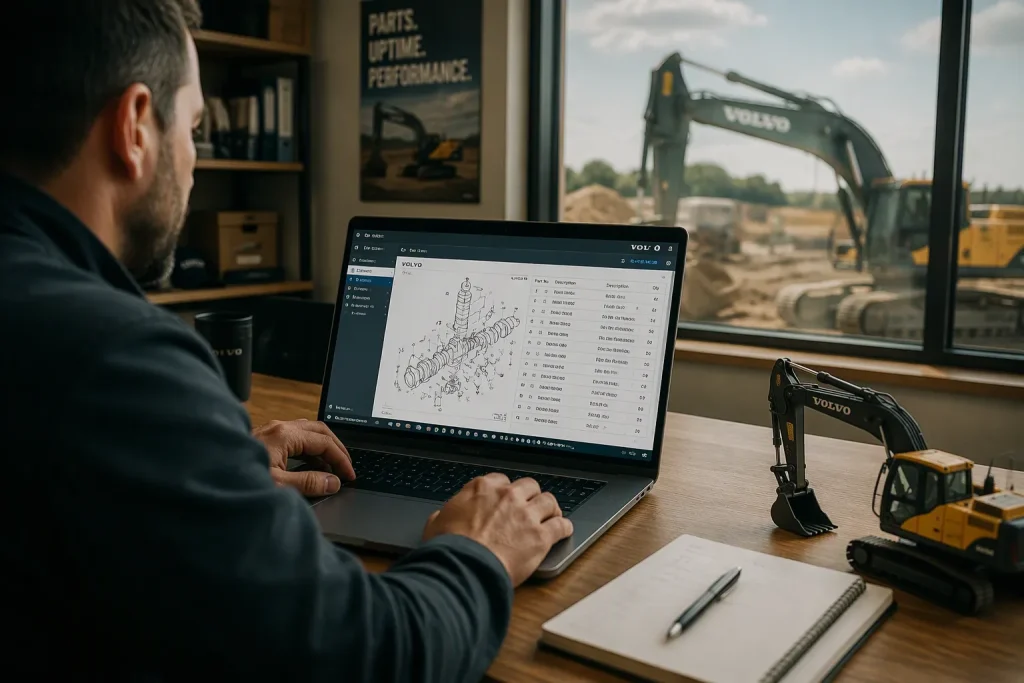
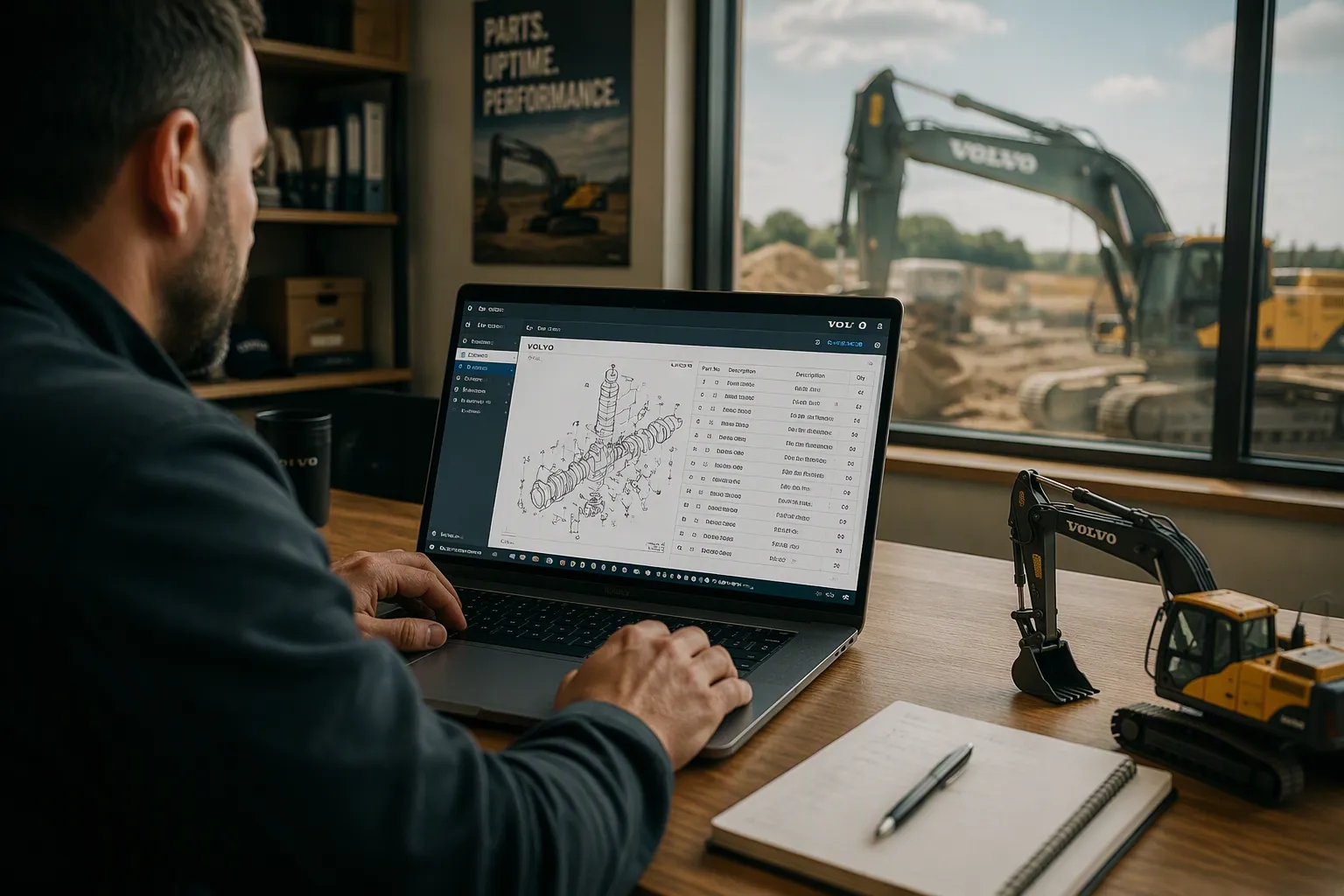
Find a candidate Volvo excavator part number by identifying the actual machine and assembly, using the applicable parts catalog and checking the diagram, parts list and configuration notes. Then investigate any marking or cross-reference differences before ordering. An online search result is a starting point, not a fitment or authenticity guarantee.
Key Takeaways
Start by finding your machine’s model and serial number. This info helps you locate the right part.
Go to Volvo’s official parts website or a dealer site that is approved to look for parts online.
Narrow down the parts catalog by model and part type. Then match the callout numbers on the diagram to the parts list.
Check the part number against another source. Ask a dealer to make sure you don’t make a mistake.
Check the listing details before you buy. Save the part number for later use.
Step 1: Gather Model and Serial Number
Locate the Serial Plate
Use documentation for the actual model to locate the machine identification plate or other specified markings. Plate locations vary; do not apply a generalized compact-excavator position to every model.
Record the complete machine model and serial number using the appropriate identification guidance.
Check available machine records against the actual identification.
Record relevant installed assembly details and modifications.
If identification is missing or unclear, obtain qualified assistance and appropriate records before confirming a replacement. Do not search a guessed plate location as though it were a universal standard.
Note the Part Description
Record the complete machine identification, relevant assembly markings and the component’s function and location. A known number helps the lookup but still requires application checks. Clarify whether a marking identifies a casting, assembly or orderable service part.
A good description helps you look up parts more accurately. Search excavator parts with the full part number when you have it. Add the equipment brand to get the most precise results. Add the equipment brand and model, then use category filters like component category and equipment type. Industry names vary, so try other terms — a track roller is also called a bottom roller, and a carrier roller is a top roller. When you cannot find it, send the part number if you have it, the equipment brand and model, and photos or technical notes for manual matching. A parts diagram also helps you spot the right parts. Each section of the excavator is labeled, so you can describe the part by its position. That lowers confusion and speeds up your order. Keep the make, model, and serial number with your machine records. Double-check the model and serial number before you order.
Step 2: Access Volvo Excavator Parts Online
Use Volvo’s Official Parts Portal
Use documentation applicable to the actual Volvo construction machine and assembly. Verify the source and coverage of any online catalog; do not assume a general brand website supplies a complete public parts lookup.
Access, account requirements and services vary by product, region and provider. Confirm what is actually available for your machine. Truck-portal arrangements must not be applied automatically to excavator parts.
Requirement | Details |
|---|---|
Registration method | Confirm the actual access process for the relevant catalog |
Dealer involvement | Ask for assistance where the applicable records are unavailable |
Basic access | Check actual access terms; do not assume a universal free service |
Additional services | Confirm any fees and scope before subscribing |
Parts ordering | Check the actual seller’s order process and supported items |
Try an Authorized Dealer Site
If a website claims an authorized dealer relationship, verify it independently. Catalog coverage, interface and access vary; authorization alone does not establish that a search result matches your installed assembly.
For older or modified machines, request records applicable to the actual configuration. Provide the full machine and component identification and ask for the basis of the proposed match. Do not assume any seller has a complete machine history.
Step 3: Navigate the Parts Catalog
Filter by Model and Part Type
Use the available model, serial-range and assembly filters to locate relevant records. Filtering does not necessarily exclude every unsuitable option; read the actual applicability notes.
Locate the relevant system or assembly and confirm the diagram title. The appropriate group may depend on the installed assembly, so a generic component category alone is not enough.
Read the Diagram Callouts
The parts catalog uses exploded diagrams to show how components fit together. Every part in the diagram has a callout number. That number links right to a line in the parts list under the image. You match the callout number to the list to find the part numbers you need.
This visual layout helps you confirm you have the right item. You can see where the part sits on the excavator and how it connects to other components. The list gives the number, description, and quantity for each item. When you cross-check the diagram with the list, you lower the risk of ordering the wrong piece. Always check the number against your machine’s specific model and serial number before you go ahead.
Step 4: Identify the Part Number
Match the Number to the Diagram
You have the diagram open and the parts list below it. Now you need to connect the two. Every component in the exploded view carries a small callout number. That number points to a specific line in the list. Find the callout on the diagram first. Then look for the same number in the left column of the parts list. The row next to that number gives you the part numbers you need.
This process works the same way for every section of the excavator. Suppose you are looking at the hydraulic pump assembly. You see callout 14 pointing to a seal kit. You scroll to line 14 in the list. The description reads “seal kit” and the part number sits right beside it. You now have the exact number for that seal kit. The same logic applies to engine components, undercarriage parts, and hydraulic valves.
Pay attention to the quantity column. Some callouts appear more than once in the diagram. A single callout number may represent multiple identical parts. The list tells you how many you need. If you see callout 7 in three places, the quantity column might say 3. Order the correct amount the first time.
The parts catalog also groups items by assembly. You might see a sub-list for a specific sub-assembly. Each sub-list has its own callout numbers. Make sure you match the callout from the correct diagram section. Mixing callouts from two different diagrams leads to wrong part numbers. Always confirm the diagram title matches the area you are working on.
Check Existing Markings and Origin Claims Separately
Record accessible labels, stamps and casting marks on the existing and proposed items. A logo, production code or serial number may help identification but cannot independently authenticate a component.
Marking methods and condition vary. Missing, faded or uneven markings require clarification but do not, by themselves, prove counterfeiting. Ask for item-specific evidence rather than assuming a universal font or code format.
Compare the package, item and order identification, while recognizing that packaging can be copied and may carry assembly or packaging references. Resolve discrepancies before acceptance; a label alone does not establish origin.
Before you move on, double-check the number against your machine’s model. A part number that fits one model may not fit another. The same excavator series can have serial number breaks that change which part you need. Look at the serial number range in the catalog. Confirm your machine falls within that range. This step catches errors that diagrams alone cannot. A quick check now saves a return later.
Step 5: Cross-Reference and Verify
Compare with a Second Source
Cross-check the candidate number against appropriate, independently sourced documentation for the actual machine and assembly. Confirm that the second reference has the correct scope and revision rather than assuming agreement between two listings proves fitment.
Catalog and seller-site features vary. Do not assume universal access, older-model coverage, order limits or a fit guarantee. A third-party cross-reference needs supporting application information.
Investigate differences associated with the installed assembly, configuration and any documented supersession. A broad model listing or another region’s reference alone cannot establish suitability.
Resolve Differences with Qualified Parts Support
Provide the complete machine and component identification when requesting clarification. Ask which catalog, serial-range note or specification supports the proposed number. A seller category alone does not establish the strongest answer.
Other owners’ experiences can suggest questions to investigate, but another machine’s successful installation is not proof for your configuration. Treat community information as a lead requiring technical confirmation.
When you confirm with a dealer, ask about exact serial number breaks. The same excavator series can change parts at a certain serial number. Your machine may fall before or after that break. A dealer can tell you which side your machine falls on. This detail prevents ordering a part that looks correct in the diagram but does not fit your specific machine.
If sources disagree, resolve the reason before ordering. Check revision, serial-range applicability, assembly changes and supersessions. Do not automatically prefer a source solely because it claims dealer status or access to a database.
Step 6: Order the Part with Confidence
Review the Listing Details
Review item identity, condition, quantity, documented application and relevant interfaces. Ask for available traceability and inspection evidence appropriate to the actual component. Read the written warranty and return conditions separately from compatibility and origin claims.
Measurements can support identification, but dimensions alone do not establish suitability. Hydraulic and electrical assemblies may also require operating, control, connection or calibration information. Obtain qualified help where the necessary evidence is missing; do not treat a vague fitment claim or certificate as sufficient.
Keep Records for Next Time
Retain the machine and assembly details, catalog reference, proposed number and any documented supersession. Sellers may use different references, so record what the actual order covers instead of assuming all dealers or aftermarket sellers recognize the same designation.
Keep service and installation records according to the applicable schedule. For unknown history, obtain an appropriate assessment and maintenance plan; do not reset machine hours or treat routine maintenance as proof of known-good internal condition. Preserve uncertainty and completed-work records accurately.
Record the machine and assembly, locate the applicable catalog, connect the diagram callout with the orderable item and resolve configuration or number differences. Keep the evidence and written order terms. No fixed lookup time or checklist guarantees reduced downtime or a correct replacement.
FAQ
Where do I find the model and serial number on my Volvo excavator?
Consult the identification guidance for the actual model. Locations vary; do not assume the front face, boom base or cab panel is correct for every machine.
What if I cannot read the serial plate?
Clean the plate gently and take a photo with good lighting. If the numbers are still unclear, contact a dealer with your machine details. They can help identify your excavator using other records or markings on the machine.
Can I search volvo excavator parts online without a serial number?
You can browse by model alone, but results may include parts that do not fit your machine. A serial number narrows the list and reduces errors. Always confirm the part number against your machine before ordering.
How do I know the part number I found is correct?
Check the relevant diagram and parts list, serial-range applicability, configuration notes and documented supersessions. Markings can aid identification but do not independently establish fitment or authenticity.
What should I do if two sources give different part numbers?
Investigate revision, serial range, installed assembly and supersession differences. Ask for the documented basis of each answer and resolve the discrepancy before ordering rather than automatically trusting a seller’s status.
For Volvo excavator parts sourcing, consider YNF Machinery. Provide full machine and component identification, applicable part numbers and quantities, and request supported compatibility information, an actual quotation and written warranty and return terms before ordering.



