
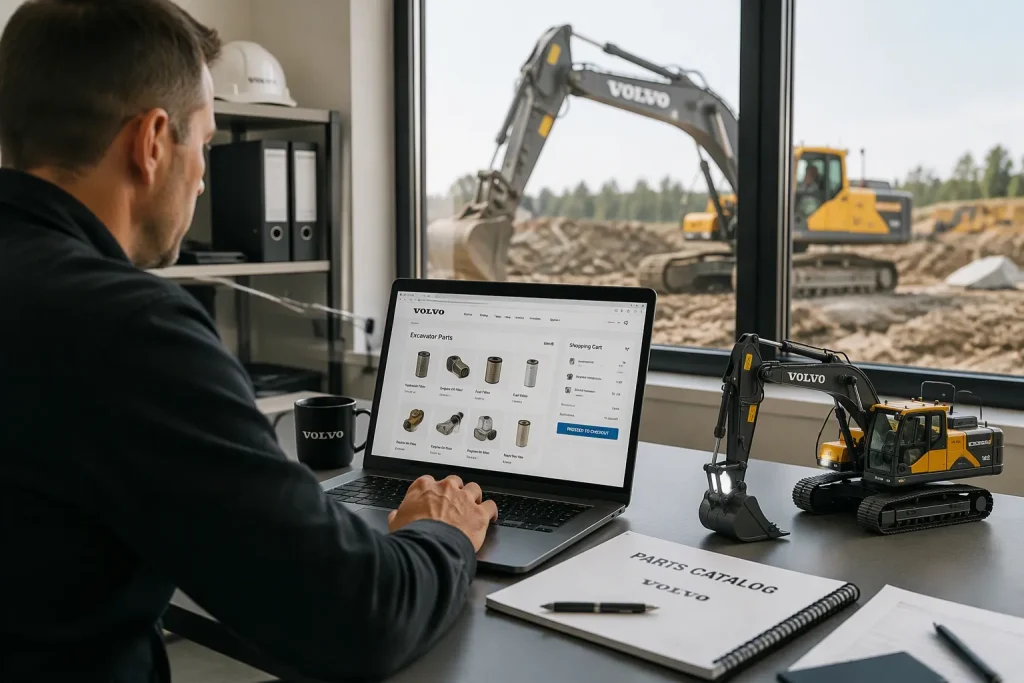
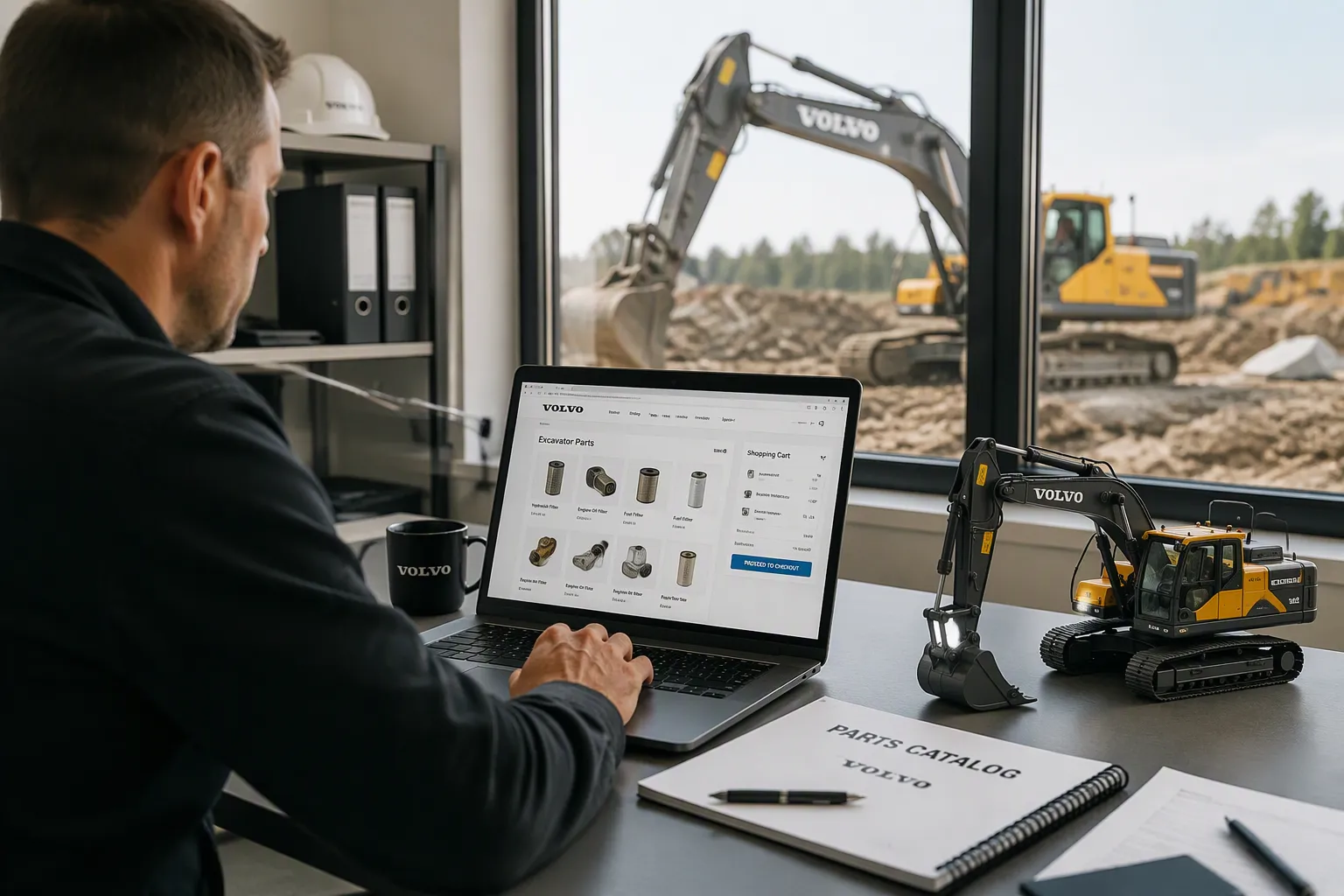
Prepare an online Volvo excavator parts order by identifying the machine and component, evaluating the seller, checking the proposed match, comparing written quotations and arranging delivery and receipt. This guide treats the Philippines as sourcing or delivery context for U.S. buyers; it does not establish local stock, guaranteed shipping or a universal warranty.
Key Takeaways
Find your excavator’s model and serial number before you shop online.
Use online parts lists to find the right part for your machine.
Check prices, shipping fees, and delivery times from more than one supplier.
Check that the part fits your machine and is real to avoid ordering the wrong one.
Watch your order and check the part when it gets there.
Step 1 — Identify the Part
Every parts order begins with two facts: your machine’s model and serial number. These details work like a fingerprint for your excavator. No two machines have the same combination. Without them, you might order the wrong part and waste time and money.
Use Model and Serial Number
A model name identifies a machine family but does not alone determine its exact weight, installed assemblies or replacement parts. Use the complete machine identification and relevant component details to check the actual configuration.
You need both numbers when you search any parts catalog. Type them in together to get the best results. Some suppliers ask for just one, but giving both keeps you safe. If one number has a typo, the other helps spot the mistake.
Locate the Serial Number
Use documentation for the actual model to locate identification plates or markings. Do not assume a position near the tracks, behind the cab or inside the cab applies to every excavator.
Record the complete model and serial number exactly as shown. Keep accessible component markings and photographs for the parts lookup; do not infer a universal number format.
If identification is unclear, consult the applicable documentation and available machine records, or obtain qualified assistance before selecting a replacement.
Use an Online Parts Catalog
Obtain the parts catalog applicable to the actual machine and assembly. Access arrangements vary by product and region; do not assume every buyer has a public, searchable portal or universal ordering system.
Check the catalog’s serial-range and configuration notes. A model search can help locate records but does not necessarily exclude every unsuitable option.
Distinguish diagram callouts from orderable part numbers, and check quantities and assembly relationships. A catalog entry is not, by itself, evidence of stock or dispatch readiness.
Online catalogs also give step-by-step guides for finding parts. Follow these guides closely. They lead you through each component group, from the engine to the undercarriage.
Check Availability and Lead Time
Ask the actual seller whether the exact item and quantity are available, allocated or subject to transfer or production. Confirm dispatch readiness separately from transit estimates.
Lead times matter for construction projects. A part that takes six weeks to arrive won’t help if your excavator sits idle tomorrow. Compare availability across different suppliers before you place an order.
Use the service documentation for the applicable maintenance and repair procedures, and the relevant parts catalog for orderable items. One generic manual may not include every required reference.
Remember that your service/repair manual holds valuable reference information. It explains how each part works and how to install it the right way. Use it to confirm the part you picked matches your machine’s specifications.
Taking time to identify your part correctly saves hours of frustration later. A wrong order means return shipping, restocking fees, and more downtime for your equipment.
Step 2 — Find Volvo Excavator Parts Philippines Suppliers
You already know which part you need. Now you have to find a supplier who can send the Volvo excavator parts philippines buyers depend on. There are two main ways to go: official Volvo CE online channels and third-party sellers. These machines need parts you can trust.
Search Online Sources
Investigate the seller and ordering channel using independently checked business information. Do not assume a particular regional portal, account or delivery option is available for every machine or destination.
A nearby or international seller may offer different items and terms. Confirm actual dispatch location, availability and shipment scope rather than assuming a local source is faster or a distant one is cheaper.
Verify claimed authorization independently. Request item-specific origin and condition information, the compatibility basis and actual written warranty and return terms. Response speed alone does not establish reliability.
Warranty terms must apply to the actual excavator component and transaction. Passenger-car accessories or vehicle mileage warranties must not be applied to construction equipment parts. Use the following questions to clarify the actual offer.
Warranty question | Information to request | Why to clarify it |
|---|---|---|
What item is covered? | Exact part and condition covered by the written terms | A general brand policy may not apply to this order |
When does coverage start and end? | Actual duration, start point and applicable conditions | Do not assume a universal number of years or operating hours |
What is excluded? | Installation, wear, labor, freight and other stated exclusions | Coverage for one cost does not imply coverage for every related expense |
How is a claim submitted? | Reporting steps, evidence and available remedies | Retain the terms and order records for any claim |
Read the terms issued for the actual item and confirm the identity of the party responsible for a claim. A warranty is a commercial term, not independent proof of origin or compatibility.
Do not substitute a passenger-vehicle lifetime, mileage or accessory policy for the excavator part’s actual written coverage. Resolve unclear terms before ordering.
Check Supplier Credentials
Business records and product documentation support due diligence within their scope. Verify important claims independently; neither a certificate nor a quick response automatically establishes authorization or item authenticity.
Confirm that delivery is available to the exact destination and clarify freight, clearance and any additional responsibilities in the quotation. Do not assume charges or transit time from the word international alone.
Ask who coordinates the shipment, which records are provided and how delays are communicated. Do not assume the seller handles every clearance or destination requirement.
Retain the proposed item description and written logistics arrangements with the order.
Step 3 — Verify Compatibility and Authenticity
Confirm Part Numbers and Specifications
Compare the proposed service part with the catalog applicable to the actual machine and assembly. Investigate supersessions, casting numbers and aftermarket cross-references. A valid part number alone does not authenticate the delivered item or prove all application requirements.
When you are not sure about specifications, give your supplier full details. Start with the machine make, full model, and serial number. Add the existing part number and any identification on the engine, pump, or motor. Mention modifications, past replacements, and attachments that differ from the original setup. Ask the supplier to explain how the proposed part relates to your references. If the replacement number differs, ask whether it is a superseding number, an aftermarket cross-reference, or a different assembly. For dimension-sensitive items, request a drawing or verified dimensions. Your service manuals also list recommended part numbers and service intervals, so keep them close during this check.
Choose Genuine, OEM, or Aftermarket
Compare the specific item and evidence rather than assuming fixed quality, price or warranty levels from an OEM, aftermarket, remanufactured or used label. The table identifies questions to resolve for each option.
Part Type | Evidence to assess | Price comparison | Warranty | Application check |
|---|---|---|---|---|
Genuine Volvo OEM | Verify the stated origin and exact item condition | Actual delivered quotation | Actual written coverage | Confirm documented application for the actual configuration |
Aftermarket (Premium) | Relevant specifications and inspection evidence | Equivalent-scope quotation; no universal percentage saving | Supplier warranty (variable) | Confirm the actual requirements; do not assume suitability from price |
Remanufactured component | Documented rebuilding and test scope | Actual quotation including any core conditions | Actual written coverage | Confirm compatibility and acceptance criteria |
Used/Reconditioned | Available condition measurements and repair history | Actual quotation plus assessment or repair costs | Actual written terms, if any | Confirm serviceability for the intended application |
Seek traceability and independently confirmed verification methods appropriate to the exact item. Not every part has a certificate, individual serial number, hologram or digital authentication method. Packaging and visible markings can be copied and do not prove origin or internal condition.
Step 4 — Compare Prices and Shipping
Comparing quotes for volvo excavator parts philippines orders helps you get the most value for your money. One supplier may charge more for the part but less for shipping. Another may offer lower pricing with slower delivery. You need the full picture before you commit. A careful comparison now prevents surprises later.
Request Quotes from Multiple Suppliers
Ask at least three suppliers for a written quote. Give each one the same details so you can compare fairly. A complete quote request includes your contact information, your machine details, and the exact part numbers you need. The table below shows what to send.
Category | Required Information |
|---|---|
Contact Information | First Name, Last Name, Preferred Contact Method (Email or Phone), Email Address, Phone Number |
Machine information | Complete make, model, machine serial number and relevant assembly identification |
Components Needed | Part Number(s) |
Compare equivalent quotations and the full transaction terms, including payment, delivery, returns and unresolved repair costs. A lower unit price is not a reason to accept an unverified application or safety-critical condition.
Check Shipping Costs and Lead Times
Request a shipment-specific freight quotation and estimated timetable using the actual package, route and destination. Do not apply whole-machine freight costs or a generic ocean-transit range to every spare-part order. Clarify clearance responsibilities and additional charges where applicable.
Compare dispatch readiness and transit estimates separately, and note any dependencies. Faster or flexible handling is not a guaranteed price reduction or delivery date.
Step 5 — Order, Pay, and Track
Place the Order and Choose Payment
Look over every order detail before you pay. Check the part number, quantity, and machine model against your notes. Make sure the total price is right, including shipping and any customs fees. A quick check now stops a costly mistake later. Ask the supplier to confirm stock and the ship date in writing. Some suppliers ship in-stock items right away. Others need time to pull parts from a warehouse. Get this timeline in writing so you can plan your repair schedule.
Review the accepted payment methods, legal payee, fees and any available dispute procedure for the actual transaction. No payment method automatically guarantees protection. Independently verify unexpected changes to payment instructions and retain confirmation records.
Track Delivery and Inspect the Part
Ask how order and shipment updates are provided. A tracking reference may be available after dispatch, but live maps, driver locations, delivery photographs and linked invoices are not universal features. Retain the records actually supplied.
Inspect the delivery promptly using the applicable handling arrangements. Compare item identity and quantity with the order, document damage or discrepancies, and follow the actual reporting procedure. Resolve questionable identity or condition before installation; a responsive seller does not guarantee an immediate remedy.
Keep the process documented: identify the item, verify the proposed application, assess the seller and terms, compare equivalent quotations, arrange receipt and check the delivered component. No fixed preparation time guarantees reduced downtime.
FAQ
What if I cannot find my excavator’s serial number?
Consult documentation for the actual model and available machine records. Plate locations vary; obtain qualified help when identification remains unclear rather than assuming a universal position.
How do I know if a part fits my machine?
Use the applicable parts catalog, machine and assembly details, relevant specifications and documented supersessions. Resolve differences between physical markings and orderable numbers before acceptance.
What is the difference between genuine and aftermarket parts?
These labels describe different origin or condition claims. Assess the actual specifications, documented application, inspection evidence and written terms. None guarantees a universal price advantage, warranty or service life.
How long does shipping take to the Philippines?
Timing depends on item readiness, package, origin, route and destination arrangements. Request the actual estimated dispatch and arrival dates, clarify dependencies and compare shipment-specific costs.
Can I return a part if it does not fit?
Return policies are different for each supplier. Ask about return windows, restocking fees, and shipping costs before you buy. Keep all order records and packaging. Contact the supplier right away if the part is wrong or damaged.
For Volvo excavator parts sourcing, consider YNF Machinery. Provide full machine and component identification, applicable part numbers and quantities, and request supported compatibility information, an actual quotation and written warranty and return terms before ordering.



