
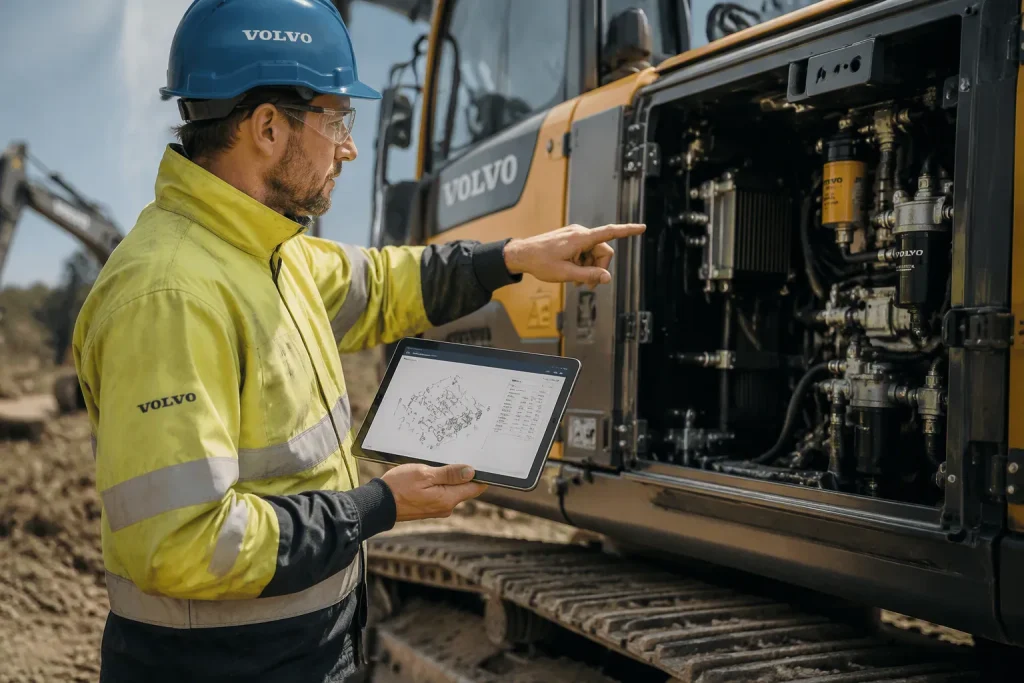
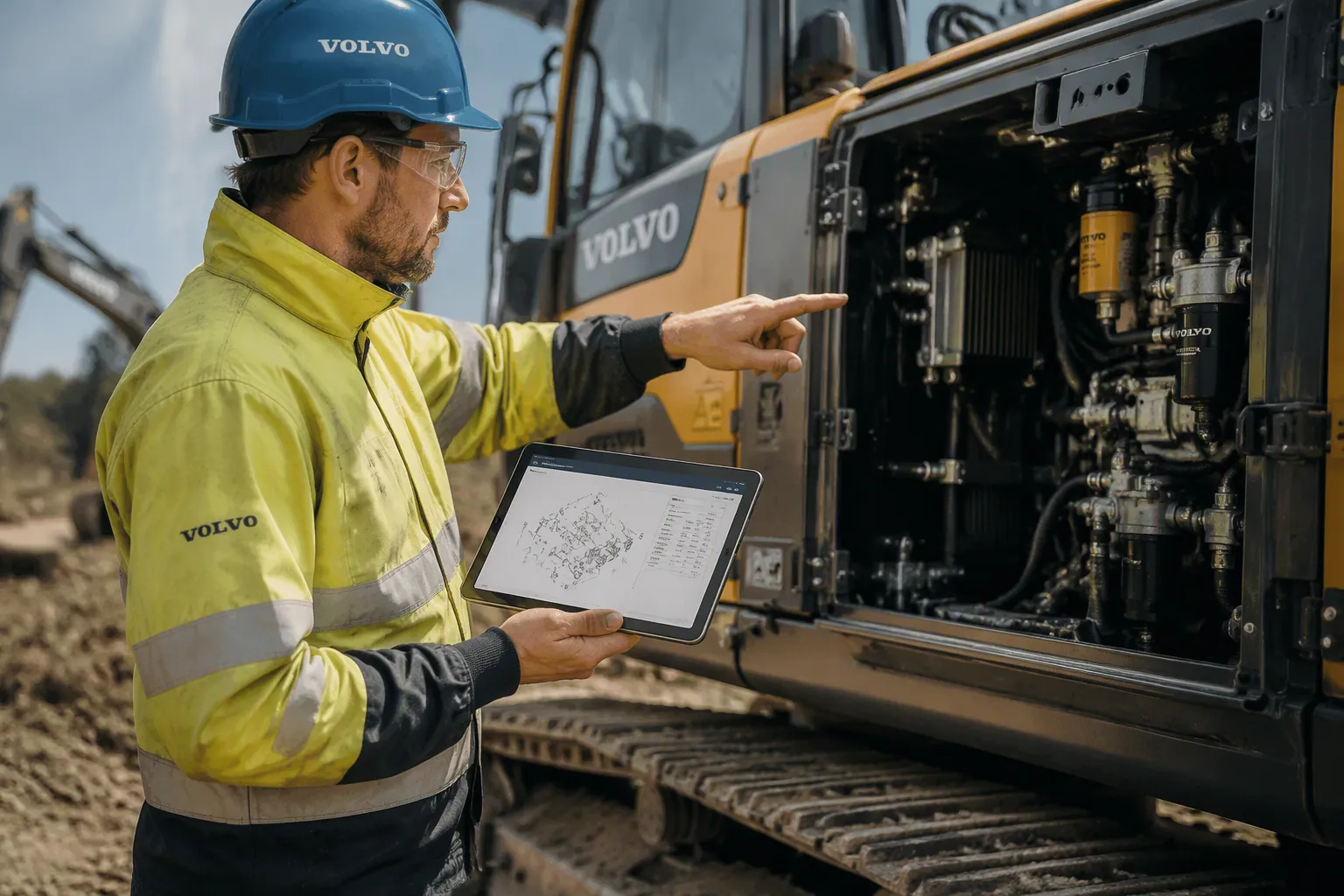
Matching Volvo excavator parts South Africa correctly starts with one fact: your machine’s exact model and serial number. Write both down before you shop. A wrong part costs you downtime, wasted money, and sometimes real damage to the machine. Accuracy matters from the very first step.
Use the applicable parts catalog and actual component details to investigate a proposed replacement. This guide treats South Africa as sourcing context for U.S. buyers; it does not establish local inventory or a universal numbering system.
Key Takeaways
Write down your machine’s model and serial number before you look for parts.
Investigate existing markings and any documented supersession before ordering.
Evaluate the actual seller and proposed item, whether sourcing locally or remotely.
Check that the part will work by using a checklist: machine details, OEM number, and supplier confirmation.
Avoid common mistakes: don’t think similar models will fit, don’t skip updated numbers, and check used parts closely.
Identify Your Volvo Excavator
Serial Number Basics
Model and serial number help locate relevant machine records. They do not, by themselves, establish every installed assembly or modification. Confirm the actual configuration.
Combine machine identification with applicable catalog information, component markings and relevant specifications. Do not assume a product identification number alone encodes all the information needed to choose a replacement.
Aspect | How Serial Number Improves Accuracy |
|---|---|
Fitment verification | Supports checking applicable catalog records; not a fitment guarantee |
Handling model variations | Accounts for differences across configurations and production updates |
Required sourcing info | Reduces incorrect orders |
Full identification data | Provides a reference for investigating the actual configuration |
Locating Model Details
Locate identification using documentation for the actual model. Record accessible markings and relevant service records; do not assume one plate location applies to every Volvo excavator.
Production changes, regional configurations and installed assemblies can affect part requirements. Use the actual records and catalog notes rather than a model-year label or list of similar model variants.
A product-range announcement or fuel-efficiency claim does not establish compatibility for a particular repair.
This steady change means you should never think that a part from one variant fits another. Always check with your serial number before buying excavator parts.
Understand Excavator Parts Numbers
How Part Numbers Work
Treat part numbers as identifiers to look up, not codes whose meaning can be inferred reliably from digit patterns. Clarify whether an existing marking identifies a casting, assembly or orderable service part.
Use the catalog applicable to the machine serial range and relevant assembly. Check diagram callouts, quantities and configuration notes. A catalog number alone does not establish the delivered item’s origin or condition.
A documented supersession can replace an earlier number, sometimes with additional components or conditions. Confirm applicability instead of assuming every newer number is directly interchangeable.
Genuine Vs Aftermarket
OEM and aftermarket describe different product claims. Assess the actual origin, specifications and condition evidence for either option rather than assuming a universal manufacturing source or quality level.
Compatibility includes the interfaces and operating requirements relevant to the actual assembly. Cross-reference information supports the investigation but should be checked against applicable documentation and specifications.
A matching model name, photograph or dimensional similarity alone is insufficient. Resolve the documented application and any differences before ordering.
Find Volvo Excavator Parts South Africa
Local Dealers And Suppliers
An authorized dealer, independent supplier or online retailer may offer different items and terms. Verify any claimed authorization and evaluate the actual part, condition, support and written quotation rather than assuming capabilities from a supplier category.
Ask consistent questions about exact identification, origin claims, condition, inspection scope, availability and written terms. Distance from the machine alone does not establish price, quality or support.
Document the Proposed Replacement
Prepare an item-specific order record. Include machine identification, relevant assembly details, available part markings and the basis of the proposed match.
A broad catalog description is not evidence of current stock, universal suitability or inspection of the actual item. Obtain clarification for the specific order.
Useful records include:
The item description and stated condition
The applicable catalog reference and configuration notes
Relevant markings, photographs and interface measurements
The actual quantity and written quotation
Dispatch, packaging and receiving arrangements
Order attribute
Evidence to request
Machine identification
Complete model, serial number and relevant assembly details
Availability
Confirmation for the exact item and quantity
Product claim
Stated origin and condition, with available traceability
Order quantity
Actual minimum or packaging quantity for the quotation
Compatibility
Applicable catalog and specification basis
Inspection
Method, scope and recorded findings relevant to the item
Communication
Agreed contact and response arrangements
Packaging
Shipment-specific protection and handling arrangements
Delivery
Actual dispatch location, destination and estimated timetable
Retain the agreed item description and supporting evidence. Do not substitute promotional claims for inspection, compatibility confirmation or written commercial terms.
Verify Excavator Parts Compatibility
Parts Compatibility Checklist
Locate machine identification using the applicable documentation, then identify the affected assembly and proposed service part. Check the catalog’s serial-range and configuration notes. Clarify any marking, supersession or interface discrepancy; a seller’s model filter alone does not prove fitment.
Inspect condition using the applicable safe procedure and qualified help where needed. Leaks, abnormal movement, fluid-level changes and unusual noise have multiple possible causes. They require diagnosis rather than an assumption that a particular component has failed.
For buckets and attachments, confirm the approved mounting arrangement, machine limits, geometry and relevant hydraulic requirements. Pin diameter and spacing alone cannot establish suitability. Keep clear of moving linkages; use the specified safe measurement setup.
Questions For Suppliers
Ask for the compatibility basis, inspection scope and actual test results where appropriate. A product description or broad claim of quality-tested parts does not prove that the specific assembly meets its required operating criteria.
A strong parts compatibility checklist includes your complete Volvo excavator model, machine serial number, component description, original oem part number, identification tags, stamped numbers, casting numbers, dimensions, mounting details, and clear photos of the existing component. For attachments, add machine operating weight, pin-on or quick coupler configuration, pin diameter, pin spacing, stick width, hydraulic flow and pressure, and your primary job application. Suppliers who match by oem tolerances and serial range reduce the risk of cross-compatibility errors. Treat every order as a verification task, not a guess.
Common Compatibility Mistakes
Assuming Similar Models Fit
Similar names or appearance do not establish interchangeability. Differences in assemblies and configuration require checking the actual parts documentation. Do not assume that either every part or no part interchanges across two models.
Machine identification supports the lookup, but installed components and modifications must also be considered. Confirm relevant dimensions, interfaces and operating requirements before installation.
Use the applicable linkage specifications and allowable clearances rather than an assumed pin-size difference by year. Check connected components and the approved attachment configuration.
Ignoring Updated Part Numbers
A number may be superseded for several reasons. Investigate the documented relationship, applicability and any required additional components rather than assuming the earlier item is obsolete or defective.
Confirm the service part currently specified for the actual machine and repair scope. A newer number does not automatically prove improved materials, seals or universal fit.
Assess stored-item condition and storage history where relevant. A superseded number alone does not prove that stock has deteriorated or will fail early.
Buying Used Parts Without Inspection
Used excavator parts attract buyers with low prices. But used parts hide serious problems. You cannot see internal wear from a photo. You cannot test hydraulic pressure from far away.
Check undercarriage components closely before purchase. Look at track links for stretch and bushings for oval wear. Check rollers and idlers for flat spots and seal leaks. Sprockets wear unevenly when tracks run too loose or too tight.
Request measurements, relevant tests and available repair history. Source-machine hours are context, not a universal measure of remaining component life.
Scoring, leakage or damage warrants further assessment but does not, by itself, establish internal bypass or predict failure. Internal condition may require qualified workshop testing.
The safest path is still checking every part against your serial number and OEM reference before purchase.
You now have a clear plan for matching Volvo excavator parts South Africa the right way. Begin with your model and serial number. Learn how part numbers work. Source them locally with care. Check every excavator parts order before you pay. Stay away from guesses about similar models or outdated numbers.
Treat compatibility as a documented investigation. No checklist guarantees savings, service life or reliability under every operating condition.
Resolve unanswered identification, condition and commercial questions before committing to the order.
FAQ
How do I find the right excavator parts for my Volvo model?
Record the full machine model, serial number and relevant installed assembly details. Use the applicable parts catalog and specifications to investigate the proposed match. Identification alone does not guarantee fitment.
Can aftermarket excavator parts fit as well as genuine ones?
An aftermarket item may be suitable when its documented specifications and application meet the actual requirements. Check the particular item, interfaces, condition and evidence; dimensions alone are not enough.
What should I check before buying used excavator parts?
Look closely at wear surfaces and seals. Ask for measurements and photos. Get the machine hours from the donor unit. Check hydraulic cylinders for scoring and leaks. Look at undercarriage parts for uneven wear. A used part with hidden damage causes new downtime instead of saving money.
Why does my part number not match what I find online?
Clarify whether the difference involves a casting number, assembly number, documented supersession or another configuration. Do not assume a different number proves obsolescence, improved design or a counterfeit item.
What information should I give a supplier for accurate matching?
Give your complete model and serial number. Include the OEM part number and clear photos of the old component. Add dimensions and mounting details. For attachments, share pin diameter and spacing. Suppliers who match by serial range and OEM tolerances cut down on compatibility errors.
For Volvo excavator parts sourcing, consider YNF Machinery. Provide full machine and component identification, applicable part numbers and quantities, and request supported compatibility information, an actual quotation and written warranty and return terms before ordering.



